


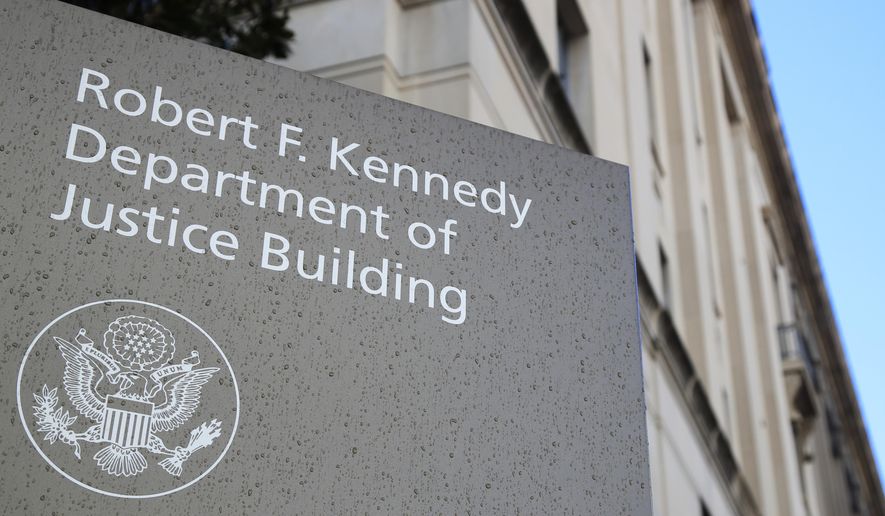

The Justice Department announced a new legal opinion Wednesday finding that states that take federal money to finance their cash welfare programs must report unauthorized immigrants to the Department of Homeland Security — a move that could potentially defang states’ sanctuary policies.
DOJ’s Office of Legal Counsel, which serves as the in-house lawyer for the Executive Branch, said the federal government can now condition states’ receipt of Temporary Assistance for Needy Families — the main cash welfare program — on whether all of their agencies share information on unauthorized immigrants.
Previously, the state agencies that handled the programs were required to report unauthorized immigrants, but other state agencies were exempt.
People were interested in these podcasts
“Any participating state must report to DHS any person that the state knows to be not lawfully present,” Joshua J. Craddock, a deputy assistant attorney general, concluded in the new opinion.
If that is applied to police and motor vehicle bureaus, it could force states to choose between their existing sanctuary laws and access to federal money.
At issue is the scope of the 1996 welfare reform law.
Previously, the OLC had concluded that the law’s reporting requirements only applied to the actual state agencies that handled TANF. Other state agencies that had knowledge of unauthorized immigrants weren’t swept in.
The new OLC opinion, dated Tuesday and released Wednesday, overturns that 1998 opinion.
DOJ officials said there won’t be any penalty for states for past behavior, since they were operating in good faith under the previous opinion. But moving forward, the feds can condition billions of dollars in federal money on states’ cooperation.
TANF’s block grants to states total about $16.5 billion a year.
Matthew O’Brien, deputy director at the Federation for American Immigration Reform, said he expects the new interpretation to be challenged in court but said the administration should prevail.
He said it would be an “effective workaround” to state sanctuary policies.
Those policies limit the amount of cooperation with federal immigration authorities. Policies range from weaker ones that allow cooperation but restrict state officials from being proactive with offers of help, to strong ones that forbid most interactions.
U.S. Immigration and Customs Enforcement has said some sanctuary policies are so stern that they automatically refuse email from ICE.gov accounts.
The Trump Justice Department has sued to try to end sanctuary policies but has been wiped out in courts.
Judges have turned back DOJ challenges in Colorado, Illinois, Minnesota and New York.
DOJ said states are free to give up the federal money if they don’t want to obey the new conditions.
“When a state chooses to participate in TANF, it accepts the obligation to report illegal aliens in the United States,” said Assistant Attorney General T. Elliot Gaiser, who heads the OLC.
The 1998 OLC opinion said the 1996 welfare reform law’s use of the word “state” was ambiguous but that it appeared Congress had only intended for the welfare agency to have to report unauthorized immigrants.
In the new opinion, Mr. Craddock said that the previous reading “erred in its analysis and result.”
The reporting requirements apply to TANF, Supplemental Security Income funding and some Housing and Urban Development contracts.
The opinion doesn’t take a position on whether local jurisdictions within a state would also be bound by the state’s agreements to continue receiving TANF funds.
Contact the author

Please read our comment policy before commenting.