



A version of this story appeared in the daily Threat Status newsletter from The Washington Times. Click here to receive Threat Status delivered directly to your inbox each weekday.
A suggestion that Russia should bomb Berlin — a new verbal sucker punch from the Kremlin’s designated provocateur-at-large, Dmitry Medvedev — is the latest volley in Russia’s ever-growing hybrid war on Europe.
Moscow’s low-grade conflict, aimed at intimidating Europe and testing NATO’s collective resilience, has intensified in recent weeks with aggressive rhetoric, relentless cyberattacks, drone incursions and sabotage.
On Wednesday, Mr. Medvedev, a former Russian president who serves as deputy chairman of Russia’s security council, blasted NATO member Germany on social media after authorities there said the Kremlin was behind an attempted Aug. 4 drone attack on Leipzig/Halle Airport.
People were interested in these podcasts
“Berlin has accused Russia of an unproven attack on Leipzig Airport,” Mr. Medvedev said on his Telegram page. “Given the neo-Nazi, rabidly Russophobic policies of the current German leadership, a fabricated act of sabotage is the weakest form of punishment for their sins.”
He said Germany deserves a “direct strike” on factories supplying arms and munitions to Ukraine, “and quite possibly, several other locations in Berlin as well.”
The explicit public threat of a direct Russian assault on Germany, a major U.S. and NATO ally, was made a week after CIA Director John Ratcliffe made a surprise visit to Moscow to meet with Russian intelligence officials.
Although President Trump has said Mr. Ratcliffe made the trip as part of an ongoing push by the administration to end the Ukraine war, speculation is mounting that U.S. intelligence has become increasingly focused on the prospect that Russia may be attempting to widen the war to other fronts.
Some analysts suggest Mr. Ratcliffe may have flown to Moscow to personally discourage his Russian counterparts from triggering an escalation.
Mr. Medvedev, meanwhile, was once seen in the West as a moderate. He now plays a role as Mr. Putin’s “bad cop” in what analysts describe as a carefully choreographed Kremlin propaganda campaign devised to stir unease and division within NATO.
His frequently over-the-top rhetoric allows Mr. Putin to appear more diplomatic and statesmanlike by comparison.
“Medvedev increasingly functions as a controlled ’hawk’ tasked with articulating the Kremlin’s most radical threats,” according to a recent analysis published by the Robert Lansing Institute for Global Threats and Democracies Studies, a U.S.- and Europe-based think tank.
“In practice, he serves as an instrument of nuclear and psychological intimidation directed at Europe,” the analysis stated. “Even if many observers view Medvedev as a caricatured or erratic figure, the Kremlin values not moderation or credibility, but his willingness to act as a loud and aggressive transmitter of threats.”
Mired in a grinding war against Ukraine since launching an invasion more than four years ago, Russia’s military would be at a distinct disadvantage in a conventional fight with the better-equipped, U.S.-backed NATO.
An asymmetrical or hybrid war — carried out through clandestine operations against European nations and designed to sow dissension and disruption while raising the domestic political cost of supporting Ukraine — is seen as a lower-risk strategy that the Kremlin has embraced.
Analysts say Mr. Putin’s goal is to bully the Europeans without triggering a direct military response by NATO.
On Tuesday, Germany formally accused Russia of being responsible for an explosive-laden drone discovered Aug. 4 near a Ukrainian cargo aircraft at Leipzig/Halle Airport, one of Germany’s busiest freight airports.
Investigators say the defused device was part of a hybrid sabotage mission.
German Foreign Minister Johann Wadephul said the drone was the latest in a long series of Russian attempts to threaten Europe through sabotage and disinformation.
“Russia’s leadership is treating our country with blatant hostility. With the attempted attack in Leipzig, Russia’s leadership has made a conscious decision to inflict further significant damage on our bilateral relations, which are already under tremendous strain,” Mr. Wadephul said Tuesday during a press conference.
The situation grew more vexing Wednesday, with authorities reporting that an explosion at a train station in the southern German city of Augsburg had injured a 17-year-old woman and an 18-year-old man, both Ukrainian citizens.
German officials have not publicly linked the incident to Russia, although suspicion quickly swirled across social media, and the explosion triggered heightened security measures.
In retaliation for the Aug. 4 drone incident, meanwhile, the German government has ordered the closure of Russia’s consulate general in Bonn and the Russian House cultural center in Berlin.
“We will tighten immigration controls for Russian nationals. We will step up the pressure on Russia’s shadow fleet,” said Mr. Wadephul, referencing a hidden fleet of oil tankers that Western officials say Moscow relies on to sell oil in violation of international sanctions.
Germany will also “continue its efforts within NATO to strengthen its own defense capabilities and to provide an effective deterrent for Russia,” Mr. Wadephul said.
European Commission President Ursula von der Leyen said Wednesday the attempted drone attack at Leipzig/Halle Airport had the potential to cause severe damage and even loss of life.
At a press conference alongside NATO Secretary-General Mark Rutte, Ms. von der Leyen said the incident marked a “new escalation” in the conflict and laid the blame at Russia’s feet.
“This was an attack using military-grade material carried out by Russian operatives on European soil. If the intention was to make us think twice about supporting Ukraine, I can tell you it has only strengthened my resolve,” she said. “Europe and NATO will not just maintain our pressure on Russia; we will increase it. We will not stop — not until Russia stops bombing and killing innocent children, men and women in Ukraine.”
Russian intelligence and security services are also waging hybrid warfare against Poland and the Baltic States. Mr. Rutte said Moscow has grown “increasingly reckless” as it continues to wage war against Ukraine.
“We have seen more drones and missiles crossing into our airspace along our eastern flank, creating increased risk,” he said. “We have also seen an increase in malign activities targeting our territory directly, whether it is fires set in factories producing defense equipment for Ukraine, or indeed, the Russian hybrid attack in Leipzig.”
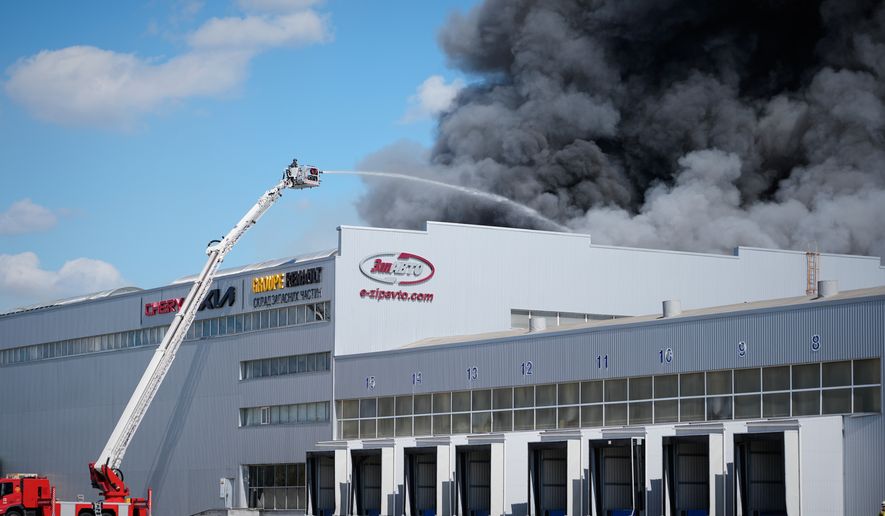
Officials in Estonia suspect Russia was involved in an Aug. 15 fire at the Milrem Robotics factory in Tallinn, the country’s capital. The company specializes in autonomous systems for the military, including Ukrainian forces.
“Russia has taken its hybrid attacks in Europe to a new and dangerous level. Its aim is to intimidate us and weaken our support for Ukraine [but] it will not work,” Estonian Prime Minister Kristen Michal said this week on X. “Our response must be the opposite: more support for Ukraine and more pressure on Russia.”
Officials in Poland are investigating a fire that broke out on Monday at a defense factory located about 90 miles south of Warsaw. The company, WB Electronics, manufactures key components for drones. According to media reports, firefighters spent two hours containing the fire. No injuries were reported.
Poland, which has been a vocal supporter of Ukraine since Russia’s full-scale invasion, has accused Moscow of sending agents into the country to carry out acts of sabotage.
“We don’t seek conflict with Russia, but Russia seems to be at hybrid war with us. We need to show Putin that we will not be intimidated,” the Polish Ministry of Foreign Affairs said on X. “Poland is in a special position. We are a frontline state ourselves, and we have cruise missiles and Russian drones breaching our airspace. So we have to be extra careful.”
Latvia is also regularly targeted by Russian hybrid warfare operations, including sabotage of critical infrastructure and retail sites. Rather than use their own operatives, Russian intelligence agencies such as the Main Intelligence Directorate, known as the GRU, often recruit low-level proxies to carry out acts of arson and vandalism, officials said.
Poland has scrambled fighter jets to intercept Russian drones, while Romanian and NATO forces have shot down stray Russian aerial and naval drones over Romanian airspace, including during a suspected Russian incursion on Aug. 16.
Since 2022, hackers have targeted Latvian government ministry networks, financial systems and media outlets. Pro-Kremlin activist groups have regularly claimed responsibility for the online attacks, officials said.
“Russia’s hybrid war against Europe is in full swing,” Latvian President Edgars Rinkevics said Monday on X.
Contact the author


Please read our comment policy before commenting.