


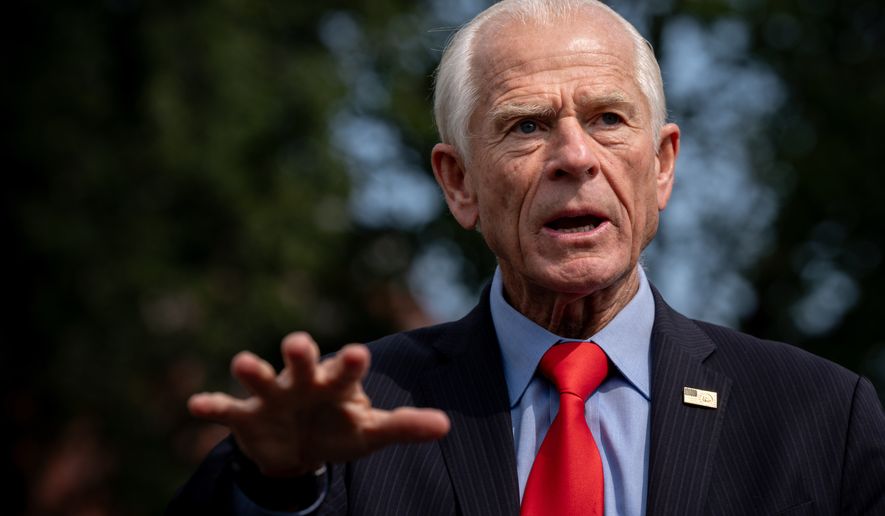

White House senior counselor Peter Navarro said Thursday that the Federal Reserve made a “monumental mistake” by raising interest rates during an energy price shock.
Mr. Navarro said sudden surges in energy prices take money out of people’s pockets and add expenses to businesses, effectively replicating rate hikes designed to cool economic activity and tame inflation.
“They effectively act as a tax. In effect, they do the work of a rate hike to control inflation, so when the Fed raises rates on top of an energy price shock, it runs the very real risk of an overreaction in driving the economy down into a recession or worse,” Mr. Navarro, who advises President Trump on trade and manufacturing, said at the White House.
People were interested in these podcasts
Mr. Navarro criticized Fed Chairman Kevin Warsh, whom Mr. Trump picked to replace Jerome Powell in May.
Mr. Navarro said past Fed chairmen did not raise interest rates because they knew an energy shock was “contractionary by its very nature.”
He pointed to an energy shock under Fed Chairman Alan Greenspan around the Gulf War in 1990-91 and another in 2007-08 under Ben Bernanke. He said both chairs held firm and did not raise rates.
“For me, it’s inexplicable that the Fed and Kevin Warsh do not understand that history,” Mr. Navarro said. “What it’s doing is ahistorical and bad economics.”
The Fed on Wednesday raised interest rates for the first time in three years, an attempt to control inflation that defied Mr. Trump’s wishes and clashed with his upbeat economic message to midterm voters.
The Federal Open Market Committee voted unanimously for a 0.25-percentage-point increase in its benchmark rate, raising it to 3.75%-4%.
“Today’s policy action will support a timelier return to the committee’s 2% [inflation rate] goal. This committee will deliver price stability,” Mr. Warsh said.
Mr. Trump wanted the Fed to slash interest rates but was reluctant to criticize Mr. Warsh.
“He’s got a very tough board. He’s got a board that was put there by a lot of other people,” the president told reporters on Wednesday, referring to the rest of the Fed. “And the interest rates are too high. They’re not appropriate. I told Kevin, I said, you might as well vote with the board because it’s just not going to matter. The board is very hostile. They’re very political.”
The Consumer Price Index, a leading measure of what American consumers pay for common goods and services, rose 3.4% for the year ended in August, the government reported Friday.
A string of inflation reports has pointed to rising energy prices from the conflict in Iran, where Tehran and its proxies have harassed oil tankers in the Strait of Hormuz and bombed pipelines across the Middle East.
The average U.S. price of a gallon of gas is $4.44 per gallon, up from around $3 at the start of the war on Feb. 28, and diesel hit an all-time high on Thursday of $6.40 per gallon, according to the AAA motor club.
Mr. Trump says the economic pain will be short-lived and well worth his effort to prevent Iran from getting a nuclear weapon.
“Hopefully we’re towards the end of the war,” Mr. Trump said late Wednesday. “They want to make a deal, and we’ll see how that works out. They’re very much wanting to make … a deal.”
Contact the author

Please read our comment policy before commenting.