



A version of this story appeared in the daily Threat Status newsletter from The Washington Times. Click here to receive Threat Status delivered directly to your inbox each weekday.
LONDON — Latin American governments have begun taking more forceful action against Russia-linked recruitment networks drawing their citizens into the war in Ukraine.
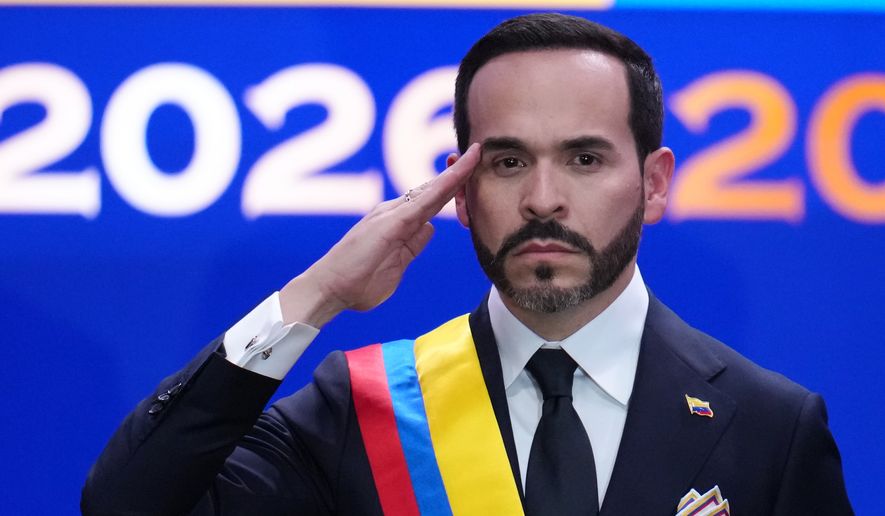
Colombia’s new Trump-aligned president, Abelardo de la Espriella, formally asked Moscow and Kyiv on Sept. 5 to stop enlisting Colombian nationals.
Meanwhile, Peruvian authorities are prosecuting an alleged recruiter accused of directing Peruvians into Russian military service under false pretenses.
People were interested in these podcasts
The legal efforts are being made as Russia appears to be stepping up efforts to recruit new soldiers both at home and abroad.
The Russian outlet Vyorstka, as cited by the Kyiv Independent, reported that Irkutsk Governor Igor Kobzev authorized, by decree, payments of nearly $18,000 to recruiters for each foreign soldier. The sum is distinct from the recruit’s salary or enlistment bonus, underscoring the financial push behind new recruitment.
Peruvian investigators have offered a detailed account of how an overseas employment pitch is luring Latin American youths to death in Ukraine.
In a Friday statement, the Peruvian prosecutor’s office said it had 22 open cases involving more than 300 Peruvian nationals recruited into the Russian military under false pretenses.
Court documents in one case reveal that a Peruvian was lured to Russia with promises of a $2,600 monthly salary and free travel. Once in the country, the alleged victim was induced to sign a Russian-language contract with the promise of a $26,000 signing bonus. The Peruvian national mentioned in the reports said he never received the funds and was promptly sent to the front lines in Ukraine.
“Someone who does not speak Russian becomes dependent on interpreters and intermediaries for almost everything,” said Daniel Lara Farias, a Venezuelan political analyst. “This places recruits in an extremely vulnerable position and can expose them to highly precarious conditions, potentially including forced labor or slavery.”
The Panamanian Foreign Ministry also acknowledged in July that Panamanian citizens were serving in Russia’s armed forces. According to the ministry, Russian authorities said the contracts signed by Panamanian citizens were “voluntary.”
Panama differs from the broader pattern: Its gross domestic product per capita exceeds Russia’s, yet its citizens are still being targeted by the recruitment network.
“These cases must be addressed from a comprehensive perspective of citizen protection, human trafficking prevention and action against deceptive employment advertising, particularly given the use of digital platforms to promote job opportunities abroad,” Panamanian National Assembly member Yarelis Rodriguez said in a written statement to The Washington Times.
Ms. Rodriguez maintained that Panama must continue to strengthen its prevention, oversight and education mechanisms, as well as its international cooperation, to prevent more citizens from being drawn into the conflict.
According to information from Panamanian authorities, about 30 citizens are believed to be linked to the conflict, while at least one Panamanian is reported to have died. Others remain missing, and some 17 Panamanian nationals have been repatriated. Of the returnees, 11 came back from fighting with Russia and six from serving on the Ukrainian side.
“There is a debate to be had about the proper terminology for these individuals: volunteers, mercenaries, soldiers for hire, private military contractors,” said Wilfredo Alejandro Sanchez, president of Second Flood Strategies, a consulting firm in Washington. “But since the war has lasted almost five years, both sides need more troops on the front lines.”
Colombia has faced Marxist insurgencies, drug cartels and other armed groups since the 1960s, producing a large pool of combat-experienced veterans.
Colombians also have worked as security contractors in Iraq and Afghanistan. That same manpower pipeline now sends Colombian fighters to Yemen and Sudan. Colombians are also believed to be among the largest non-European contingents in Ukraine’s armed forces, although reliable figures are unavailable.
“Peruvian citizens have also died fighting for Ukraine, but according to media reports, those were volunteers who wanted to fight. Latin American citizens are fighting on both sides in this conflict,” Mr. Sanchez said.
Amnesty International, a human rights organization, released a report accusing Russia of human trafficking in its foreign recruitment efforts.
A substantial portion of its evidence came from interviews with Brazilian, Colombian and Cuban nationals who were recruited by Russia and ended up in Ukrainian prisoner-of-war camps. Amnesty International was formally designated an “undesirable organization” by Russia in May 2024, criminalizing any association with the group.
President Trump’s “Donroe Doctrine” seeks to curb rival powers’ influence in the Western Hemisphere.
The January capture by U.S. forces of Venezuelan strongman Nicolas Maduro and the subsequent intervention in the country, long a close partner of Russia and China, was presented as consistent with that goal.
Yet the recruitment cases show how Moscow can still exert influence in the region through social media, private recruiters and other intermediaries.
For Latin American governments, the immediate issue is less a contest among great powers than the protection of their citizens. Their emerging response treats deceptive military recruitment not simply as a foreign policy problem but as potential criminal human trafficking.
Although Moscow rarely publishes casualty figures, Russia faces critical manpower shortages. A joint research project by the independent Russian media outlet Mediazona and the BBC Russian service has confirmed the identities of at least 249,000 Russian military personnel killed in the conflict — a figure researchers note is likely significantly higher, as it reflects only deaths verifiable through public sources such as obituaries, regional media reports and statements from local authorities.
“While Russia reduces its material, human and political costs, it can increase domestic production and preserve its reserve forces,” Latin American affairs analyst Joelvin Villarreal said in a written statement to The Washington Times. “For the public, a dead Russian is not the same as a foreign fighter.”
Please read our comment policy before commenting.