



A version of this story appeared in the daily Threat Status newsletter from The Washington Times. Click here to receive Threat Status delivered directly to your inbox each weekday.
OPINION:
In the satirical 1964 anti-war film “Dr. Strangelove,” fears of a “doomsday machine” — an automated, unstoppable device programmed to trigger global nuclear annihilation in the event of an attack on the Soviet Union — gripped U.S. leaders and the Soviet ambassador in the American “war room.”
Predictions of doomsdays by various means have fascinated and even entertained the world for centuries.
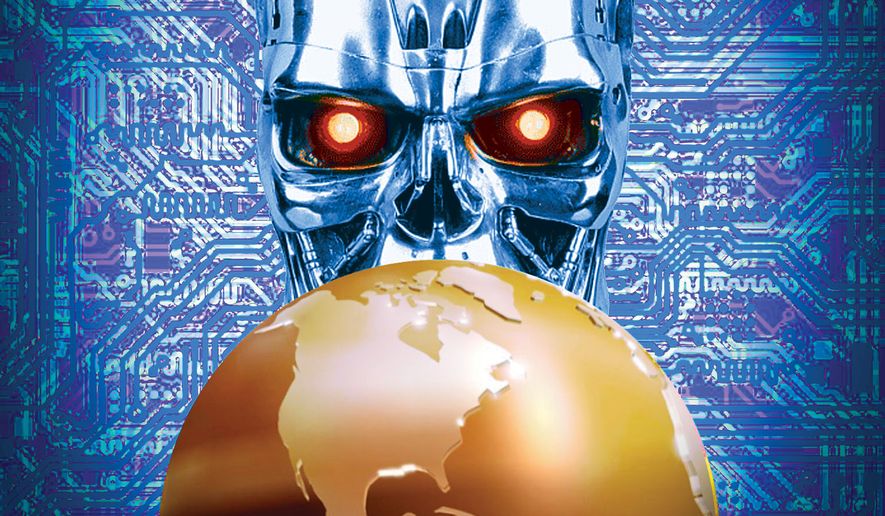
We are just getting over bogus predictions of “climate change” disasters, and now comes artificial intelligence. AI insiders are telling TV interviewers that AI can potentially destroy the human race.
People were interested in these podcasts
Over the weekend, President Trump and House Speaker Mike Johnson, Louisiana Republican, responded to these latest “Chicken Little” warnings by acknowledging that we need “guardrails” on AI.
Then the president flipped, saying the U.S. already had enough protections in place and did not need more. Mr. Trump says he does not want to limit the potential of AI to provide cures for diseases. As with so many other things — such as fire and guns — AI can be used for good or evil.
I have long thought that artificial intelligence has existed in Washington for years. It is called Congress.
Should we be as worried about AI as some have been when other “end of the world” predictions have come and gone?
History suggests we should not put much stock in the latest disaster prediction, though caution appears warranted when it comes to AI.
Courtesy of the Encyclopaedia Britannica, the latest forecast to go wrong — other than “climate change” disaster predictions — was the 2012 Maya apocalypse. By Dec. 31, 2012, various end-of-the-world scenarios included the Earth colliding with an imaginary planet called Nibiru, giant solar flares, a planetary alignment that would cause massive tidal catastrophes and a realignment of Earth’s axis.
Preparations for the end of the world as we know it included a modern-day Noah’s Ark built by a man in China and extensive sales of “survival kits.”
Radio preacher Harold Camping predicted the end of the world as many as 12 times based on his interpretations of biblical numerology.
As each date passed without a disaster, Camping came up with a new one. This one was even more bizarre: “Taiwanese religious leader Hon-Ming Chen established Chen Tao, or True Way, a religious movement that blended elements of Christianity, Buddhism, UFO conspiracy theories, and Taiwanese folk religion. Chen preached that God would appear on U.S. television channel 18 on March 25, 1998, to announce that he would descend to Earth the following week in a physical form identical to Chen. The following year, he prophesized, millions of devil spirits, together with massive flooding, would result in a mass extinction of the human population. Followers could be spared by buying their way aboard spaceships, disguised as clouds, sent to rescue them.”
Then there was the Halley’s Comet panic: “The nearness of its approach in 1910 created fear that it would destroy the planet, either by a celestial collision or through the poisonous gases it was rumored to contain.”
Mark this one as the ultimate chicken joke: “In 1806, a domesticated hen in Leeds, England, appeared to lay eggs inscribed with the message ’Christ is coming.’ Great numbers of people reportedly visited the hen and began to despair of the coming Judgment Day. It was soon discovered, however, that the eggs were not in fact prophetic messages but the work of their owner, who had been writing on the eggs in corrosive ink and reinserting them into the poor hen’s body.”
AI should be taken seriously, but we probably do not need to panic as we did with so many other doomsday predictions. Nuclear weapons would appear to be a greater threat with the ongoing danger of causing a reduction in the human race.
• Readers may email Cal Thomas at tcaeditors@tribpub.com. Look for Cal Thomas’ latest book, “A Watchman in the Night: What I’ve Seen Over 50 Years Reporting on America” (Humanix Books).
Follow the author
Please read our comment policy before commenting.