



A version of this story appeared in the daily Threat Status newsletter from The Washington Times. Click here to receive Threat Status delivered directly to your inbox each weekday.
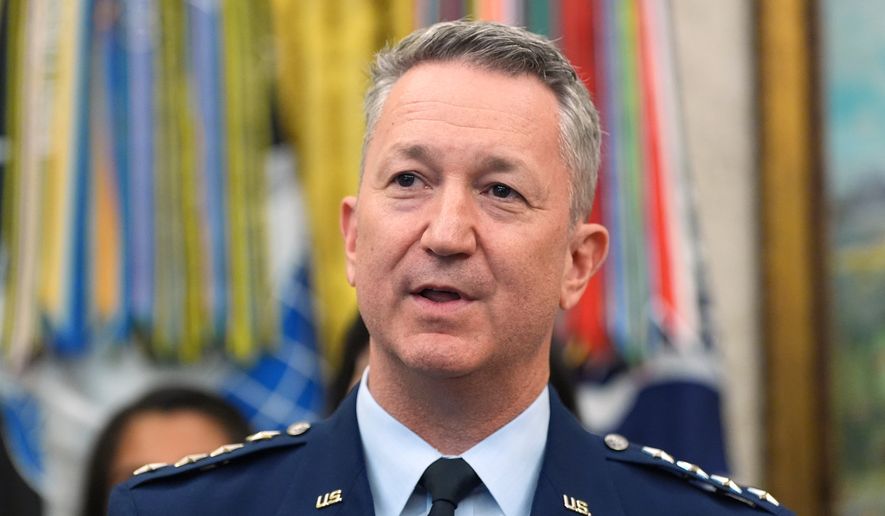
The U.S. faces rapidly evolving challenges around the world and must move faster to deploy advanced technologies such as artificial intelligence and massed drones, according to the chairman of the Joint Chiefs of Staff.
Conflicts in Ukraine and the Middle East are providing valuable military lessons, especially regarding drone warfare and the need to rapidly develop new autonomous warfare capabilities, Gen. Dan Caine said in recent remarks at a defense conference.
Gen. Caine said novelist Tom Clancy could not make up the global threats challenging the American military today.
People were interested in these podcasts
As chairman, Gen. Caine is required to confront multiple threats and problem sets as well as anticipate future challenges.
Current dangers include the Ukraine war, ongoing military operations in the Middle East, terrorism threats in Africa, drug trafficking in the Western Hemisphere, “and of course the Pacific that wraps around all of that,” Gen. Caine said, in an apparent reference to ongoing tensions with China over Taiwan, the Chinese bullying the Philippines in the South China Sea and mounting Chinese pressure on Japan.
The main difference today compared to past challenges is how fast information travels, he said.
Earlier Joint Chiefs chairmen and past combatant commanders and company commanders had time to consider multiple military options and associated risks, and the opportunity to be more thoughtful about the use of American combat power, an instrument used along diplomatic, informational and economic efforts, he said.
“But the ability to fight and win from seabed out to cislunar space and beyond, along with the ability to win in the information domain and the challenges that seem to be scaling in front of us, it’s an important time for this conference, it’s an important time for the partnership [with industry], and we got go faster together,” Gen. Caine said.
Cislunar space is the area between the top of Earth’s atmosphere and the moon — a zone increasingly contested with advances by adversaries China and Russia.
“As we move toward a more open architecture joint force, I think our lethality and survivability are going to scale much, much faster than they have previously,” he said.
A major effort right now is underway to “scale” up drone warfare capabilities across multiple war fighting functions with a mix of traditional high-end weapons and large numbers of low-cost systems, the four-star general said in remarks to the National Defense Industrial Association on Wednesday.
“There’s clearly a role for bespoke, high-end combat capabilities that can go do unique things that the nation needs that force to do,” he said.
“And at the same time, quantity has a quality all of its own. And we have to make sure to meet that quantity requirement with quality quantity as we move forward.”
The goal will be to provide war fighters with a mix of advanced precision-guided strike and defensive arms and masses of inexpensive autonomous weapons that are a part of what the Pentagon is calling offensive drone dominance and defensive counter-drone arms, Gen. Caine said.
“There will still be a need for a high-low mix in the force of the future as we look out to the joint force in 2030 and 2040 and back into what that joint war fighting concept must look like for us to ensure that we can go in [during] high-end conflict,” he said.
The Pentagon’s drone dominance initiative calls for spending about $1 billion to rapidly field with combat units large numbers of attritable uncrewed systems.
Companies have been selected for building the drones and are in various phases of competition and procurement.
The fiscal 2027 defense budget request also includes $54.6 billion for the Defense Autonomous Warfare Group, a unit that seeks to fix the slow weapons buying process in mass-producing autonomous drones and other uncrewed systems.
Autonomous weapons are also being rapidly adopted within the military with younger troops more easily attuned to using digital systems, while older war fighters are being trained on the use of air, sea and underwater artificial intelligence-powered drones, he said.
“We’re in a confidence-building phase right now across the joint force” on autonomous warfare, he said.
Central Command military forces are already using autonomous weapons and systems, and European forces also are integrating the advanced capability, Gen. Caine said, without elaborating.
“As we move toward a more open architecture joint force, I think our lethality and survivability are going to scale much, much faster than they have previously,” he said.
Defense contractors that are producing autonomous systems are working closely with military war fighters in developing new weapons, including in the Middle East, a practice Gen. Caine said is “a big, big deal for us.”
The cost of military lethality is exponentially decreasing through advanced technology that is “everywhere,” he said.
“The capabilities that we see emerging in frontier AI models, the work that the joint force is doing in space, the work that we’re doing in the undersea domain, but all those technologies must nest within the way we’re going to go fight our wars, our war fighting functions: fires, maneuver, command and control, sustainment, intelligence, protection, information,” he said.
Asked about growing threats from hypersonic missiles, Gen. Caine said adversaries are aggressively moving to deploy hypersonic weapons and the U.S. military services are doing so as well.
“From the joint war fighting enterprise, we’re going to need hypersonic capability at scale. Services are working on that,” he said.
Gen. Caine said he has been studying Gen. George Marshall, the Army chief of staff in 1939 who had to build a military force quickly during a time of national emergency.
“We have to be mindful that could we do that today? If not, why not? If we had to, what would have to be true to create that kind of capability if the nation and the world found ourselves in similar situations?” Gen. Caine said. Gen. Caine urged defense companies to move rapidly in giving high priority to building and deploying new capabilities.
Companies have been doing a lot in that area but “teammates, we all have to go faster on our side, on your side,” he said.
The Pentagon’s Defense Innovation Unit and the Office of Strategic Capital, along with efforts by the military services to work more closely with companies are positive signs, he said.
Contact the author

Please read our comment policy before commenting.