



A version of this story appeared in the daily Threat Status newsletter from The Washington Times. Click here to receive Threat Status delivered directly to your inbox each weekday.
SEOUL, South Korea — It’s been a vintage week for North Korean leader Kim Jong-un.
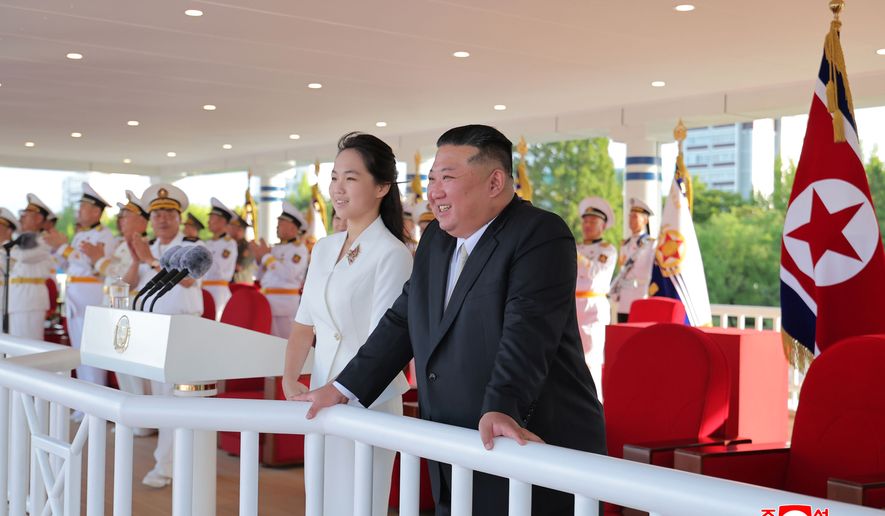
On Tuesday, he commissioned a nuclear-capable destroyer, bristling with on-deck weaponry.
On Wednesday, the first trucks rolled over a road bridge across the Tumen River, expanding transport options between North Korea and Russia beyond a pre-existing rail bridge and sea links.
People were interested in these podcasts
Also on Wednesday, the nation marked the 78th anniversary of its founding under Mr. Kim’s grandfather, Kim Il Sung. Chinese President Xi Jinping and Russian President Vladimir Putin sent messages of amity.
On increasingly good terms with Mr. Xi, fully backed by Mr. Putin in return for his support for the war in Ukraine and with President Trump keen to renew bilateral summitry, Mr. Kim’s diplomatic star shines bright.
Domestically, no known opposition exists, his long-dormant economy is growing and his combat-tested conventional force and expanding nuclear deterrent make his rule unassailable.
This state of ultra-security was not always guaranteed. According to Korean-Russian author Fyodor Tertitskiy, the Kim dynasty teetered on the edge of the abyss on multiple occasions.
Its repeated recoveries, he says, have strengthened its resilience.
Mr. Tertitskiy, 38, a North Korea scholar at Seoul’s Korea University, has examined multiple archives — including Russian — and details these events in “Pyongyang on the Brink: Sixteen Crises That Shaped North Korea,” published in March.
The biggest risk the nascent “Kimdom” faced came in autumn 1950, Mr. Tertitskiy told The Washington Times. Having invaded South Korea in June, its army was trounced, and U.S.-led forces counter-invaded. Pyongyang fell and Soviet dictator Josef Stalin abandoned state founder Kim Il Sung.
Only a massive, shock intervention by Chinese forces saved Kim and his state.
The world-shaking reversal of fortune in late 1950, however, is widely known. Mr. Tertitskiy says Kim, his son and grandson mastered multiple lesser-known crises, underwriting the survival of what he calls “an extremely closed and repressive hereditary dictatorship that is obsessed with self-preservation — more a despotic regime than one that is loyal to any ideology.”
He also details the one and only risk he believes hovers over the current supreme leader — but expresses doubts about any overthrow of a Kim.
In 1956, amid Soviet shakeups, Kim Il Sung faced internal resistance. His response showcased his talent for self-preservation.
“In February 1956, Nikita Kruschev in Moscow denounced Stalin, saying he was a terrible leader who’d betrayed Leninsism, was incompetent and headed a one-man dictatorship,” Mr. Tertitskiy said. “Everyone in Korea could point out a man like that.”
Figures in the Party Central Committee with ties to Russia and China tried to pass an anti-Kim resolution, and a Chinese-Soviet delegation arrived to urge change.
Kim unleashed a purge. Surviving actors escaped across the border, never to return home.
“He is pressured by his boss, Kruschev, to step back and of course he steps back — then steps forward,” Mr. Tertiskiy said. “After the purge, he was strengthened.”
Freed of opposition, Kim’s personality cult flourished, and he built up a massive and intrusive surveillance infrastructure. He also groomed his son, Kim Jong Il, to succeed him.
Some military officers had other ideas.
North Koreans studying at the elite Frunze Military Academy in Moscow amid “glasnost” were teased by fellow cadets, who critiqued North Korea as backward and feudal.
Pyongyang summoned its cadets home, but their loyalties had evaporated.
In 1992 a plan, possibly modeled on the 1981 assassination of Egyptian President Anwar Sadat, was hatched. The plotters would open fire on a reviewing stand with tank-mounted machine guns during the annual April 23 military parade in Pyongyang.
It did not happen.
“They could not shoot, as the wrong unit of tanks had been sent to the parade,” Mr. Tertitskiy said. “Word leaked out, and there was a huge purge.”
Kim Il Sung died in 1994, and Kim Jong II inherited a crisis.
The disintegration of the Soviet Union led to the cratering of North Korea’s trade. That economic disaster, combined with unfavorable climactic conditions that generated famines between 1994-1998, may have killed 10% of the populace.
Against that backdrop, another coup was hatched in the 6th Corps in the northeastern city of Chongjin in 1995.
“It was the Great Famine, the economy was collapsing and the political and security officers of the corps said, ’We need to rise, seize Chongjin — which had Chinese and Russian consulates — then reach out to South Korea,’” Mr. Tertitskiy said. “The commanding general said, ’No,’ so they killed him.”
Word reached Pyongyang, which deployed a trusted, ruthless general to Corps HQ. He initiated a lethal purge. Subsequently, the 6th Corps was disbanded.
Even post-famine, peril remained for Kim Jong II. In April 2004, a massive explosion devastated the town of Ryongchon just hours after his private train had passed through following a China visit.
Some pointed fingers at dilapidated infrastructure, suggesting live electric cables dropped onto a wagon full of fertilizer and detonated the blast.
Mr. Tertitskiy considers an assassination attempt likely, citing comments from Kim Jong II himself that leaked out.
In 2015, a tantalizing rumor emerged: That the aging survivors of Kim Il Sung’s 1956 purges based in China and Central Asia accessed information about Kim Jong II’s rail schedule and plotted the blast.
Only one of the 16 crises Mr. Tertitskiy covers in his book relates to Kim Jong-un.
Mr. Kim’s weight periodically shifts between heavyset and grossly obese, and he constantly has cigarettes at hand. In 2020, he disappeared from public view for months.
“There were reports that he was treated at a special hospital in the mountains,” Mr. Tertitskiy said. “He’s very fat: What happens if he has a heart attack?”
South Korean intelligence believes Kim III’s daughter Ju Ae, aged 13 or 14, is being groomed as the supreme leader. Citing state media nomenclature, Mr. Tertitskiy is less sure.
“It seems a decision is not made yet,” he said, noting that her name has not been publicly released, only her title, “Beloved Child” — and that is not written in bold font, unlike her father.
The 1990’s expectations that North Korea would collapse withered long ago, and there is no likelihood of significant reform.
“Nothing ever changes,” Mr. Tertitskiy said.
With the military cowed by the events of 1992 and 1995, he sees little chance of another coup attempt.
Some activists have proposed unleashing an info-war campaign aimed at revealing truths to North Korea’s citizenry, starved of external information. But the Kimdom’s public has neither the capacity to rise nor the leadership.
The latter vacuum could — feasibly — be filled.
“Maybe help people escape and build alternative elites?” Mr. Tertitskiy suggested. “But in the short run, there’s little you can do.”
With North Korea offering China an authoritarian buffer against the democracies on its northeastern flank, Beijing has likely got Mr. Kim’s back.
“While China exists, [Mr. Kim] is quite safe: Xi could help him crack down on dissent,” Mr. Tertitskiy said. “His worst-case scenario is becoming a Chinese puppet state and becoming a bit less militarized.”
q
Contact the author

Please read our comment policy before commenting.