



A version of this story appeared in the daily Threat Status newsletter from The Washington Times. Click here to receive Threat Status delivered directly to your inbox each weekday.
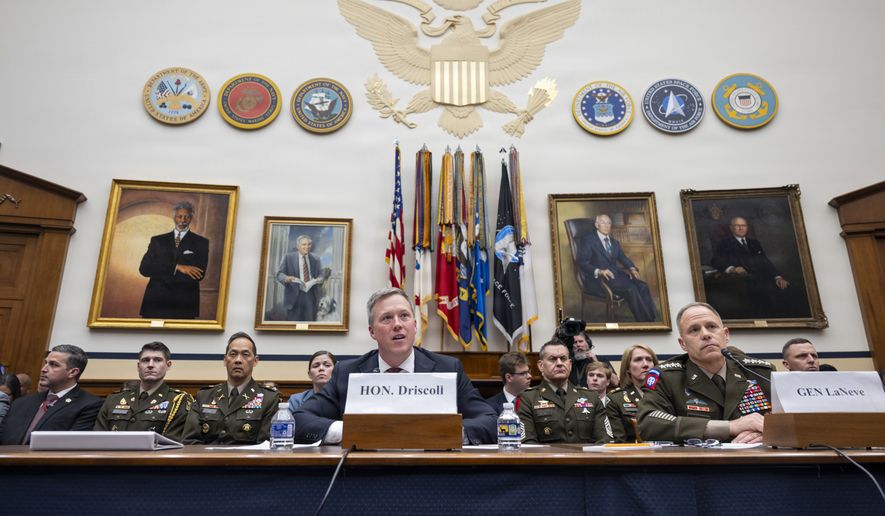
The U.S. military’s largest branch is left without a top civilian leader or a congressionally confirmed senior officer after the sudden departure of Army Secretary Dan Driscoll, a move that some of the leader’s closest staff members said was unusually swift.
Mr. Driscoll’s departure from the Pentagon after only 18 months on the job leaves the Army’s modernization and wartime readiness efforts without its principal civilian champion. Mr. Driscoll clashed with Defense Secretary Pete Hegseth for months over the firings of transformation-minded generals.
Mr. Driscoll told President Trump that he was worried about the future of the Army, as his efforts to modernize the force faced resistance at the Pentagon, said a former official close to the discussions.
People were interested in these podcasts
The Pentagon has yet to comment on Mr. Driscoll’s departure. Anna Kelly, a White House spokesperson, praised Mr. Driscoll in a statement but did not directly address his departure or discussions with the president.

“Secretary Driscoll has been highly effective in advancing President Trump’s agenda to Make America Strong Again at the Department of the Army by providing outstanding leadership,” she said.
Mr. Driscoll’s sudden exit came as a shock to many around him, even some of his immediate staff, a person familiar with his team said, who, like others, asked for anonymity to discuss sensitive internal matters.
SEE ALSO: Trump nominates Hung Cao to be Navy secretary
The Army secretary had bipartisan support on Capitol Hill. Both Republicans and Democrats described him as easy to work with and candid about the questions they wanted answered. Lawmakers said they were concerned about the personnel churn in the top positions of the military.
Mike Rogers, the Alabama Republican and chairman of the House Armed Services Committee, said he was “disappointed.”
“I’m tired of all the churn,” Mr. Rogers said. “I want to see some stability over there.”
As Army secretary, Mr. Driscoll brought urgency to an institution that cannot afford complacency, said Rep. Pat Harrigan, a North Carolina Republican who served multiple combat tours in Iraq and Afghanistan as a Green Beret officer.

“He understood that maintaining the strongest Army in the world means constantly questioning how we buy equipment, sustain it and prepare our soldiers for the battlefield,” Mr. Harrigan said. “Dan was willing to take on entrenched systems and challenge assumptions that had gone unquestioned for far too long.”
In particular, Mr. Harrigan noted Mr. Driscoll’s push for giving troops the legal authority, tools and technical manuals required to fix their own equipment and weapons — known in military circles as “Right to Repair.”
“I’ve been fortunate to work alongside him on many of those fights,” Mr. Harrigan said. “His leadership made the Army stronger, and the impact of his work will be felt long after his time as secretary.”
Key military officials and defense industry leaders are set to attend a major Army conference in October, one that last year served as a spotlight for the 21st-century modernization effort and was part of a push across the Pentagon.
The Association of the United States Army hosts an annual conference billed as the “Army’s most powerful event.” Mr. Driscoll was still planning to attend the conference. Army headquarters staff at the Pentagon were recently receiving guidance and input about his attendance and participation, the person said.
“It surprised me. It surprised everyone I know,” another current official said. “I don’t know anyone who saw it coming, and it happened while leadership is thin.”
Dave Fitzgerald, deputy undersecretary of the Army, is also expected to resign from his role this week, said a source close to the matter.
The senior Democrat on the Senate Armed Services Committee accused Mr. Hegseth of hollowing out the Army’s senior ranks and leaving the military chain of command in limbo. Mr. Hegseth’s decisions on Army leadership have drawn sharp criticism from Capitol Hill since Mr. Driscoll’s resignation.
“In the Army alone, he has fired and blocked the promotion of dozens of senior officers without explanation, including Army Chief of Staff Gen. Randy George and half of all four-star generals,” Sen. Jack Reed of Rhode Island, a former Army officer and West Point graduate, said in a statement. “Secretary Hegseth is creating a culture where dissent is punished and competence is secondary to personal allegiance.”
Mr. Driscoll’s resignation had become “the worst-kept secret in Washington” in recent months, as one former official put it. The resignation of Gen. George set into motion a glacial slide toward the replacement of Mr. Driscoll as well.
A former Army officer himself who fought in Iraq and a Yale Law School classmate of Vice President J.D. Vance, Mr. Driscoll has garnered wide-ranging and bipartisan influence on Capitol Hill since taking on the role of secretary of the Army.
Gen. George and Mr. Driscoll, as a pair, have had a significant impact on major legislation over the last 18 months. Their initiatives have continually scraped through a politically charged environment in Congress.
Rep. Jason Crow, Colorado Democrat, said he worked with Mr. Driscoll on the House Armed Services Committee and the House Permanent Select Committee on Intelligence.
“We had some policy disagreements, but I can tell you, he was pushing hard to modernize the Army, to reduce inefficiency and waste, and to bring it into the 21st century,” said Mr. Crow, a former Army Ranger who fought in Iraq and Afghanistan. “That he is being pushed out is just another example of the fact that Pete Hegseth does not care about competency or people trying to do the right thing.”
Mr. Driscoll’s scope during the Trump administration went beyond his work as Army secretary. He was tapped by the White House to serve as a key negotiator in the Russia-Ukraine war. In November 2025, he became the highest-ranking administration official to travel to Ukraine to present a U.S.-brokered peace plan.
From April 2025 to April 30, 2026, Mr. Driscoll also served as the acting director of the Bureau of Alcohol, Tobacco, Firearms and Explosives, better known as the ATF.
As Army secretary, Mr. Driscoll worked closely with Gen. George to push forward research, development and funding for some of the Army’s core technologies. That partnership, the former official said, was critical to a successful Army leadership team in a Pentagon plagued by intrigue and personality clashes.
“It just got to a point where all his efforts on innovation and transformation were being stymied,” they said. They said it was a matter of friction with Mr. Hegseth, a long-standing narrative circulating in the Pentagon.
Mr. Hegseth’s decisions on high-level leadership firings or forced retirements in the Army, including the ouster of Gen. George, were also to blame.
The new chief of staff of the Army, Gen. Christopher C. LaNeve, has a reputation for a greater focus on the “warrior ethos,” said multiple sources, citing military training, physical fitness and standards for Army soldiers as examples. Gen. LaNeve holds a Senate-confirmed four-star rank but is serving in an acting capacity as chief of staff.
Gen. George’s fervor for his “Army Transformation Initiative” propelled the program into one of the most discussed modernization efforts at the Pentagon. That ardent direction was coupled with a sterling reputation in Congress across the political spectrum.
In April, Mr. Driscoll told lawmakers during a Defense Appropriations subcommittee hearing that he was with his children in North Carolina when he learned that Gen. George had been told to submit his retirement papers.
“When we drove back from North Carolina, I drove straight to Gen. George’s house. We walked right in, and we all gave him a hug,” he said. “There is no person that has more respect for Gen. George and his 42 years of service, his Purple Heart, his wife Patty, their grandkids and their kids. He was an amazing, transformational leader.”
Still, the politics of the “iron triangle” — the connections among the White House, Congress and the Pentagon, as an insider described — are a dynamic that Mr. Hegseth has shown disdain for publicly. That pervading culture at the Pentagon was, at least in part, another reason Mr. Driscoll resigned.
“Not in terms of like, [Mr. Hegseth] yelling at him or something,” the former official said. “Just in making it impossible to do what he wanted.”
Many who had served alongside Mr. Driscoll during his early years bolstered his reputation among soldiers in the Army. Mr. Driscoll was well-liked as a service secretary.
“He was very easy to respect, even for folks who didn’t agree with everything he was doing,” one officer outside Washington said. “For a political appointee, he blended the political nature of his job really well with actual leadership.”
Many were quick to point out that although soldiers today are more aware of the news in Washington, the impact of his resignation will be felt mostly inside the Beltway.
“Most normal Army soldiers barely know who their division commander is,” they said.
Contact the author

Please read our comment policy before commenting.