


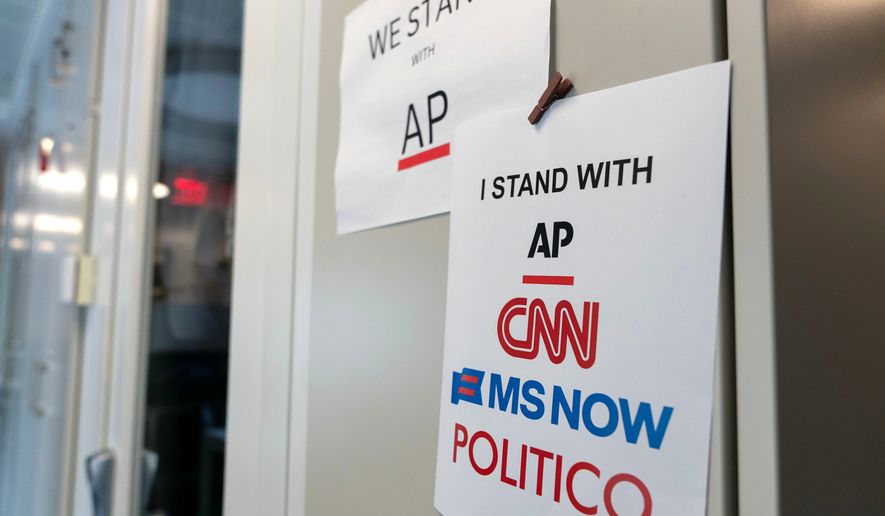

A federal judge said he’ll decide by Tuesday whether to issue a long-term pause on President Trump’s banishment of three news outlets that he claims pose a national security risk.
Theodore “Ted” Boutrous Jr., a lawyer representing Politico, MS Now and CNN, argued in U.S. District Court on Thursday that 78 journalists from the three outlets unlawfully had their White House credentials and access revoked because the president believed their coverage was too negative, and that their banishment would cause irreparable harm.
He asked Judge Timothy Kelly to issue a preliminary injunction, “restoring these credentials, the hard passes and all the access they represent and cover,” while the matter plays out in court.
People were interested in these podcasts
A 14-day temporary restraining order against Mr. Trump’s ban, issued last month by Judge Kelly, expired Thursday.
Judge Kelly, a Trump appointee, appeared likely to issue the injunction based on his statements in court that the White House did not follow due process in banning the outlets. Instead, officials kicked out the journalists before providing advance notice or chance for the outlets to respond.
“We do have a notice problem,” Judge Kelly told Justice Department senior counsel Michael Velchik, who argued on behalf of the White House.
A preliminary injunction would preserve the journalists’ access to the White House — but may not stop the president’s war with the press.
It’s not clear how an injunction would impact the Trump administration’s continued banishment of the three outlets from pool coverage of the president.
The judge’s ruling last month temporarily restoring credentials to the outlets has not stopped the administration from blocking the affected journalists from traveling with the president aboard Air Force One, from events with the president inside the Oval Office and other areas where limited media access to Mr. Trump is granted.
The ban has ignited a broader battle between Mr. Trump and the media that has left the president short of pooled media coverage. Most other print, broadcast and cable news outlets have refused out of solidarity to fill in for the banned outlets in the pool rotation.
Mr. Velchik said the media outlets failed to respond to letters sent to them last month detailing the stories that were allegedly a threat to national security. A Sept. 25 deadline passed without a response from any of them.
“We did provide a process. They chose not to participate. I think that has to defeat any due process that they have when the government does provide opportunity and it’s not taken up,” Mr. Velchik said.
He also pushed back against the outlets’ argument that the ban would cause irreparable harm by hindering critical media coverage that is in the public interest.
“If we are in a situation where all the other pool members are acting in solidarity, so-called, or in coordination, so that they all still have equal access to the same information, I would ask the court to try and analyze, like, how, in practical terms, can they say that is irreparable,” Mr. Velchik said.
The president revoked the credentials of the three outlets on Sept. 18, citing their “fake news” and overwhelmingly negative coverage of his administration.
Mr. Trump’s press team, in separate letters sent to the banned organizations the following Tuesday, said their credentials were revoked because they published stories containing “sensitive security information.”
The White House press team included several examples, among them an August 2026 CNN story that cited unnamed sources who reported the U.S. had exhausted most of its interceptors for a critical missile defense system.
The White House referenced a Jan. 19, 2026, CNN article, “Inside the Plans to rebuild the ‘top secret’ bunker beneath the White House East Wing,” among others.
The coverage, Mr. Trump’s press team wrote to the impacted outlets, “diverts White House resources and those of the national security team in particular, which must evaluate whether the leaked information is classified, the source of any leak, and the security implications of any such disclosure.”
Some of the impugned reporting had nothing to do with national security, a point Mr. Boutrous raised repeatedly in court, citing Mr. Trump’s own words.
“He’s been candid. He’s been clear as the law requires. His reason for this ban is he doesn’t like scrutiny of his policies. He doesn’t like the reporting. He wants more good press, and that’s content-based. It’s viewpoint-based. It violates due process,” Mr. Boutrous said.
The Washington Times reached out to the White House.
Contact the author

Please read our comment policy before commenting.