


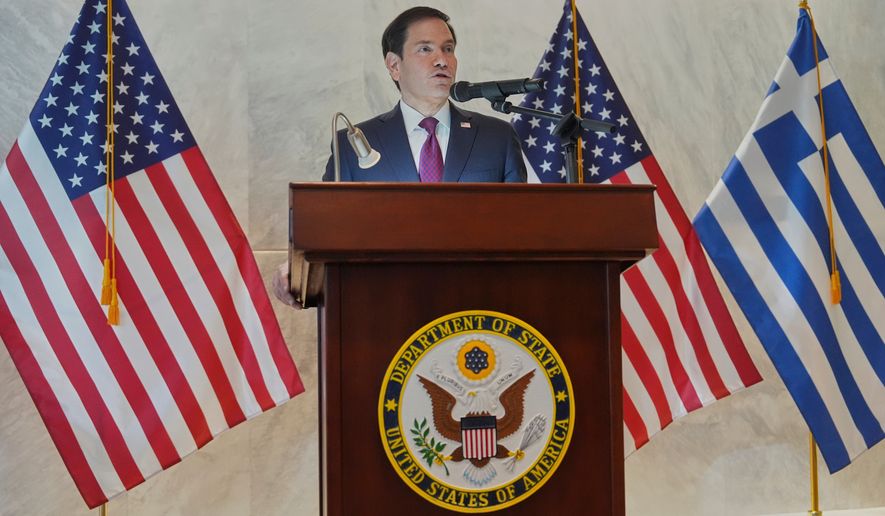

Secretary of State Marco Rubio cautioned that Western nations will face critical choices over the coming decade that will decide whether they remain global leaders or face a “future of atrophy, servitude and decline.”
Speaking Wednesday in Athens, Mr. Rubio told a crowd of diplomats, Greek government officials and reporters that the convictions and philosophies the ancient Greeks handed down, which inspired America’s founders, have weakened.
“Over time, we in the West came to feel ashamed of the very things that made us exceptional. We felt embarrassed that our achievements set us apart from the rest of the world. Our prosperity somehow became a source of guilt. We no longer believed that we deserved and earned our greatness,” he said.
People were interested in these podcasts
He added that the qualities that once defined the West have eroded as it “opened our borders and outsourced our industry and allowed our militaries to wither and decay.”
Mr. Rubio also bemoaned outsourcing “our decisions to global bureaucracies,” in an apparent reference to the United Nations and the International Criminal Court.
Under President Trump, Mr. Rubio said, the U.S. is attempting to reverse decay by unapologetically pursuing its national interests and encouraging partners to do the same.
He pointed to a growing U.S.-Greece partnership on issues such as defense and immigration enforcement.
The secretary also struck a relatively positive tone when discussing U.S.-European relations, citing the recently signed trilateral pact on Greenland security as evidence that the partnership remains strong.
The agreement, signed last month by Mr. Trump and the prime ministers of Greenland and Denmark, expands the existing security deal, gives the U.S. two more defense areas and bars non-NATO countries from establishing a military presence on the Arctic island.
Wednesday’s speech echoed Mr. Rubio’s Munich Security Conference address, where he warned that Western civilization could be wiped out by mass migration.
Mr. Rubio’s Athens speech capped a brief visit to Greece, the latest stop on a short European trip. Earlier this week, he visited Iceland to meet his counterpart and is scheduled to travel to Portugal next.
Following a meeting with Foreign Minister George Gerapetritis of Greece earlier on Wednesday, Mr. Rubio told reporters that Athens is a “very close strategic partner” on border security, a partnership he said is necessary to ensure the “birthplace of the West” isn’t threatened by “bad decisions.”
He also said Greece agrees with Mr. Trump’s assessment that NATO allies need “to take on a greater share of the burden defending their continent.”
“Greece is doing just that,” Mr. Rubio told reporters, adding that Athens is on track to meet Mr. Trump’s benchmark of 5% of gross domestic product on defense spending, though he did not say when he expects it to reach that goal.
Ahead of his meeting on Wednesday, Mr. Rubio touted the U.S.’s success in eliminating threats from Iran in the Strait of Hormuz, telling reporters in Athens that commercial traffic in the waterway is nearing pre-war levels.
“The Strait of Hormuz is open. There’s almost as much oil flowing out now as there was before this conflict began,” Mr. Rubio said. “They’ve lost complete control of the strait.”
While traffic through the strait increased in September according to reports from various independent maritime tracking firms, overall security in the waterway remains in flux.
United Kingdom Maritime Trade Operations reported this week that 12 tankers were struck by Iranian missiles or drones in the strait between Sept. 29 and Oct. 5.
That’s a major increase from last month, when independent tanker trackers recorded several days without an attack. An unnamed U.S. official told the Wall Street Journal this week that Iran may have improved its targeting techniques.
Much of the oil that has made it through the waterway has done so under U.S. Navy guidance and through Omani waters.
Mr. Rubio’s comments come as administration officials increasingly pivot away from the strait as the central issue of ongoing negotiations with Iran and stress the goal of eliminating Tehran’s nuclear program.
Mr. Rubio told reporters that any deal would have to include provisions that ensure Iran never gets a nuclear weapon. He has, in the past, advocated for a full ban on enrichment in Iran.
Vice President J.D. Vance, who represented the U.S. in negotiations with Iran earlier this year, was more vague in comments on Tuesday, telling Reuters that if Iran wanted to convince Washington that it is not seeking a nuclear weapon, it would do “something meaningful on their enrichment capacity.”
“If you want to show commitment to not building a nuclear weapon, don’t build highly enriched fuel. That’s a very basic threshold issue,” he said, without clarifying if the U.S. would accept limits on enrichment and not a full ban.
Contact the author

Please read our comment policy before commenting.