



OPINION:
Two attempted terrorist attacks occurred last week. The question is whether Iran is responsible for either or both.
One, which grabbed most of the headlines, is the attempted hijacking of a FlyDubai airliner headed to Tel Aviv. It was thwarted by the pilot, Israeli civilians and off-duty pilots who landed the plane safely.
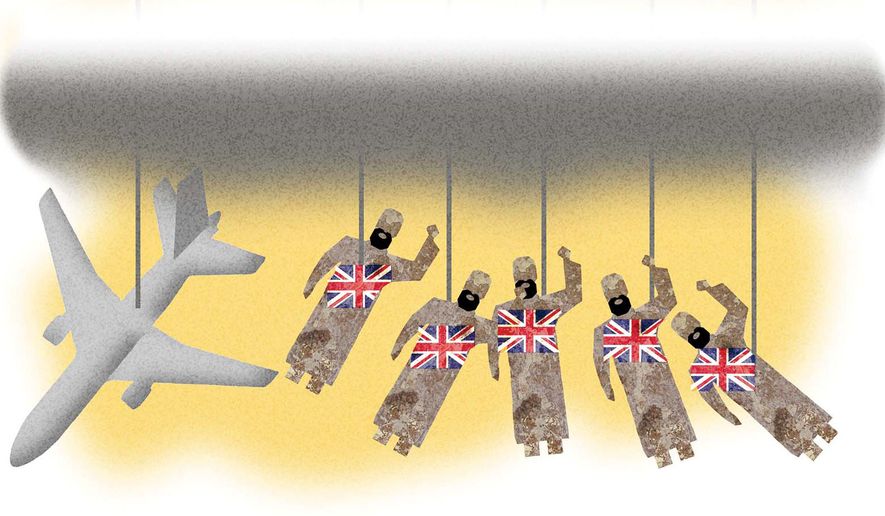
The second, which has received far less media coverage, was the attempted attack late last month on the air base at Royal Air Force Fairford in Britain. It was thwarted by the police.
People were interested in these podcasts
The alleged FlyDubai hijacker — co-pilot Hamam al-Hammami — reportedly struck the pilot from behind with a crash ax and sent the aircraft into a steep 14,000-foot dive on Sept. 30. The BBC and The New York Times — whose politics are identical — said it was an “altercation” in the cockpit, borrowing language from FlyDubai’s own official statement. It was not. It was an attempt to crash the aircraft and kill all aboard.
The pilot, Smit Machchhar, fought off Mr. al-Hammami and opened the cockpit door for Israeli civilians, who overpowered the attempted hijacker, while off-duty pilots on board landed the aircraft safely in Tabuk, Saudi Arabia.
Mr. al-Hammami had previously been suspended from flying by Oman Air because of extremist materials found in his possession, but FlyDubai hired him without vetting his background with his former employer.
The incident exposed a huge gap in Dubai airport security, which can be remedied only by close searches of aircrews.
The UAE is investigating, but its investigation will not reveal the truth. Both Israeli Prime Minister Benjamin Netanyahu and Anwar Gargash, a senior diplomatic adviser to the UAE president, labeled the attack terrorism.
President Trump said Iran may be connected to the incident.
Mr. Trump said the alleged attackers at RAF Fairford, in Gloucestershire, west of London, were out to do “big damage” to the base. Fairford has been used for B-1 and B-52 strikes on Iran. We have since brought the aircraft back to the U.S.
On Sept. 27, five British nationals from London were arrested near the base after police received calls — including one from a local farmer who spotted three vans with masked men — alerting them to suspicious activity. They were held on suspicion of terrorism offenses and possession of explosives, though no explosives were ultimately found in the vehicles. A sixth suspect, a dual British-Iranian citizen, was arrested on Oct. 1, followed by a seventh suspect arrested in London on Oct. 6.
All seven have since been released on bail by British authorities. They are sure to disappear and surface in Iran or elsewhere, greeted as heroes.
Iran, naturally, is suspected as the most likely source of the attack.
Why the alleged attackers were not spotted and interdicted earlier remains a mystery. They were not labeled as possible attackers by intelligence agencies, only by a local farmer. It seems that, once again, U.S. and British intelligence agencies failed in their jobs.
Mr. Trump said Iran will be “hit very hard” if the investigations show that it was the source of the FlyDubai and RAF Fairford attacks, but his history of empty threats and broken promises does not inspire confidence.
Can Iran be taught not to sponsor terrorism? It is highly doubtful. The Tehran regime is dedicated to sponsoring terrorism, and its principal proxies — Hamas and Hezbollah — are still working hard to repeat their attacks on Israel and beyond.
Iran should be hit extremely hard if it is responsible for these terrorist attacks. The regime in Tehran appears to be keeping its promise to back militant groups worldwide. It takes little to do so: only a bit of money and perhaps some smuggled arms or explosives.
The problem is that it is very hard to prove Iran’s sponsorship of terrorism. It has decades of experience in hiding the regime’s connections to terrorism. Are our intelligence experts up to the challenge? Perhaps, perhaps not.
Our Middle East “allies” — excluding Israel — are not likely to accept what they find because it is ideologically inconvenient for them to do so.
So we are caught between the absolutist ideology of Islam and the facts. Iran will not be ending its sponsorship of terrorism, nor will it give up its nuclear weapons ambitions. Mr. Trump’s economic sanctions have a chance to bring down the Tehran regime. The Iranian rial is now trading at roughly 1.7 million to the U.S. dollar, and inflation is approaching 90%, with food and goods prices up more than 100%.
Meanwhile, the Democrats seem stupefied by the Islamic Revolutionary Guard Corps’ endorsement of voting against Republicans in the November midterms. It is too delicious a quandary not to enjoy.
• Jed Babbin is a national security and foreign affairs columnist for The Washington Times and a contributing editor for The American Spectator.
Follow the author

Please read our comment policy before commenting.