


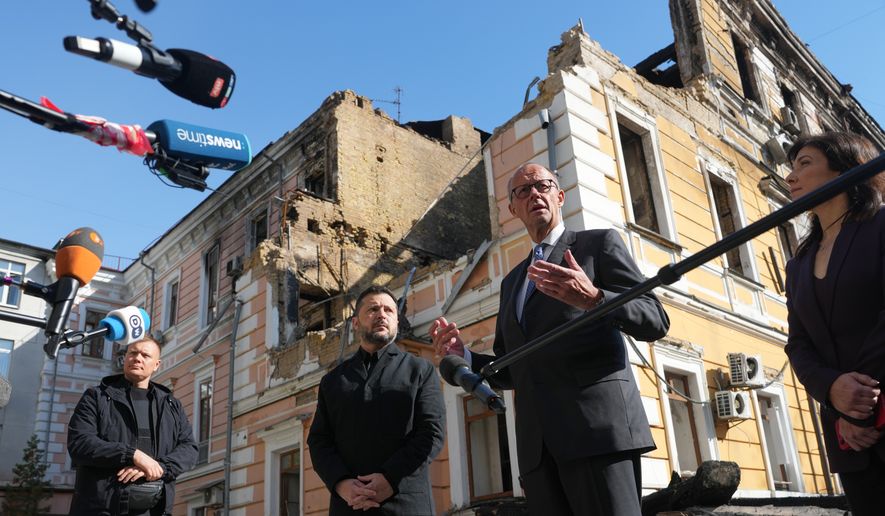

The Germans came to Ukraine over the weekend with another infusion of much-needed cash for the Russian-battered country, but this trip wasn’t just another charity-flavored aid drop-off.
Chancellor Friedrich Merz and the delegation of high-powered defense executives who accompanied him on Sunday came with checkbooks in hand, ready to buy Ukrainian technology and wartime experience.
War is in the air in Europe, and Mr. Merz and other leaders across the continent are scrambling to get ready.
People were interested in these podcasts
During the visit, German companies signed 14 agreements with Ukrainian partners worth about $7.4 billion (roughly 6.6 billion euros). The deals included an agreement with Diehl Defence for IRIS-T air-defense missiles, radar equipment from Hensoldt and jet-powered drone interceptors developed by Quantum Systems.
“What is important in this visit is that not only is Germany helping Ukraine, but Ukraine is sharing its knowledge, experience as well as orders,” Ukrainian President Volodymyr Zelenskyy said.
The agreements are part of a broader effort to tie Ukraine’s fast-growing defense industry into European industry and supply chains. After years in which the relationship largely consisted of Europe sending weapons east, Ukrainian firms are now bringing their own drones, missiles, software and — most importantly — their battlefield experience west.
“Europe has factories, resources and industrial capacity,” an executive at Ukrainian drone maker BlueBird Tech told The Washington Times. “Ukraine is in a very difficult situation, but because of that situation we are gaining an enormous amount of practical experience.”
“The challenge is how to transfer that experience quickly and effectively,” said the executive, who asked that his name be withheld for security reasons.
The European Union has begun integrating these partnerships into its defense policy: In July, Brussels and Kyiv signed a defense-industrial partnership intended to remove barriers, align standards and make joint ventures easier. The agreement calls for joint production of drones and counter-drone systems by the end of this year and sets a goal of joint production of anti-ballistic missiles by 2028.
The EU-Ukraine Drone Alliance, launched alongside the agreement, held its first board meeting in Brussels last month. Its 18 founding members include European companies such as Fincantieri, Indra, Delair, Quantum Systems and Poland’s WB Group, alongside Ukrainian manufacturers including F-Drones, Vyriy Industry, TAF Industries and Deviro.
Factories meet battlefield experience
The partnerships are no longer confined to unmanned systems.
German sensor maker Hensoldt signed an agreement with Ukrainian missile manufacturer Fire Point at Eurosatory in June to work on Freyja, a proposed ballistic missile defense system built by integrating existing, field-tested components. This week, Hensoldt signed another memorandum with Ukraine’s Defense Ministry covering additional radar deliveries, further development work and possible joint operation of long-range radars. The company said the agreement expands its existing cooperation with Ukraine on ballistic missile defense.
For Iryna Terekh, Fire Point’s CEO and chief technology officer, the goal is to build a supply chain Ukraine can rely on even where it cannot yet produce every component domestically.
“My big goal at the very end is to create strategic autonomy for Ukraine in terms of missiles and our space program,” she told The Times back in March. “If we cannot do something within Ukraine, to do it at least within Europe.”
Elsewhere in the region, cooperation is moving from supply contracts toward licensing and joint production.
Poland and Ukraine signed a letter of intent in February aimed at establishing joint weapons and ammunition production in both countries. Czech defense group CSG has expanded cooperation with Ukrainian Armor from licensed artillery ammunition production into engines for missiles and unmanned systems, with the companies also envisaging future joint ventures and further localization in Ukraine.
Freddie Bradshaw, business development lead at Ark Robotics, said the division of labor is increasingly clear: “The cutting-edge innovation is in Ukraine at the moment,” he told The Times at the MSPO defense exhibition in Poland in September.
Ukraine’s wartime experience and co-development model, he said, are what NATO should be trying to absorb, while countries such as Poland can provide “the scale of manufacturing” and the ability to pool larger budgets.
Ukrainian drone maker BlueBird is looking for European partners that can offer more than financing.
“Having strong manufacturing capacity close to Ukraine, for example just across the border, would also be extremely valuable,” the BlueBird executive told The Times.
His preferred partner, he added, brings “financial resources, manufacturing capabilities and strategic alignment,” with the longer-term goal of developing new systems alongside major European defense contractors.
Ukraine has a financial incentive to make those deals quickly.
Ukrainian lawmaker Halyna Yanchenko told The Times in July that private defense companies had developed production capacity roughly five times larger than the amount the government could afford to purchase.
“Keeping exports closed no longer made sense,” she said. “In fact, it was slowing down the development of the entire industry.” Foreign orders can keep unused production lines running, finance research and development and ultimately lower unit costs for weapons that Ukraine still needs.
France is putting $22.5 million (20 million euros) behind its own joint-development program with Ukraine. Ukraine’s Brave1 defense technology cluster and the French Defense Innovation Agency launched the $22.5 million Brave France program at Eurosatory in June. French and Ukrainian companies are being paired to develop missile technology, unmanned systems and defenses against air threats, with selected technologies to be tested in Ukraine under combat conditions.
The problem is speed
The biggest source of friction might be speed.
Ukrainian weapons developers have become accustomed to receiving feedback directly from combat units and changing products while they are already in production. Moving their technology into European factories risks exposing it to procurement and certification systems that Ukrainian companies learned to bypass during the war.
Vadym Stepanchuk, head of business development at BlueBird Tech, said battlefield lessons themselves can have a short shelf life. Ukraine changes a drone, Russia introduces a countermeasure and developers must begin anew.
That makes simply importing the latest Ukrainian system insufficient, he said.
“The important thing is not only to transfer specific answers but to recreate the mechanism that continuously generates new answers,” he said.
Mr. Bradshaw said procurement may prove as important as the technology itself.
“The critical lesson learned here when it comes to defense generally is procurement, how the procurement system changes,” he said. Ukrainian units can often control funds and purchase equipment needed for a particular battlefield problem, while that flexibility remains less common across NATO.
EU officials say they are trying to shorten those timelines.
“The challenge we face is not only technological edge but also about speed and industrial capacity to deliver together,” EU Defense Commissioner Andrius Kubilius said at the first meeting of the Drone Alliance in September. “We need design cycles in weeks, not months.”
That is also shaping new EU funding. The bloc’s planned $130 million (115 million euros) AGILE program is intended to help startups and smaller companies move new technologies from development to deployment in weeks or months rather than years. Ukraine will be eligible to participate when the program becomes operational in 2027.
The test is whether those agreements produce weapons and production lines, rather than another layer of European defense initiatives.
European manufacturers want access to weapons and production methods tested against Russian electronic warfare and mass drone attacks. Ukrainian companies, short of capital and manufacturing capacity at home, are looking for factories, components and long-term customers in Europe.
Europe has the factories and money Ukrainian companies need. Whether it can match their development speed is a different question.
Please read our comment policy before commenting.