



A version of this story appeared in the daily Threat Status newsletter from The Washington Times. Click here to receive Threat Status delivered directly to your inbox each weekday.
SEOUL, South Korea — President Trump earned solid reviews in the Indo-Pacific for refusing at last month’s summit to bend to Chinese leader Xi Jinping on Taiwan: The president offered no concessions on the island’s independence, and there was no backpedaling on weapons sales.
But the perception that Mr. Trump continues to view Taiwan as a bargaining chip in his back-and-forth negotiations with China has many in the region on edge.
“For Taiwan, the main issue is … not simply whether one weapons package is approved but — much more importantly — whether Taiwanese security is rapidly becoming a bargaining variable in the broader U.S.-China relationship,” the Asia Society Policy Institute noted in a recent post-summit analysis.
People were interested in these podcasts
For those who have been sounding the alarm on China, it was not enough that Mr. Trump held the line in his meetings with the Chinese leader — the president missed a critical opportunity to push back against an increasingly aggressive Beijing.
“The White House readout made no mention of Taiwan at all,” a report by The Center for American Progress stated. “There was no mention of dangerously provocative [Chinese] bullying of Taiwan as well as of U.S. treaty allies Japan and the Philippines.”
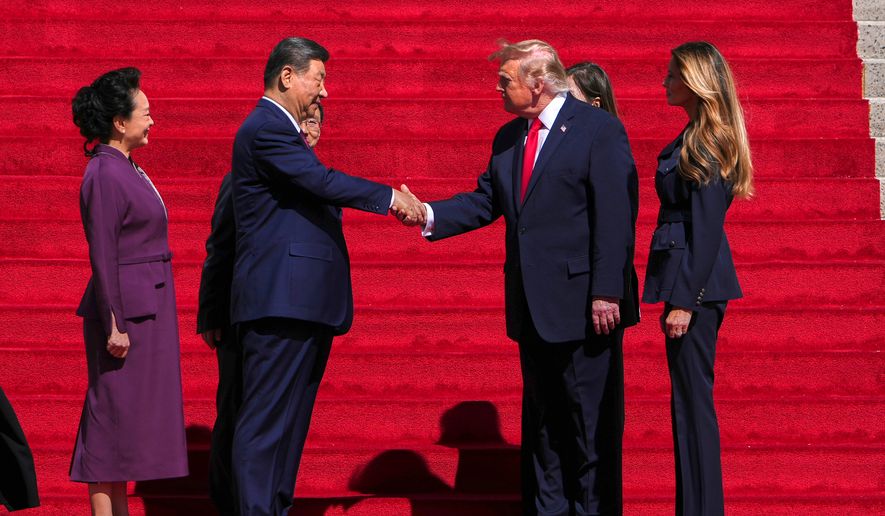
Others said the president’s use of Washington pomp and pageantry showed he understands Mr. Xi better than most observers have given him credit for.
“I think it was clearly, really about optics with President Trump trying to give Xi a little of what he wanted in terms of political theater and outward shows of respect,” said Drew Thompson, a senior fellow at the S. Rajaratnam School of International Studies at Nanyang Technological University in Singapore. “That is important for Xi: It is political capital that shows peers and potential competitors in the party that he is being treated as an equal.”
However, Mr. Thompson, a former director for China, Taiwan and Mongolia in the U.S. Department of Defense, reckoned that Taiwan “came out quite well.”
“There was so much messaging from China in advance on how hard Xi would push, and that is consistent with previous meetings — China always raises Taiwan at all meetings, at all levels,” he said. “Trump held firm, he did not budge and did not say anything out of hand.”
Brookings Institute expert Michael O’Hanlon agreed in a written analysis.
Referencing reports stating that Mr. Xi had pressed Mr. Trump to take a stance against eventual Taiwanese independence, Mr. O’Hanlon wrote, “Trump appears to have declined; acceding to Xi’s request would have been a unilateral American concession.”
A central issue — for Taiwan and for China — is a frozen $14 billion U.S. arms package for the island.
The delayed weapons delivery has given ammunition to Taiwan’s main opposition party, the Kuomintang, or KMT, at the expense of the ruling Democratic Progressive Party, or DPP.
“The KMT is more U.S. skeptical of the U.S. while the DPP hold a favorable view, and the KMT are saying the U.S. did not fulfill its promises on the arms sale,” said Taipei-based Marcin Jerzewski, who heads the Taiwan Office of the European Values Center for Security Policy. “Observers in Taipei have been watching this very carefully, after Trump said that arms sales were a bargaining chip in his summit in Beijing in May.”
Mr. Thompson thinks Mr. Trump wants to maintain negotiating room in upcoming summits. He expects the administration to pass the arms deal after the APEC Summit, set for Shenzhen, China, in November, and the G20 Summit, set for Miami, Florida, in December, have been concluded.
“Once we get through the G20 and APEC I would expect to see the administration notify Congress of the Taiwan arms sale — there is pressure on Trump to do it, congressional pressure, and financial benefits,” he said. “The reality is that, by acting with restraint he gains nothing from Xi, so he has no incentive to not make the sale.”
Mr. Jerzewski agreed, saying “There is not a lot of fear that this deal will not go through.”
Regarding the brouhaha over U.S. Ambassador to China David Perdue’s statement that Mr. Trump had offered to sell arms to China — which Mr. Trump subsequently denied — Mr. Thompson shrugged it off.
“It is fairly clear that the ambassador misspoke, I think it was a Freudian slip, it happens,” he said. “These are very long media interviews not short hits.”
Mr. Jerzewski, however, questioned Mr. Trump’s negotiating style.
“It raises questions about U.S. deterrence,” he said. “Taiwan is concerned about how Trump exercises U.S. discourse power.”
Mr. Jerzewski pointed to the cavalier way Mr. Trump treated the history of America fighting alongside China in World War II. While the U.S. was, indeed, allied with China during that struggle, China itself was divided. America’s ally was Chiang Kai-shek’s nationalists, rather than Mao Zedong’s communists.
Post-World War II, Mr. Chiang’s nationalists fled to Taiwan and established a government, while Mr. Xi, in Beijing, is in a direct line of power from Mr. Mao.
For Chinese and Taiwanese, these matters speak volumes.
“A very trendy term among people in the ‘China Bubble’ is ‘discourse power’ — a Chinese term that refers to framing debates and controlling narratives,” Mr. Jerzewski said. “I think the fact that Trump put equal significance on the Republic of China and the Peoples Republic of China is a huge win for China’s discourse power projection.”
The matter “triggered some sensitivities in Taipei,” he said.
The ruling DPP, which takes a hard line against Beijing and promotes a Taiwanese identity, has sought to distance itself from a Chinese identity. As a result, the summit granted Beijing “a very effective tool for poking Taiwan.”
Others agreed. Brookings Institute Fellow Mireya Solis wrote, “This summit spoke volumes, in ways that undercut U.S. partners and allies — for its intangible elements: optics, narratives, and signaling.”
Per discussion of the arms package, many analyses focus on the hard-power realities that involve going head-to-head with the Peoples’ Liberation Army in combat.
Despite its size and vast armory, the PLA’s last combat experience — a land-sea battle with Vietnam in the Spratly Islands — was in 1988. However, it has plentiful experience of gray-zone, hybrid war, in domains ranging from sub-threshold maritime moves in the South China Sea, to cognitive war in the Chinese-language information space.
That is on Mr. Jerzewski’s radar.
“We should not only prepare for a full-scale, kinetic invasion; there will be many steps before we get there,” he said. “There is a lot of work to do on cognitive warfare, so I am more concerned about soft-power considerations.”
Contact the author

Please read our comment policy before commenting.