


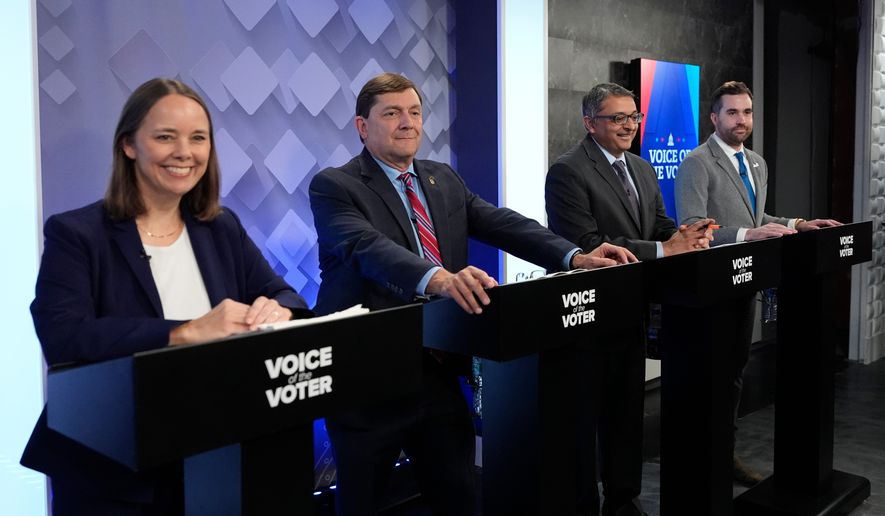

Debate season is about to pick up speed, at least in the states where candidates have agreed to take the stage.
From the Northeast through the Midwest, voters are about to get a rare, side‑by‑side look at contenders who have mostly sparred from a distance in TV ads, at rallies and in the press.
In Maine, Republican Sen. Susan M. Collins and Democrat Troy Jackson are diving into a rapid‑fire stretch of four debates in 10 days: Tuesday, then Oct. 8, Oct. 13 and Oct. 15.
People were interested in these podcasts
Ms. Collins, chair of the powerful Senate Appropriations Committee, is seeking a sixth term. Mr. Jackson, a former state Senate president, is still trying to prove he’s ready for primetime after stepping in after Democratic nominee Graham Platner dropped out following a rape allegation.
A recent CBS News poll shows the challenge ahead: 53% of Democrats and independents said they wished someone else were the nominee, even as Mr. Jackson tries to tie Ms. Collins to President Trump, who placed behind then-Vice President Kamala Harris in Maine two years ago.
The first debate also lands on the eighth anniversary of Ms. Collins’ vote to confirm Justice Brett M. Kavanaugh to the Supreme Court — a moment that helped set the stage for the overturning of Roe v. Wade and angered many Democrats. CBS found 61% of Maine voters disapprove of that decision. Polls show the race is a toss‑up.
Iowa gets its turn Wednesday, when Republican Rep. Ashley Hinson and Democratic state Rep. Josh Turek meet for their first debate on Iowa PBS. Their second debate is set for Oct. 13. They are running to replace retiring Republican Sen. Joni Ernst.
Michigan follows Thursday: Democrat Abdul El‑Sayed and Republican former Rep. Mike Rogers will share a studio in Grand Rapids for the first of two debates, with the second scheduled for Oct. 21 in Detroit. They are running to replace Democratic Sen. Gary Peters, who is not seeking reelection.
Also on Thursday, Democratic Sen. Jon Ossoff and Republican Rep. Mike Collins face off in Georgia.
And next week keeps the momentum going. Republican Sen. Dan Sullivan and Democrat former Rep. Mary Peltola debate Thursday in Alaska. Republican Michele Tafoya and Democratic Lt. Gov. Peggy Flanagan meet Friday in Minnesota. They are battling to take over the seat of Democratic Sen. Tina Smith, who is retiring.
All of this comes as campaigns weigh the risk‑reward of stepping onto a debate stage.
The upside is a chance to command the room and rebut attacks in real time. The downside is that a shaky answer or cringeworthy moment can dominate coverage and shift a race overnight. Front‑runners often decide the risk isn’t worth it; challengers usually see debates as one of the few chances to change the trajectory of a race.
Elsewhere, debate season is far murkier.
In Texas, Democrat James Talarico says he’s accepted multiple debate invitations — including one from Fox News — and has pressed Republican Ken Paxton to join him. Mr. Paxton, the state attorney general, hasn’t committed to any debates.
Ohio and North Carolina are in similar holding patterns.
Neither Democratic former Gov. Roy Cooper nor Republican nominee Michael Whatley have agreed to a debate in North Carolina. Republican Sen. Jon Husted and Democratic former Sen. Sherrod Brown also have yet to lock in a debate in Ohio.
All of this is unfolding in a tough political environment for Republicans. Polls show Mr. Trump’s approval rating is underwater, and voters are frustrated with the cost of living, including high gas prices tied to the Iran war. That has Democrats eyeing long‑shot opportunities in deep red states such as Kansas and South Carolina.
Republicans currently hold a 53-47 Senate majority. Democrats need a net gain of four seats to reclaim the chamber.
Please read our comment policy before commenting.