



PYEONGTAEK, South Korea — Behind razor-wire-topped walls, under cover provided by a Patriot missile battery, Camp Humphreys, 40 miles south of Seoul, is America’s biggest overseas military base.
Helicopters buzz constantly over the sprawling facility — which could accommodate 29 Yankee Stadiums — while top brass huddles in command posts.
The base, home to as many as 28,000 American troops, provides key command, training and depot facilities to soldiers tasked with deterring North Korea. But it, and two sister installations on South Korea’s Yellow Sea coast, also offer America proximate eyes on China.
People were interested in these podcasts
A U.S. public affairs official calls it the “center of gravity” of the Seoul-Washington alliance. That partnership, which has endured since the Korean War ended in 1953, has hit some turbulence of late.
Seoul’s progressive Lee Jae-myung government is determined to regain wartime operational control — “OPCON Transfer” — of South Korean troops from the U.S. by 2030.
Experts warn that will kill the current joint command structure and possibly trigger reductions in America’s only bootprint on the Asian mainland.
U.S. Defense Secretary Pete Hegseth and South Korean Defense Minister Kang Shin-chul addressed these knotty issues in the Philippines Wednesday on the sidelines of a regional defense forum.
The two agreed that an annual bilateral dialogue, the Security Consultative Meeting, expected in December, would be postponed to early 2027 to give negotiators time to find common ground.
‘Little America’ on the Yellow Sea
Camp Humphreys is named for Benjamin Humphreys, a U.S. helicopter pilot who died in a 1961 crash.

On the edge of Pyeongtaek town, the base was activated as the home for U.S. Forces Korea in 2018. Its $11 billion price tag was 90% paid for by Korean taxpayers.
The three key U.S.-led headquarters on-site are USFK; the United Nations Command — covering those nations that deployed in the Korean War; and Combined Forces Command, or CFC — tasked to lead South Korean and U.S. forces in war.
Were it not for the uniforms and 7- and 12-story barracks, it could be a small U.S. town.
Its commissary is a huge store; brands like Burger King and Popeyes offer familiar stateside staples; four schools educate the troops’ children. All facilities are decked out in ghostly paraphernalia ahead of Halloween.
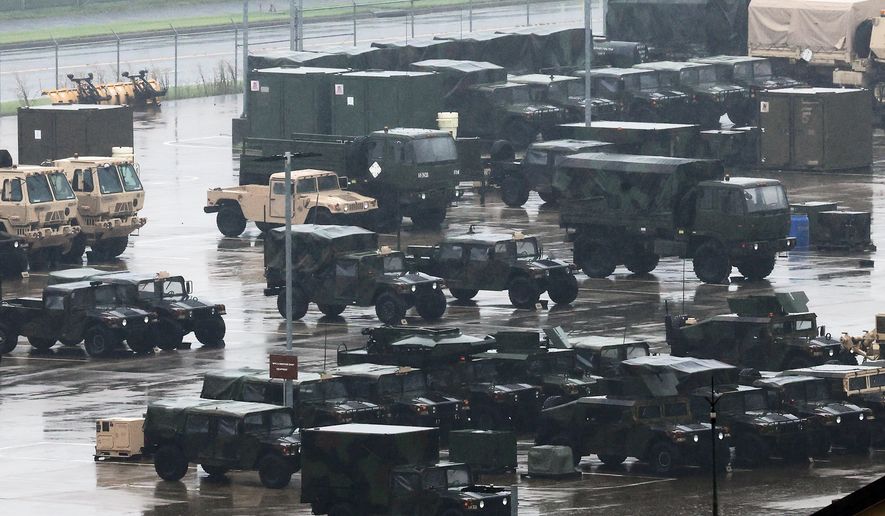
Still, the Olympic-size pool, cinema and 18-hole golf course do not camouflage a mission delivered by huge vehicle parks, a humming airfield and high-tech training facilities.
Foreign reporters on Wednesday were shown some.
They were briefed, at poolside, on training modules that teach how to egress helicopters shot down in water, courtesy of mock cockpits lowered under the surface.
At an indoor range, they fired at electronic targets, and “flew” a helicopter flight simulator.
One module proved harrowing. Medical manikins, complete with blood-filled veins, heartbeats and skins bearing replicated combat wounds, train triage and first aid. Their location — cellar-like chambers drenched in red and green light — echoes to sounds of simulated battle.
So advanced are Humphreys’ facilities — which include a “Mud Room” and a store of Russian weapons — that foreign units fly in to train, a sergeant briefed.
Humphreys, in the south, in many ways represents the distillation of America’s pullback from the peninsula frontlines, from the DMZ and Seoul.
The only U.S. troops close to North Korea today are a security battalion at the DMZ village of Panmunjeom, and 2nd Infantry Division, south of the DMZ. 2ID is at brigade strength.
These days, South Korean forces are responsible for forward defense.
Humphreys at Pyeongtaek; a drone-air base at nearby Kunsan; and an Air Force-Space Force base at Osan; all face China across the Yellow Sea.
This conglomeration, combined with the South Korean naval base at Pyeongtaek – frequently visited by U.S. warships - offers full-spectrum capabilities: land, sea, air, space, cyber, intelligence.
It is impressive. But it is overshadowed by larger issues.
An uncertain future
OPCON Transfer was initiated by the Roh Moo-hyun administration, in office from 2003-2008. It has proceeded lethargically, but Mr. Lee accelerated matters, aiming for completion before his term ends in 2030.
Progress is bumpy. Seoul has been irked by USFK Commander General Xavier Brunson, who has stated that preconditions for OPCON Transfer — which are not public — are shifting, and has advised against setting a date.
Amid widening political rifts, experts are alarmed.
Two U.S. generals who formerly commanded USFK, who spoke at an online forum on Tuesday, and two Korean experts approached by this newspaper, all believe OPCON Transfer will impact the alliance.
CFC is considered a model war-fighting headquarters. Unlike the case for U.S. Forces Japan, a single command leads both militaries. But it is anticipated that, once OPCON shifts, the U.S.-led CFC will be collapsed.
“OPCON Transfer is a concern because it is now a political, not a military issue,” said Shin Kyoung-soo, a retired general. “One thing is clear: CFC will not be continued.”
“That whole combined nature goes away,” retired U.S. Gen. Walter Sharp told a symposium hosted by the Institute for Corean-American Studies and reported by Korean media.
Washington has historically been reluctant to place GIs under foreign command for anything other than short-term operations. Few expect Washington to place USFK, 28,500 strong, under a Korean general.
“The U.S. is too proud to be commanded by a foreign country,” said Yang Uk, a security specialist at Seoul’s Asan Institute.
Another issue is ISR: intelligence, surveillance and reconnaissance. Seoul currently lacks the necessary capabilities to take the lead.
“Our command-and-control capability is a dog-and-pony show!” said Mr. Yang. “In the U.S, C&C is like 5G telecoms trying to be 6G, but Korea’s C&C network is 3G, at most.”
As an example, he cited Seoul’s lack of a closed, dedicated frequency for military drones.
U.S. ex-general Paul LaCamera suggested any headquarters replacing CFC will lack current efficiencies.
“We will probably make it suboptimal, because that is what we can agree to,” he said online.
These issues could lead Washington to slash force size in Korea.
“I really do see it as a doorway to greatly reducing the alliance, greatly reducing our work with Korea,” Gen. Sharp said.
South Korea sits at the junction of China, North Korea and Russia’s Far East, Gen. Brunson has spoken extensively on why this strategic geography makes Korea makes an excellent power-projection platform for regional U.S. operations.
An off-record source suggested that this advocacy aims to ensure Korea remains a four-star command, as well as an Army command in a region dominated by Navy and Marines.
But Washington, too, is downplaying USFK’s original mission. Deputy Under Secretary of War for Policy Elbridge Colby has repeatedly called China, not North Korea, America’s “pacing threat.”
“If USFK doesn’t have a more specific job — say, against China, which Brunson wants — there is no reason for such a big force here,” said Mr. Yang.
Such talk raises Korean hackles. Seoul fears that the U.S., engaged in hegemonic competition with China, could drag it into a confrontation it does not seek with its giant neighbor.
Seoul’s stance contrasts with Tokyo’s. Japan, where twice as many U.S. soldiers are based, is more suspicious of China, supportive of Taiwan and engaged in regional operations.
“We need to understand USFK’s need for strategic flexibility,” Gen. Shin suggested. “There might be discussions on that in the near future.”
If neither Seoul nor Washington budges, America could lose out.
“China really wants U.S. forces out, as Korea is a big dagger against China’s throat,” said Mr. Yang. “If the U.S. wants to throw that away, it would be their loss.”
John T. Seward, reporting from Manila, contributed to this article.
Contact the author

Please read our comment policy before commenting.