


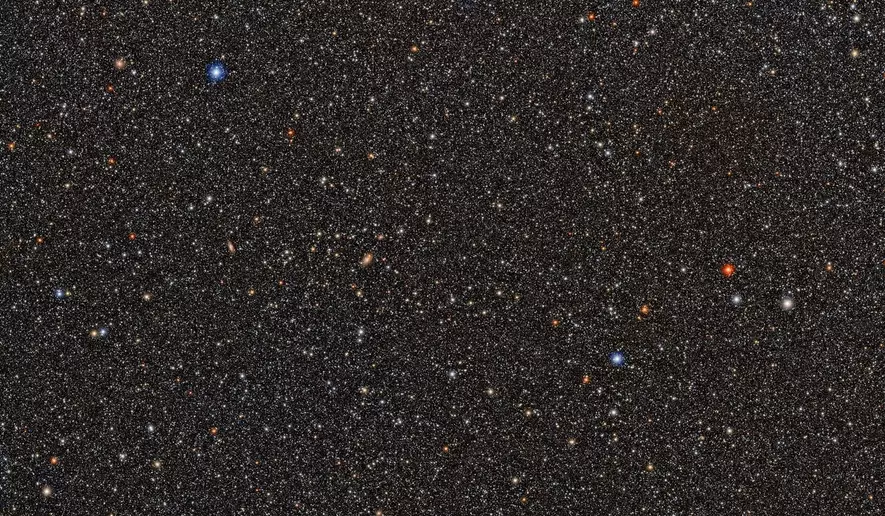

Scientists have identified a possible new dwarf planet orbiting the Sun beyond Pluto, which would be the sixth dwarf planet confirmed in the solar system.
The Chile-based Vera C. Rubin Observatory, funded by the National Science Foundation and the U.S. Department of Energy, said Tuesday that they found a “large, bright trans-Neptunian object” that is provisionally being called 2026 ED138.
Observatory operations team member Matthew Holman noticed the size and brightness of ED138 on Oct. 13 while going through data taken by the observatory’s telescope earlier this year.
People were interested in these podcasts
“My first reaction was one of excited disbelief. Objects like this are very rare, so I immediately started checking whether I or the code had done something wrong,” Mr. Holman said.
A subsequent search of additional telescope data showed ED138 appearing 30 times on 20 nights between March 4 and July 11, the observatory said.
The estimated size of ED138 is between roughly 372 miles and 932 miles in diameter. It is about 46 astronomical units away from the sun, where one unit is equivalent to the average distance between Earth and the Sun, almost 93 million miles. By comparison, Pluto is orbiting at a distance of about 40 astronomical units on average, the observatory said.
If it is confirmed by the International Astronomical Union as a dwarf planet, ED138 would be the solar system’s sixth.
According to NASA, the other five are: Pluto; Ceres, in the asteroid belt between Mars and Jupiter; Haumea and Makemake, which, like Pluto, are part of the Kuiper Belt of icy celestial bodies that orbit past Neptune; and Eris, which orbits the Sun past both Neptune and the Kuiper Belt.
NASA Administrator Jared Isaacman said in April that Pluto should be restored it to its former position as the ninth planet in the solar system. The International Astronomical Union downgraded Pluto to dwarf planet status in 2006 after determining that its gravity was too weak to clear similarly sized celestial objects out of the path of its orbit.
Please read our comment policy before commenting.