



JACKSONVILLE, Fla. — Florida voters will have the chance to lower their property taxes Tuesday with a history-making ballot question that has bitterly divided the state.
Amendment 3 would raise the state’s homestead exemption substantially in the state’s 67 counties, giving those who own and live full time in their homes a significant break on property taxes that have climbed dramatically in the past decade.
But residents smarting over high property tax bills who are eager to check “yes” on Amendment 3 are facing threats from police, firefighters and county officials.
People were interested in these podcasts
First responders warn homeowners that their tax savings from Amendment 3 will lead to billions in lost revenue and force counties to cut services, potentially leading to longer wait times for police and firefighters in emergencies.
“It’s going to have a dramatic impact on our community and the services we provide if it’s passed,” Tampa Mayor Jane Castro said in a recent press conference opposing the amendment.
Polk County Sheriff Grady Judd called Amendment 3 “a train wreck” that doesn’t ensure funding for county services, which rely almost exclusively on property taxes.
Homeowners aren’t buying their threats. Property tax revenue in the state has risen by more than 100% over the past decade.
“We need elected officials who can figure out where to cut spending and work with what they have. If any one of us lost a source of money, we have to change our spending and work with an updated budget!” Michelle Amerson, of Jacksonville, posted in a Facebook debate on the topic.
If the amendment passes, Florida voters will be among the first in the nation to slash their own property taxes.
Property tax reductions are on the ballot in six other states, but none moves as aggressively as Florida to get rid of them entirely.
Wyoming voters will decide whether to impose a homestead exemption on 50% of a primary residence’s assessed value. The ballot in North Carolina will ask voters whether to compel the state legislature to set caps on property tax increases. In Oklahoma, voters will decide whether to reduce the cap on taxable property values.
Florida’s ballot question is gunning for zeroing out all non-school property taxes.
In addition to expanding the homestead exemption, Amendment 3, if passed, would require the Florida legislature “to prescribe a uniform procedure” for local governments to increase the homestead exemption “up to full assessed value,” if they choose.
Much of Florida’s property tax revenue surge happened during the COVID pandemic, when home values in the state began to skyrocket following a significant influx of new residents fleeing blue state lockdowns.
The higher property appraisals led to big windfalls for county governments, and their spending increased right along with it, far exceeding population growth.
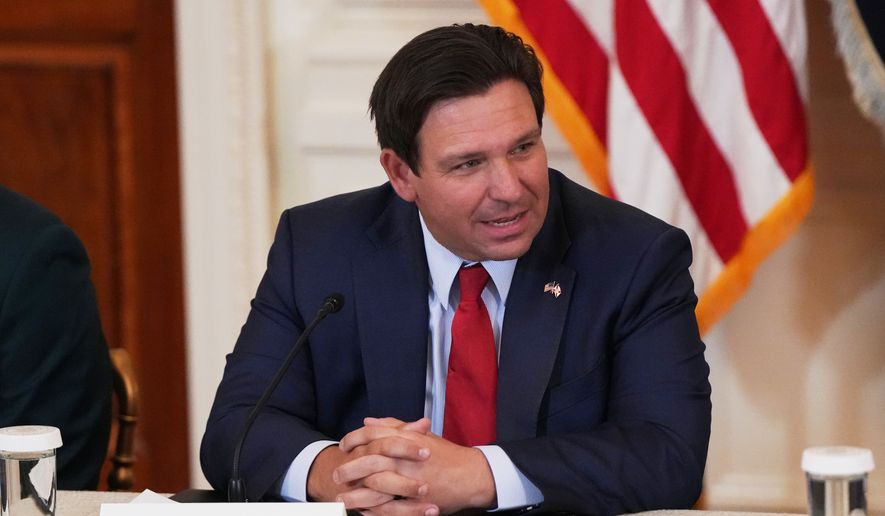
Florida Gov. Ron DeSantis, the leading proponent of getting rid of property taxes, said Florida’s local jurisdictions collected $62 billion in property taxes this year, up from $33 billion in 2019.
Mr. DeSantis, limited to two terms, is seeking to usher through the tax cut in his final year in office and amid speculation he will attempt another presidential run in 2028.
He has pushed back on the threats from counties claiming they won’t be able to provide essential services if the amendment passes.
The amendment requires local governments to spend the money only on essential services such as public safety and infrastructure. The tax break completely excludes property taxes directed at school funding.
“You are seeing a lot of local governments basically coming out and trying to tell people that the sky is gonna fall,” Mr. DeSantis, a Republican, said at a roundtable event in Miami. “Did we not have a fire department in 2019? Did we not have police in 2019?”
Opposition to Amendment 3 has intensified as Election Day nears. Many police and firefighter organizations oppose it, including the Florida Fire Chief’s Association, Florida Professional Firefighters and the Florida State Fraternal Order of Police.
Several Republican state lawmakers have flipped from supporting the amendment to opposing it, among them Senate President Ben Albritton, who voted earlier this year to put Amendment 3 on the ballot.
He said this week he will vote “no” because the tax break “would eliminate up to 30% of resources from Florida’s rural counties, gutting essential support for law enforcement, emergency response services and critical infrastructure.”
The amendment requires 60% voter approval to pass. It would increase the exemption for non-school taxes from $50,000 to $150,000 of assessed value in 2027 and expand the exemption to $250,000 in 2028. The homestead exemption would be adjusted for inflation in future years. Counties could continue to hike the exemption to eventually eliminate all of the tax.
Economists project Amendment 3 would cut property tax revenue by $13.7 billion in the first two years alone.
Mr. DeSantis and other proponents of Amendment 3 said the state will fill any critical budget gaps in rural areas and other local governments through grants, but the language of the amendment doesn’t address funding shortfalls.
About 36% of property tax revenue in Florida’s counties comes from homeowners who would qualify for the Amendment 3 tax break. The rest comes from homes that do not qualify for the tax break, such as vacation homes and rentals, as well as commercial and investment properties.
Mr. DeSantis began building his case for a property tax cut by establishing the Florida Department of Government Efficiency, led by Chief Financial Officer Blaise Ingoglia.
Mr. Ingoglia flagged nearly $2 billion in “excessive, wasteful spending,” including $75,000 spent by the city of Jacksonville on a hologram of Mayor Donna Deegan and $7.5 million the city spent on a mile-long sidewalk project.
Broward County officials, Mr. Ingoglia said, spent nearly $900,000 on DEI training since 2020, while Pensacola officials shelled out $150,000 to a management company that brought a drag queen show to the city theater.
Mr. DeSantis said he cut the state’s budget four years in a row and reduced the workforce, all while the population grew by more than half a million people. Local governments are also capable of finding savings, he said last week.
Counties and cities will collect $3 billion in revenue in 2028-2029, compared to $2.2 billion they collected in 2021-2022, Mr. DeSantis said Tuesday at a property tax roundtable in Tampa, asking those in the room, “Are we honestly saying we can’t make that work?”
Contact the author

Please read our comment policy before commenting.