



OPINION:
There is a particular kind of American fatigue that does not show up in a thermometer or a blood test — but a pollster can find it in about four questions.
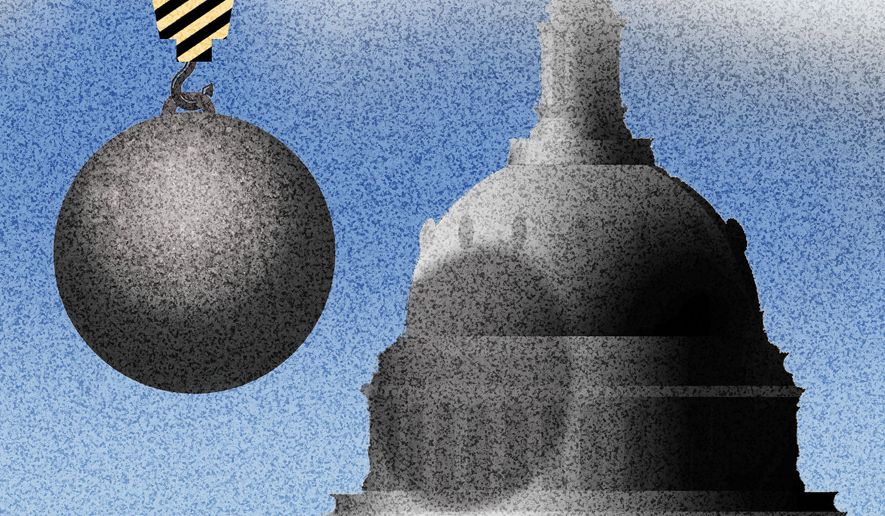
According to a new survey from The Associated Press-NORC Center for Public Affairs Research, roughly 8 in 10 voters believe that the country needs “substantial change” or “complete and total upheaval” in how it is run. Three in 10 want the full upheaval — not a tuneup, not a reorganization chart, but a wrecking ball.
That’s not a protest vote. That’s a renovation show where the hosts walk into the kitchen on day one and just start swinging sledgehammers.
People were interested in these podcasts
What makes this poll remarkable isn’t that people are mad — Americans are perpetually, constitutionally mad, and it’s basically a national pastime alongside baseball and complaining about the weather. What’s remarkable is how evenly the madness is spread.
This is not a partisan grudge match where one side seethes and the other high-fives. Even among Republicans, whose party currently holds the White House and Congress, 45% want substantial change and another 13% are ready to torch the blueprints entirely.
When you have voters cheering for the team that is technically winning and still demanding a trade, something has gone sideways in the locker room.
Diana Walker, a 65-year-old Democrat from Georgia, put it about as plainly as anyone could: “The world is going backwards. We can barely afford anything. Everybody’s down. I don’t care if you’re a Democrat or Republican, we’re all catching hell,” she told the AP. That’s not spin from a campaign consultant — that’s a grocery receipt talking.
And the receipts, as it happens, are the whole ballgame. Eighty-five percent of voters say the economy is a top issue heading into the midterms, and 84% say the same about the cost of living, numbers so close they’re basically holding hands.
President Trump returned to office promising to wrestle prices back down, and the poll suggests that voters think he has lost that match in straight sets. Nearly 8 in 10 disapprove of his handling of the cost of living, and about three-quarters disapprove of his economic stewardship overall.
Even inside Mr. Trump’s own party, only 44% approve of how he’s handling living costs — a figure that should make any White House communications team reach for the aspirin.
Krista Kohles, a 70-year-old Republican from Nebraska, captured the GOP’s quieter rebellion: “I’m kind of tired of sending people there and nothing gets done. Nothing’s changing.” It is the political equivalent of being loyal to a restaurant while acknowledging that the food has gotten worse.
Then there is the war with Iran, grinding into its eighth month after Mr. Trump promised that it would wrap in four or five weeks — a timeline that aged about as well as unrefrigerated milk. Sixty-four percent of voters call it a top issue, outranking immigration and crime, each at 45%.
DonnaJean Weber, a 72-year-old Republican from Michigan, said she will keep voting Republican but is not thrilled: “Everything’s going up. I don’t agree with him fully on all of these tariffs, either. It’s making this country look bad,” she told the AP.
Here is the part that should really keep strategists up at night, though: None of this frustration has translated into Democrats being popular. Only about 4 in 10 voters view the Democratic Party favorably, barely edging out the 36% who favor the GOP. Nobody is throwing a parade for either side.
Michael Russo, an unaffiliated Texas voter, summed up the vibe with the kind of bluntness that does not poll well but tracks perfectly. Asked whether he wants Republicans to keep control of Congress, he said, “No, I want them in prison — several of them.”
As for the Democrats riding to the rescue? “I’m not confident they’re going to do anything if they get into power.”
Despite that, Democrats hold a modest edge heading into November — 47% of voters want them running the House, and 46% want them running the Senate, compared with 38% who would keep Republicans in charge of either chamber. Fifteen percent remain undecided, which, in a country this evenly, furiously split, is basically a loaded gun sitting on the table.
Maybe the most telling number in the whole poll is not about either party at all. Two-thirds of voters say they are pessimistic about the state of American politics. Only about 1 in 10 say they feel optimistic. That is not a mandate for either team’s agenda; it is a vote of no confidence in the entire stadium, scoreboard included.
Washington loves to talk about “listening to voters.” This time, voters are not whispering. They are handing over a demolition permit and asking who is bringing the sledgehammer.
• Joseph Curl has covered five American presidents over nearly four decades at The Washington Times. He can be reached at jcurl@washingtontimes.com.
Follow the author

Please read our comment policy before commenting.