



A version of this story appeared in the daily Threat Status newsletter from The Washington Times. Click here to receive Threat Status delivered directly to your inbox each weekday.
SEOUL, South Korea — North Korea’s new ties to Russia have been well reported, but Kim Jong-un apparently is not the only Korean leader cozying up to Russian President Vladimir Putin.
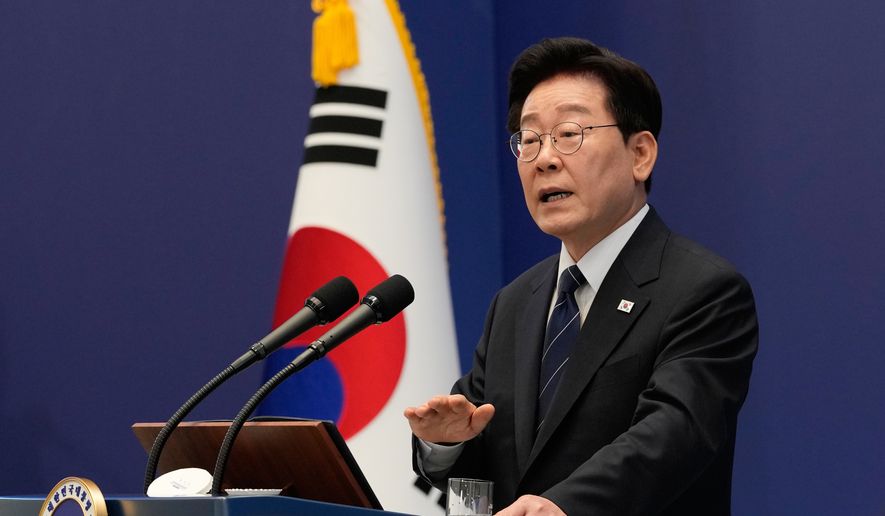
The administration of South Korean President Lee Jae-myung has surprised international analysts in recent weeks with a series of moves that signal warming relations with Moscow, including South Korea facilitating the sale of Russian fuel, a new trade route deal using Russia’s Arctic sea lanes and an escalating diplomatic feud with Ukraine.
In hindsight, given previous statements and actions, Mr. Lee’s Russian lean could have been anticipated.
People were interested in these podcasts
President Lee’s lean
On Sept. 23, Ukrainian President Volodymyr Zelenskyy revealed at the United Nations General Assembly that Kyiv had transferred two North Korean prisoners of war — who, while fighting alongside Russia, were captured by Ukrainian troops — to South Korea.
On Sept. 24, Mr. Lee accused Mr. Zelenskyy of breaching a bilateral confidentiality agreement on the transfer.
Analysts in Seoul reckoned Mr. Lee feared the relatives of POWs would suffer collective punishment if they defected, but media outlets had revealed their faces months earlier.
On social media, Mr. Lee accused Mr. Zelenskyy of trying to instigate an inter-Korean clash.
The South Korean Foreign Ministry subsequently acknowledged to local media that no written confidentiality agreement existed, but Mr. Lee demanded an apology.
Kyiv did not satisfy Seoul’s demands, leading Seoul to withdraw its ambassador and reduce its embassy staff.
It was not Mr. Lee’s first verbal attack on the Ukrainian leader.
During a televised debate in Seoul in February 2022, just three days after Russia’s invasion of Ukraine, Mr. Lee said, “A novice politician of six months became president and declared [Ukraine’s] accession to NATO, which provoked Russia and eventually led to a clash.”
After Mr. Lee became president in June 2025, he toned down public skepticism toward Mr. Zelenskyy.
Speaking at the July 7 NATO Summit in Ankara, Turkey, he said, “Safeguarding democracy, freedom and peace is not the responsibility of any one country alone.” He added that Korea “will be your most trusted partner.”
That was likely a reference to the arms Seoul has sold to Europe, but not to Ukraine, and to his ambition to make Korea the world’s No. 4 arms exporter.
Poland, firmly aligned against Russia, has been the biggest single arms buyer from Korea since the Ukraine War began. Other anti-Russian procurers of Korean weaponry in Europe include Croatia, Estonia, Finland, Norway and Romania.
The idea that Mr. Lee is enlisting Russia’s help to thaw South Korea’s icy relations with North Korea, which is engaged on the Kremlin’s side against Kyiv, is likely unsettling for these countries.
Further complicating Mr. Lee’s arms sales ambitions may be a key personnel appointment.
One day before he demanded an apology from Kyiv, on Oct. 1, Mr. Lee named veteran politician Song Young-gil as his adviser on “peace and diplomacy.”
Mr. Song is noted for his links to Russia. In 2013, he was decorated by Mr. Putin for advancing Moscow-Seoul relations, and in 2017, he served under the liberal Moon Jae-in administration as special envoy to Moscow.
Access to the Arctic
Before his elevation of Mr. Song and the row over the POWs, Mr. Lee had noted approvingly a pioneering voyage undertaken by a South Korean vessel.
On Aug. 22, a container ship left port in Busan for Europe on a course that took it eastward, northward, then westward. It cruised the length of Russia’s northern littoral before docking at the British port of Felixstowe on Sept. 12, followed by stops in the Netherlands and Poland.
It was the first time a South Korean vessel had transited the Northern Sea Route, also known as the Arctic Route, to Europe.
The route cuts Asia-Europe sea voyage times by 30% to 40%. Ice had previously rendered it non-navigable for most of the year, but climate change is making it increasingly navigable.
It runs almost entirely within Russia’s Exclusive Economic Zone, granting Moscow potentially valuable leverage via access control. Some worry that expanded use of the route will empower the Kremlin.
At an Oct. 13 ceremony in Busan celebrating the voyage, Mr. Lee called the transit “a meaningful challenge.”
He pledged that Korea “will move to open the Arctic Ocean route” and will “thoroughly abide by international norms and principles on sanctions while communicating sufficiently with key countries for cooperation.”
Just days earlier, news had broken of a different — and more secretive — format of Korea-Russian cooperation.
An Oct. 6 investigation by Britain’s Guardian newspaper found that in July and August — amid Ukrainian attacks on Russian refiners — South Korean vessels had transferred more than 194,000 tons of fuel, via ports and at sea, to seven Russian vessels, including ships sanctioned by the European Union and Britain.
Seoul said the transfers were not illegal but it was investigating. Kyiv responded with anger.
Motivations unclear
Experts are puzzled by Mr. Lee’s moves.
“It is hard to make sense of it, to think of it as a coherent strategy,” said Dan Pinkston, a Seoul-based international relations professor with Troy University. “Is it personal?”
As for whether Mr. Lee seeks Russian help in reopening doors to Pyongyang, Mr. Pinkston remained dubious.
“I think that’s fantasy,” Mr. Pinkston said. “Is it long-term and sustainable? Does South Korea want to hitch its wagon to Russia?”
Post-Cold War, bilateral ties have expanded swiftly, particularly as Russia is a proximate energy exporter to South Korea, a net importer. Even today, Russians require no visas to visit South Korea and have a direct ferry link via Vladivostok.
“Historically, Korea was the friendliest of U.S. allies to Russia,” said Fyodor Tertitskiy, a Moscow-born historian with Seoul’s Korea University.
Yet, bilateral commerce was never massive: In 2020, Russia was just South Korea’s 10th-largest trading partner. That suggests personal issues are at play.
“President Lee has a liking for authoritarian leaders like Putin and [Chinese President] Xi [Jinping],” Mr. Tertitskiy said. “And he would be ecstatic to meet Kim Jong-un — if he could.”
At a time when Seoul-Washington ties are frayed over a stalled Korean investment pledge and disagreements over the transfer of wartime operational control of South Korean troops to sovereign command, Mr. Lee’s stance aligns him — likely coincidentally — with Washington.
President Trump has demanded that Ukraine hold an election, potentially unseating Mr. Zelenskyy.
Elsewhere, Mr. Lee’s strategic thinking may be blinkered.
“The consensus within the South Korean foreign policy community seems to be that Lee wants to preserve his strategic space,” said Rob York of Hawaii-based think tank Pacific Forum. “He wants to continue selling weapons to Europe … however, he reserves the right to expand ties with Russia.”
A major question overhangs that.
“The question,” Mr. York said, “is whether European nations will hold Lee’s government accountable for his hedging.”
One European diplomat, speaking off-record, offered an answer.
“There is quite a bit of concern and a bit of dismay, about the approach Korea is taking,” the diplomat said. “It could sew questions in the minds of those who make procurement decisions, which are usually based on geopolitics.”
Another risk implicit in Mr. Lee’s stance is Korean firms being written out of lucrative Ukrainian post-war reconstruction contracts.
Still, not all share the South Korean president’s seemingly antagonistic view of Mr. Zelenskyy and the Ukrainians.
South Korean construction giant Ssangyong Engineering and Construction has dug bomb shelters for Ukrainian schools, constructed a hospital for children who have lost limbs and replaced windows blown out of apartments.
These humanitarian activities were undertaken independently of Seoul, in conjunction with a charity headed by U.S. actor Sean Penn.
Contact the author

Please read our comment policy before commenting.