


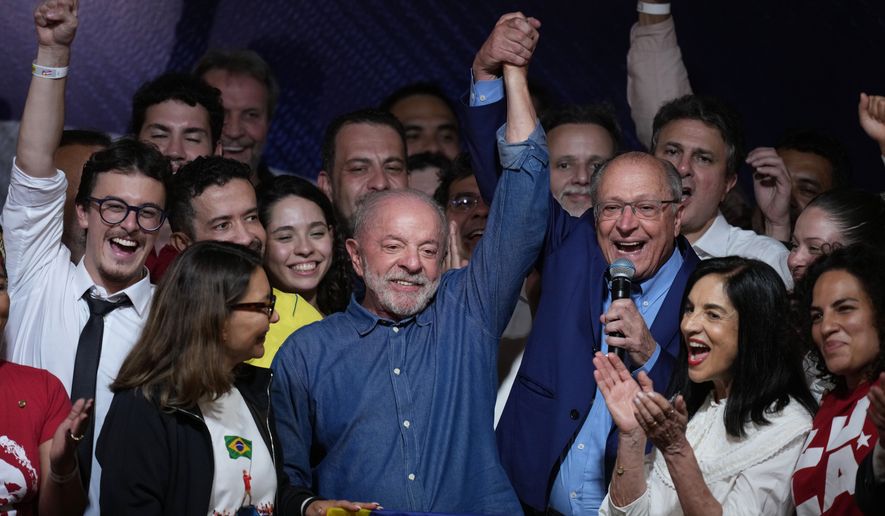

Brazil’s left-wing president, Luiz Inacio Lula da Silva, won a fourth term on Sunday, defeating conservative challenger Flavio Bolsonaro after a close race and reversing a rightward shift in South American politics.
Mr. Lula took just over 51% of the vote in the weekend’s runoff, winning about 4 million more votes than Mr. Bolsonaro. Brazilians went to the polls earlier this month, but neither candidate secured the majority of the electorate.
The victory marks Mr. Lula’s fourth presidential victory after serving two terms as president from 2003 to 2010 before returning to office in 2023.
People were interested in these podcasts
Mr. Bolsonaro, the son of convicted former president Jair Bolsonaro, won the first round Oct. 4, taking 47% of the vote, compared to Mr. Lula’s 45%.
About 3 million more Brazilians voted on Sunday than in the first round. According to reports, Mr. Lula received around 10 million new votes on Sunday from voters who had supported losing candidates in the first round or did not vote previously.
The younger Mr. Bolsonaro has refused to recognize Mr. Lula’s victory publicly and is calling for the results to be annulled. He also harshly criticized the Brazilian Supreme Court for extending voting for several hours, calling it a “dirty trick.”
Mr. Bolsonaro’s Liberal Party also challenged the presidential results in 2022, when Mr. Lula defeated Mr. Bolsonaro’s pro-Trump father. The American president has dismissed as a “witch hunt” the prosecution of the 71-year-old former leader, who is serving a 27-year sentence under house arrest for attempting a coup after his own loss to Mr. Lula in 2022.
The Brazilian Supreme Court eventually fined the conservative party $4 million for failing to provide evidence for the allegations.
Mr. Lula’s victory over Brazil’s resurgent right wing ends a conservative winning streak on the continent over the past year and a half.
Frustrated with rising violent crime and corruption, voters have handed election victories to conservative candidates in Bolivia, Colombia, Chile, El Salvador and Peru.
Those fears are likely to haunt Mr. Lula’s administration as he looks to bind together an exceptionally divided country facing high consumer prices and mounting debt. Mr. Bolsonaro’s political allies from the Liberal Party also won their regional elections, which could add further strain to Mr. Lula’s agenda.
Right-wing political victories in South America have also been driven, in part, by President Trump, who has offered high-profile endorsements, as well as military and economic cooperation with the U.S.
But the Trump administration has stayed comparatively quiet on the Brazilian election. Mr. Trump himself, who briefly met Mr. Bolsonaro earlier this year, did not publicly endorse him despite sharing a close ideological and personal alliance with his father.
Still, the White House has retained a somewhat adversarial position on Mr. Lula’s Brazil and imposed a 25% tariff on select imports from Brazil in July. Brazil, in turn, has courted rival nations such as China and has deepened its relationship with BRICS nations.
Growing tensions between Brasília and Washington could also threaten the U.S.-Brazilian partnership on critical minerals. Mr. Lula fast-tracked legislation aimed at restricting foreign influence over Brazilian rare earth minerals last month after USA Rare Earth, a mining company that the U.S. government has a 10% stake in, completed its $2.8 takeover of the Brazilian mining company Serra Verde.
Brazil produces nearly 93% of the world’s supply of niobium, a critical mineral used in everything from natural gas pipelines to cars and advanced missiles.
The Trump administration has consistently sounded the alarm over China’s dominance in the production and refining of rare earths, and how the U.S. and the Western world could be choked off from the valuable resources.
Mr. Lula could use Brazil’s heavy rare earth deposits, growing infrastructure and developing relationship with China to leverage an improved trade deal with the U.S.
Contact the author

Please read our comment policy before commenting.