


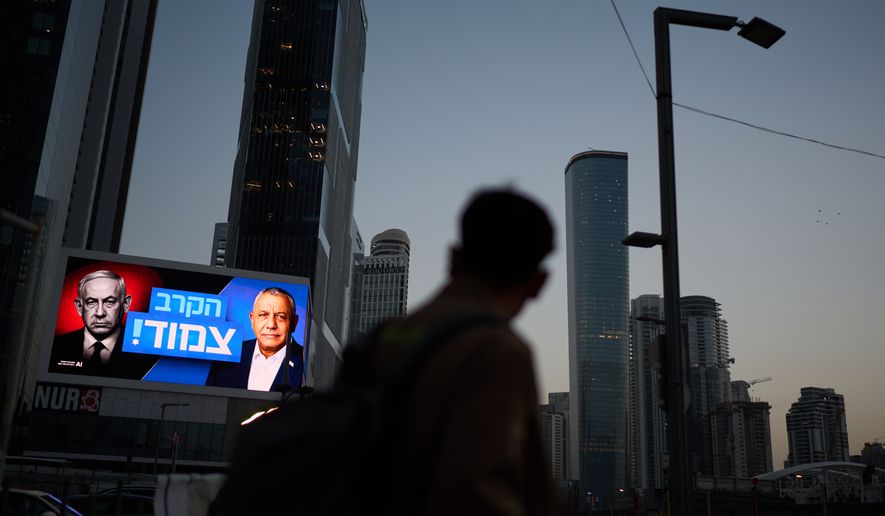

Voters go to the polls Tuesday in Israel to decide whether to stay the course with Prime Minister Benjamin Netanyahu and his Likud party or turn to opposition leader Gadi Eisenkot and his Yashar party in a race that will inevitably impact U.S. foreign and domestic politics.
With the U.S.-Israeli war threatening to spin off into a broader regional conflict, America’s most important ally in the region plays an outsized role in the military decisions facing President Trump, who has endorsed Mr. Netanyahu.
Ilan Berman, the senior vice president of the Washington-based American Foreign Policy Council, said U.S. voters have become increasingly skeptical of Israel. In the past, Israelis could count on U.S. support based on their similarities as democratic, pluralistic countries.
People were interested in these podcasts
“That doesn’t really map as compellingly as it once did among younger [U.S.] voters,” Mr. Berman told The Washington Times.
Analysts say it’s unclear which of the parties will be able to secure a sufficient number of seats in the Knesset to form a governing coalition in Israel’s deeply divided political landscape. But both Mr. Netanyahu and Mr. Eisenkot, a retired Israeli army commander, are hawks when it comes to Israeli security — a reflection of the country’s sharp turn to the right after the Oct. 7, 2023, cross-border attack and massacre that precipitated Israel’s ongoing war on Hamas in Gaza.
Mr. Berman said about 65% of the country now self-identifies as conservative in some fashion. Israelis are suspicious of any attempts to establish a working relationship with the Palestinians in the Gaza Strip. The Hamas attack in southern Israel killed at least 1,200 people — mostly civilians — and resulted in more than 250 people being taken into the Gaza Strip as hostages.
“Even if [Netanyahu] is no longer prime minister, the next prime minister is not going to be able to talk about a ‘two-state solution’ either. The electorate won’t allow it,’ he said. “This is a unique election in the sense that it’s the first time Israelis are voting since,” Mr. Berman said.
“I was just there, and the PTSD is through the roof,” he said. “They’ve had no real resolution in terms of moving past it and into accountability for the event.”
American presidents generally refrain from explicitly endorsing candidates or leaders in foreign elections. But that didn’t stop Mr. Trump from offering his full-throated support to Mr. Netanyahu. On Oct. 18, Mr. Trump wrote on Truth Social that his Israeli counterpart was a “Great Warrior Prime Minister” and an indispensable partner against Iran.
Mr. Netanyahu responded on X, saying that Israel has never had a greater friend in the White House.
“Together, we will never let Iran’s regime get nuclear weapons. Thank you for your clarity, courage and unwavering support,” he said.
The U.S. government provides billions of dollars in foreign military aid to Israel every year. The outcome of its election will also determine how closely the incoming government in Jerusalem aligns with U.S. strategic objectives.
With the U.S. facing an emerging malign coalition of China, Russia, Iran and North Korea, security analysts say Washington needs allies willing and able to defend the common interests of the West.
“Israel has contributed intelligence, targeting capabilities, technological innovation, and sustained offensive military power on a scale few American allies could match,” Michael Doran, a senior fellow at the Hudson Institute think tank, wrote in an essay for the Tablet magazine.
“The United States has supplied capabilities that Israel lacks, creating a formidable partnership against a common enemy,” Mr. Doran wrote.
Dennis Ross, a diplomat and former U.S. Special Middle East coordinator under President Clinton, said Democrats became more questioning of Israel after Mr. Netanyahu seemed to align himself with the Republicans in Washington. But even some elements of Mr. Trump’s MAGA coalition have become critical of America’s alliance with Israel.
“They are not keen on the U.S. being active in wars like Iran. They look at Israel as having somehow played a role in contributing to that,” Mr. Ross said recently at a discussion hosted by Chatham House, the Royal Institute of International Affairs think tank.
Mr. Ross said the only development that could return the U.S. relationship with Israel to the status quo would be a complete change of government where Mr. Netanyahu would play no role, even as a temporary caretaker.
“There’d be an instinct to give this new Israeli government a chance,” he said.
Middle East policy is becoming a key flash point in U.S. elections, deeply dividing both political parties and generational demographics.
How the next Israeli government handles its domestic and foreign policy concerns could impact voter behavior across the U.S.
Opposition leaders in Israel have said they’re not willing to join Mr. Netanyahu in any kind of unity government. The prime minister is simply too toxic for a growing percentage of the American electorate, Mr. Ross said.
“Whether it’s fair or not, I think that’s the reality. So, if there isn’t a change in government, I think the trend in public opinion here [in the U.S.] will continue to move in a more negative direction towards Israel,” he said.
The election in Israel could also impact gasoline prices in the U.S., even though more than 60% of America’s petroleum imports come from Canada and Mexico. A government in Jerusalem taking a hard-line stance against Iran or another regional actor could trigger supply chain disruptions and energy market volatility.
“The fact that the United States doesn’t directly use much Persian Gulf oil doesn’t shield the U.S. consumers from sticker shock,” said Margot Habiby, deputy director of editorial at the George W. Bush Presidential Center. “Oil is the most widely traded commodity in the world, refined into products like gasoline, diesel, and jet fuel, and global markets are linked. So supply issues in key parts of the world can be felt at home.”
Mr. Netanyahu is the longest-serving prime minister in Israeli history. He has led the country for almost 20 years through three separate time periods. That’s part of the problem for both Israelis and a growing number of Americans, Mr. Berman said.
“Even people that like him and people that are sympathetic are like, ‘You know, he’s been around for a long time, and it’s time for new blood,” he said. “For most young Americans, the only Israeli leader that they know is Netanyahu, and they don’t buy what he’s selling.”
Contact the author

Please read our comment policy before commenting.