


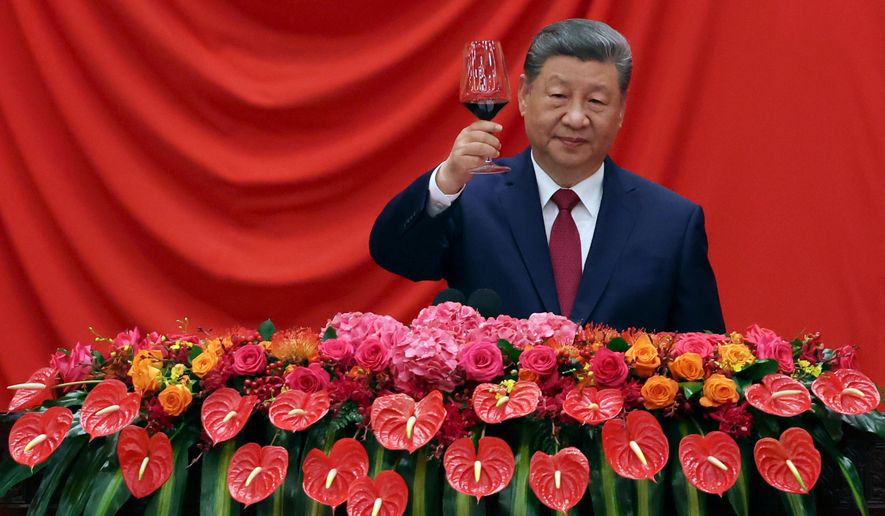

Chinese President Xi Jinping is targeting American youth with an announced plan to bring 100,000 U.S. students to study in China.
Security and academic experts say extreme surveillance and controls on foreigners, threats of intelligence recruitment, and poor-quality universities there are unlikely to attract the tens of thousands of Americans the Chinese leader seeks.
“The hope of the China-U.S. relationship lies in our people, and its future lies with the young,” Mr. Xi said during his White House visit on Sept. 24.
People were interested in these podcasts
The Chinese Communist Party general secretary then announced the invitation for 100,000 “young Americans” to visit China for exchanges and study over the next five years.
The initiative offers paid resident study at universities in China after thousands of Americans fled the communist state during draconian government lockdowns and severe restrictions imposed during the COVID-19 pandemic beginning in 2020.
The Chinese plan also calls for hosting short-term visits and cultural exchanges paid for by the government.
SEE ALSO: U.S. travel advisory for China flags threat of wrongful detention, exit bans
Critics say the student plan is a strategic influence operation by targeting young Americans and students while opening up young people to Beijing’s intelligence services for aggressive spotting and recruitment of potential future government officials or academics with access to secrets or advanced technology.
John Lenczowski, a former White House National Security Council official, said exchanges with totalitarian regimes present inherent national security risks.
Most American students who go to China don’t have top-tier academic backgrounds and are not well briefed on the realities of life under communism or the risks of being influenced or recruited for intelligence purposes, he said.
“If we are to send our students there, there should be a program to open their eyes to the realities of the CCP’s … management techniques and how they recruit Americans to serve as their spies upon their return to the U.S.,” said Mr. Lenczowski, founder of the Institute of World Politics. “The likelihood of our government establishing such a program is next to nil.”
Nick Eftimiades, a former CIA and Defense Intelligence Agency counterintelligence specialist on China, said sending large numbers of students to China has risks and benefits.
Proponents say studying in China will boost foreign language skills and provide knowledge and experience that can guide policies and business interests.
SEE ALSO: China’s open AI models vulnerable to backdoor threats
“Yet there is a risk because China’s authoritarian surveillance state conducts arbitrary arrests and exit restrictions when it suits its political interests,” said Mr. Eftimiades, now with the security firm Shinobi Enterprises.
“Chinese intelligence services also aggressively target and recruit foreign students and business persons,” he said.
The new goal of 100,000 is twice the number of American students Mr. Xi sought in 2023 over five years. The Chinese Embassy said that number was reached this year.
Foreign student attendance at universities in China declined sharply during the pandemic from 2020 to 2023 when the Chinese Communist Party imposed what it called “zero COVID” policies. That led to actions such as forced quarantines and other government lockdowns and restrictions on the entire population.
According to the Institute of International Education, American students in China declined from 2,481 in 2019 to just 382 in 2021 — the height of the pandemic that many U.S. government agencies say began with a deadly pathogen that leaked from a Wuhan laboratory engaged in dangerous bat virus research.
The CCP’s targeting of foreign students has been underway for decades. But the effort picked up momentum in 2010 when the party launched its Study in China program with the goal of hosting 500,000 international students.
Study in China participants numbered between 240,00 international students to as high as 490,000, according to the Chinese Ministry of Education and reports from academic groups that monitor student exchanges.
A statement from a Chinese Embassy spokesman said Mr. Xi’s 2023 initiative for 50,000 young Americans to travel to China for exchanges and study over five years was exceeded in number and achieved 2 1/2 years ahead of schedule.
The spokesman did not respond to a question about restrictive living and studying conditions faced by foreign students in China.
The 2023 student initiative let Chinese and American young people communicate and build friendships, the spokesman said.
As for the new program that Mr. Xi announced at the Washington summit, “the growth represents more than just numbers; it marks concrete actions to expand youth exchanges and mobilize youthful momentum for China-U.S. friendship,” the spokesman said.
“It is hoped that more young people from the two countries will take up the baton of the bilateral friendship … and make new contributions to the stable, sound and sustainable development of China-U.S. relations,” the statement said.
Mr. Xi’s initiative is not new. President Barack Obama launched a U.S. study in China program in 2010 that sought to send 100,000 students over four years. The objective was to improve U.S.-China relations. Then-Secretary of State Hillary Clinton led what was called a “100,000 Strong” student study program.
The goal reportedly was met by 2014 using counting rules that listed a wide range of credit and noncredit educational travel as study — not for full-time students seeking degrees. That program shifted to an outside nonprofit corporation in 2013.
In August 2025, President Trump said he wanted to let 600,000 Chinese students come to U.S. schools as part of an effort to improve trade and economic ties.
Currently, an estimated 273,000 Chinese students are studying in the U.S., down from a peak of over 370,000 in 2019.
“I hear so many stories about ’We’re not going to allow their students’” to come in, he said. “We’re going to allow, it’s very important, 600,000 students. It’s very important,” Mr. Trump said.
The stories he referred to were triggered by Secretary of State Marco Rubio, who announced three months earlier that his department began revoking student visas of Chinese nationals linked to the CCP or studying in critical fields.
The visa revocation was quietly shelved as part of the Trump administration’s detente with Beijing.
An educator who recently returned from work in China for more than a decade said most American students left China in large numbers during the pandemic and probably won’t return.
Chinese universities once were attractive for foreign students, but now American universities are considered far superior to even the best schools in China, especially in the science and technology fields.
Also, tight restrictions on students in China are a major disincentive, the educator said.
All foreign students in China are banned from living off campus and are confined to special university dormitories, the educator said, noting that security services place all foreign students under extreme video, telephone and internet surveillance.
Lower-level Chinese universities pay all tuition and expenses for foreign students except for major institutions such as Beijing and Tsinghua universities.
“Most of the foreign students are from the Middle East or Africa now,” the educator said speaking on background.
Living, working and studying in China can be dangerous for Americans. The government in recent years has passed strict national security laws that include presumptions that foreigners in China are potential spies.
Foreign nationals are at risk of arbitrary detentions and exit bans under China’s recently introduced security policies.
The State Department on Oct. 20 upgraded its warning of “increased caution” for Americans in China by adding the risk of wrongful detention to a list of other dangers, according to the U.S. Embassy in Beijing.
“All universities and schools in China are controlled by the CCP,” the warning said. “If foreign teachers or students in China express ideas contrary to what the Communist Party believes, they could be deported or detained.”
Exit bans can be imposed without a fair process under law, along with the arbitrary enforcement of local laws, the warning said.
“Expansive national security, counterespionage, and data security laws grant Chinese officials broad discretion to detain or interrogate foreign nationals,” the notice said.
“This places U.S. citizens at risk for conducting even routine business, research, or expression in the public domain.”
Routine Chinese documents, data and other material have been classified as state secrets, increasing the risks that foreigners may be harassed for possessing basic information.
U.S. citizens in China also are at risk of detention without information about alleged crimes or access to U.S. consular services. Plus, they can be interrogated and detained unfairly.
Wrongful detention is a “serious risk” for Americans, the embassy stated, and they can be held in a squalid prison for years.
The danger is especially severe for Chinese Americans, the warning stated.
Scott Carmichael, a former Defense Intelligence Agency counterintelligence official, said China’s objective in receiving American students is to cultivate them in advancing CCP interests.
China’s activities are similar to the Cuban communist government sponsoring of an American Venceremos Brigade of young people who visited Cuba and were assessed for future recruitment as spies or influence agents, he said.
Los Angeles Mayor Karen Bass worked as a supporter of the Venceremos Brigade, as did former State Department employee Walter Kendall Myers, who became a spy for Cuba from 1979 to 2009. He was sentenced to life in prison in 2010 and died in March.
“American applicants will be carefully screened to ensure their sympathies already align with People’s Republic of China propaganda,” Mr. Carmichael said.
“And the most successful applicants will already demonstrate potential for, if not firsthand experience, in political activism here in the United States,” he said.
The FBI states on its China Threat website that foreign students and professors in China are potential targets for recruitment as intelligence agents through a process the bureau calls spotting.
Chinese intelligence services may target students, professors and researchers through their travel to China.
The targeting can involve searches of luggage and hotel rooms, extensive questioning, manufacture of compromising situations and confiscation of electronics.
“They can spend years targeting an individual and developing a relationship that leads the student, professor, or researcher — either wittingly or unwittingly — to provide information to the foreign adversary,” the FBI stated on its counterintelligence website called “The China Threat.”
“Foreign adversaries are particularly interested in American students or researchers traveling overseas who are sponsored by the U.S. government; conducting research with future, potentially classified applications; or seeking future U.S. government employment.”
Among the recruitment techniques are appeals to ethnicity for Asian Americans, sponsorship of foreign travel, coercion, study abroad opportunities and scholarships, the FBI stated.
Former State Department China policy maker Miles Yu said Mr. Xi’s offer for the 100,000 students is “a cynical propaganda stunt” that disguises the reality of barely 1,000 American students who now study there.
“At the same time, more than 265,000 Chinese students enjoy the freedoms of American universities,” said Mr. Yu, now with the Hudson Institute.
“Americans have every reason to be wary of studying in a communist police state where surveillance, political indoctrination, censorship, arbitrary detention and the suppression of academic freedom are serious risks,” he said.
The offer for tens of thousands of American students to travel and study in China is a public relations ploy by Mr. Xi that seeks to deceive people outside the country into believing China’s repressive dictatorship is a safe, open and credible destination for genuine academic exchange, Mr. Yu said.
Analysts say the actual number of American students is not that important. Grooming several hundred susceptible young people already influenced by anti-American and Marxist professors in the U.S. will benefit Chinese large-scale foreign influence programs.
“Treat them well, groom them and wage cognitive warfare until they think China is a benign country — that’s just understood. And then they go back to the United States — to ’tell the story’ about China — and maybe more,” said Grant Newsham, a China affairs expert.
Chinese intelligence officers will closely monitor the students and maintain contact directly or indirectly during studies.
Once in China, the communist system uses a sophisticated system of influencing its students who could go on to do the bidding of the CCP sometimes unknowingly.
Reagan Dugan, director of higher education initiatives at the group Defending Education, said American students face serious risks in China, as seen in the recent updated travel warning.
China’s main organization for attracting young Americans is called Young Envoys Scholarship, or YES, and is run by the China Education Association for International Exchange, a state entity devoted to Marxism-Leninism and Mr. Xi’s thoughts on socialism, Mr. Dugan said.
The new 100,000 student initiative will also be directed by YES.
The international exchange association is linked to the CCP’s United Front Work Department, the party’s foreign influence wing that spends an estimated $11 billion annually seeking to advance Beijing’s policies, according to U.S. government reports.
Michigan GOP Rep. John Moolenaar, chairman of the House Select Committee on China, wrote a letter to the president of Columbia University in November urging it to cancel a planned student visit to China, calling it linked to Chinese intelligence operations.
The letter said the all-expenses-paid trip would be funded by the China-United States Exchange Foundation that intelligence agencies have identified as promoting CCP interests.
Mr. Moolenaar warned Columbia that the exchange program “is an instrument of the CCP’s approach to political warfare, including influence operations intended
to shape Americans’ views toward the People’s Republic of China government.”
Mr. Newsham, a retired Marine colonel and China specialist, said the case of Minnesota Gov. Tim Walz is an example of how China grooms academics and students to hold favorable views of China and its policies.
Mr. Walz traveled to China two months after the 1989 military crackdown on Chinese pro-democracy protesters to teach English, then led annual summer educational trips to China for American high school students for over a decade.
“Just an English teacher and then a staff noncommissioned officer in the National Guard,” Mr. Newsham said of the far-left Democrat. “But he got into politics and rose rather high — and nearly became vice president of the United States.”
“The numbers can add up, even if just a few hundred students a year. Influence and recruit the right people, and you have an outsized effect,” he said.
Former State Department official John Tkacik said the new push to bring students to China is an effort by Mr. Xi to balance the large number of Chinese students now in the U.S.
Also, the dismantling of China’s Confucius Institutes at most American universities diminished Beijing’s ability to influence U.S. students at home. So the Chinese leader is seeking to have them travel to China for study, Mr. Tkacik said.
“President Xi’s offer obviously envisions ample opportunity for the Chinese government to repurpose Confucius Institute funding in the other direction: bringing American students to China for indoctrination,” he said.
Contact the author

Please read our comment policy before commenting.