


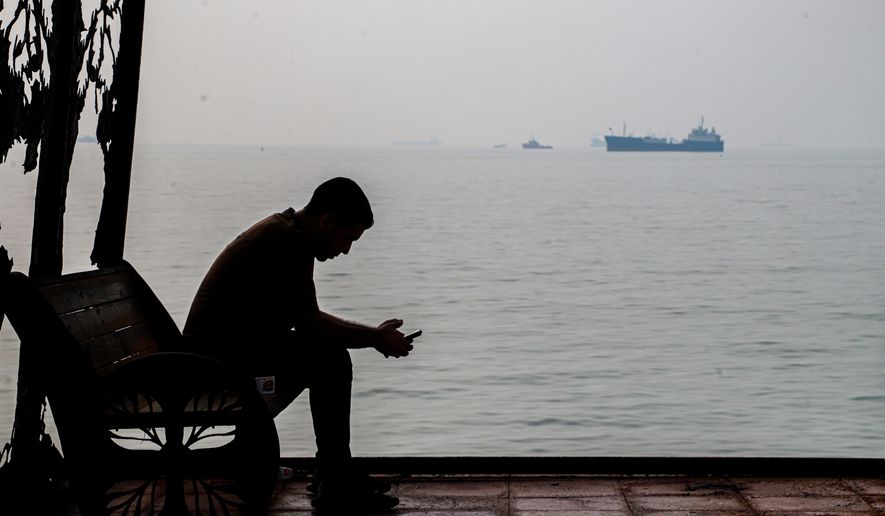

Iran’s claims that its forces on Thursday struck several oil tankers traveling in the Strait of Hormuz are false, said President Trump, who accused Tehran of inventing incidents to drive up oil prices.
The president’s comments came as the price per barrel of Brent crude, the international benchmark, topped $113 on Thursday following reports that seven tankers had been struck by Iranian fire or naval mines.
In a post on Truth Social, Mr Trump called Iran an “evil regime” and insisted that more oil is moving through the strait than ever before.
People were interested in these podcasts
“Iran is doing everything they can to drive up the price of Oil prior to the U.S. Midterm Election. They are even making up fake hits, mines, and everything else, because more Oil is coming through the Hormuz Strait now than it did even prior to the beginning of the Conflict,” he wrote.
Mr. Trump followed up his comments with another post featuring a headline from The Wall Street Journal that reads “More Oil Is Now Coming Out of the Persian Gulf Than Before the Iran War.”
The Trump administration has consistently said over the past month that the naval blockade, orchestrated by U.S. Central Command, has allowed oil flow through the Strait of Hormuz to return to pre-war levels.
Iran effectively closed the Strait of Hormuz to international traffic in March in response to U.S. and Israeli airstrikes that killed several high-profile political figures, including Ayatollah Ali Khamenei.
The U.S. instituted a counter-blockade over the summer and have frequently redirected tankers carrying Iranian oil or vessels looking to dock in Iranian ports.
Navy ships have helped in guiding tankers through Omani waters in the southern end of the strait, often during night and with transponders turned off.
While data recorded by maritime tracking firm Kpler recorded 19.5 million to 22.5 million barrels of oil leaving the waterway in late September, subsequent reporting has indicated that Iranian strikes on commercial ships have once again decimated traffic.
Maritime tracking firms such as the International Maritime Organization, United Kingdom Maritime Trade Operations and the Joint Maritime Information Center have recorded more than a dozen attacks on vessels in regional waters this month.
Iranian-state-affiliated media reported Thursday that seven oil tankers were damaged or caught fire in the Strait of Hormuz this week after being attacked by Iranian forces or hitting naval mines. UKMTO has confirmed only two attacks on tankers this week.
The strikes have inevitably increased the risk for international shipping firms to send crude through the strait, even if the U.S. military is offering protection, and have throttled traffic. Wall Street also remains increasingly skeptical that flows will maintain consistency amid an escalating war in Yemen and speculation that the U.S. will launch further military action against Iran.
Reporting on Thursday suggested that the Pentagon has plans for new attacks on Iran after the midterm elections in November.
The New York Times, citing unnamed administration officials, reported the operation would be short and would target Iran’s missile, drone and nuclear facilities in addition to its energy infrastructure.
Mr. Trump has for months insisted that he would use the U.S. military to take out Iran’s electrical grid, rail infrastructure and bridges. Analysts have argued that such attacks could be considered war crimes, conclusions the administration has rejected.
Defense Secretary Pete Hegseth reportedly discussed a military option with Prime Minister Benjamin Netanyahu during his visit to Israel this week.
Further strikes on Iran are likely to escalate the conflict. Iranian officials have repeatedly said that further U.S. or Israeli military action would lead to strikes on regional energy and military infrastructure. New targets not previously attacked by Iranian missiles or drones, such as internet cables, could also be attacked.
Contact the author

Please read our comment policy before commenting.