



OPINION:
The Israeli elections are now just days away, and the composition of the new government is anyone’s guess.
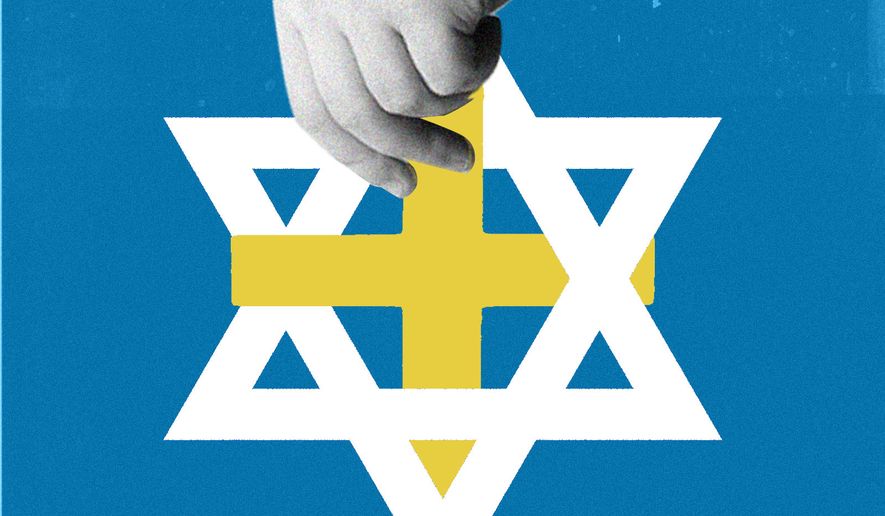
Political momentum may favor some modicum of change, but whatever coalition emerges, it is a strategic imperative for Israel to reassess its relationship with Christians.
Israel needs a plan that fully embraces its younger brothers in faith. It must welcome the reality that the state of the Christian community is inextricably linked to Israel’s own future.
People were interested in these podcasts
Traveling across the country recently and speaking to Christians, I observed a simmering discontent. Few can deny that Israel is the safest place in the Middle East and North Africa for followers of Christ. The Christian population of Israel has more than quintupled since 1948, while it has cratered regionally in Muslim-dominated nations. The number of churches has more than doubled.
A stark duality underlies the statistics, however, among the Christians who call Israel home. Christians are a small, vulnerable minority within a minority, making up approximately 1.8% of the Israeli population. Their complex status is compounded by ancient conflicts, barriers to Christians in the Palestinian Authority-controlled areas and continuing threats of violence from extremists.
The appointment of Special Envoy George Deek to the Christian world sends a powerful message of solidarity and support, but when the dust settles from the election, concrete action is necessary in addition to stronger public diplomacy.
The Christian community in Israel has access to the booming finance, technology and manufacturing sectors in Tel Aviv and Haifa, but the economy overall is uneven, with unemployment rates at crisis levels in the West Bank.
While Israeli Finance Minister Bezalel Smotrich, who doubles as the lead for civil affairs in the West Bank, focuses on building settlements, there is a dire need for sustained economic growth and diversification that benefits the Christian population there. Driving hard to increase the population without establishing an economy to support it is rightly observed as irresponsible.
Since the Oct. 7, 2023, massacre by Hamas, Israel has dramatically reduced work permits for those in the Palestinian Authority-controlled areas. This has hit the Christian population there particularly hard.
Israeli officials say the permits constitute a security risk. Others argue that the Palestinian Authority should invest in its own people rather than support Islamic radicalism. Both arguments certainly have merit, but Christians do not kill Jews, and an appropriate vetting process is possible with the political courage to institute it.
Building trust and solidarity will not be fully possible while Christians watch friends and family live behind walls and guard towers, with loved ones unable to travel freely or experience the benefits of Israel’s dynamic economy. Even a small number of permits and increased ability to move more freely will demonstrate a significant commitment to the Christians caught in the crossfire of the ongoing conflict.
The issue of family “unification” also leaves Christians marginalized. The Israeli Law of Return enables any Jew, anywhere in the world, to obtain Israeli citizenship almost immediately.
The spouse of a Palestinian Christian who holds Israeli citizenship and is a non-Jew, a foreign citizen or a resident of Bethlehem, for instance, does not receive the same legal status. Those restrictions, repeatedly extended since 2003, often leave Christian families in legal limbo for years, despite having lived in Israel for generations.
Israel should be a beacon for human dignity by working to bring families together.
Palestinian Christian teachers should not be subjected to unpredictable administrative restrictions and regulations that lead to instability in Christian schools.
The lack of trust in the security forces that oversee the West Bank cannot be ignored. Visiting disputed land and speaking with a broad cross-section of the population, I heard one narrative repeatedly: Security forces are involved in protecting Jewish settler gangs that rob Christians of their security, livestock, property and heritage.
Although the Israeli court system has been sympathetic to the plight of Christian landowners confronting settlers, the government should note that this proves security forces are neither enforcing the law nor interdicting gangs and squatters.
Israel’s desire to build in the West Bank should be tempered by concerns over its relationship with the global Christian community. To ignore the potential damage to that relationship for the sake of new settlements would be a grave strategic error.
The government cannot credibly claim that its capable military, intelligence and police forces are incapable of stopping the violent Hilltop Youth movement or ejecting other settlers now living on Christian lands.
Polls show strong opposition among the Israeli public to the aggressive settlement operations. This environment has provided tremendous fodder for Israel’s critics. It has distracted from Israel’s fight against Islamic terrorism and risks considerable damage to the relationship between Christians and Jews.
For Israel’s new government, a strategy to allow all Christians to thrive both in Israel and on its periphery has the potential to create new allies among the skeptical and marginalized. It will help maintain support for the Jewish state among America’s powerful Christian majority. It will strengthen ties globally to a universal church that now numbers more than 2.6 billion people, and it will reaffirm Israel’s commitment to a moral high ground.
Israel is more than a political jurisdiction. It is the vehicle by which biblical history is protected in the face of rising radical Islam and militant secularism driven by communism. In this battle of civilizations, Israel protects the values that gave birth to Western society and serves as a bulwark against a nihilistic future for humanity.
Israel needs broad support, and the Christian world is its largest potential ally.
For Israel and its Jewish majority, the facts are plain that the trajectory of history will bring humanity to live in either a Muslim-, Christian- or communist-dominated world. Only one of those futures has an indelible connection to the Jewish people. Only one will protect biblical history and Jewish tradition. Only one is a covenantal relationship.
• Tom Basile is the host of “America Right Now” on Newsmax TV.
Follow the author

Please read our comment policy before commenting.