


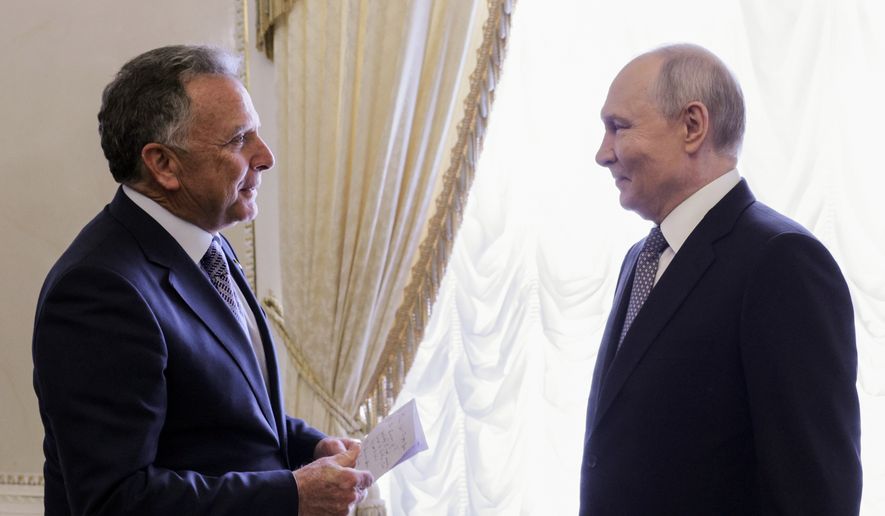

U.S. Special Envoy Steve Witkoff met Wednesday with Russian President Vladimir Putin in St. Petersburg for talks about Moscow’s invasion of Ukraine, as President Trump pushes for diplomacy that could end the war.
Mr. Witkoff said ahead of the meeting that he hoped to press Mr. Putin to consider trilateral peace talks involving the U.S. and Ukraine. He added that there is massive potential for U.S.-Russian economic cooperation after the war concludes.
He also thanked Mr. Putin for lifting the Russian ban on diesel exports, a deal spearheaded by Mr. Trump. The agreement has angered some U.S. lawmakers and Ukrainian President Volodymyr Zelenskyy who say it will provide Moscow with billions of dollars to support its war machine.
People were interested in these podcasts
Mr. Putin thanked the U.S. for its mediation efforts.
In addition to Mr. Putin, Mr. Witkoff met with Russia presidential envoy Kirill Dmitriev and foreign affairs adviser Yuri Ushakov on Wednesday.
The St. Petersburg meeting is the latest evidence of the Trump administration’s push for a permanent peace agreement between Ukraine and Russia that would end the nearly five-year-long war.
Mr. Witkoff met with Mr. Zelenskyy on Tuesday in the Norwegian capital of Oslo for talks that the envoy described as productive. Finnish President Alexander Stubb, who was also present at the meeting, said the talks made progress toward peace.
Norwegian Prime Minister Jonas Gahr Store said the meeting Tuesday marked a new phase of diplomacy surrounding the war in Ukraine, adding the Russians are “also looking for opportunities” for peace.
Mr. Zelenskyy said the Tuesday meeting covered a possible ceasefire agreement with Russia, future security guarantees for Kyiv, postwar reconstruction efforts and occupied territories in the east.
All of those issues have proved near impossible to resolve during the prior round of negotiations. Ukraine has been insistent that it not abandon any of the eastern provinces occupied by Russia, while Moscow has said it should be allowed to keep them.
Additionally, Russia has resisted a temporary ceasefire agreement that would stop the fighting while negotiations continue, arguing that it would give Ukraine time to resupply.
Contact the author

Please read our comment policy before commenting.