


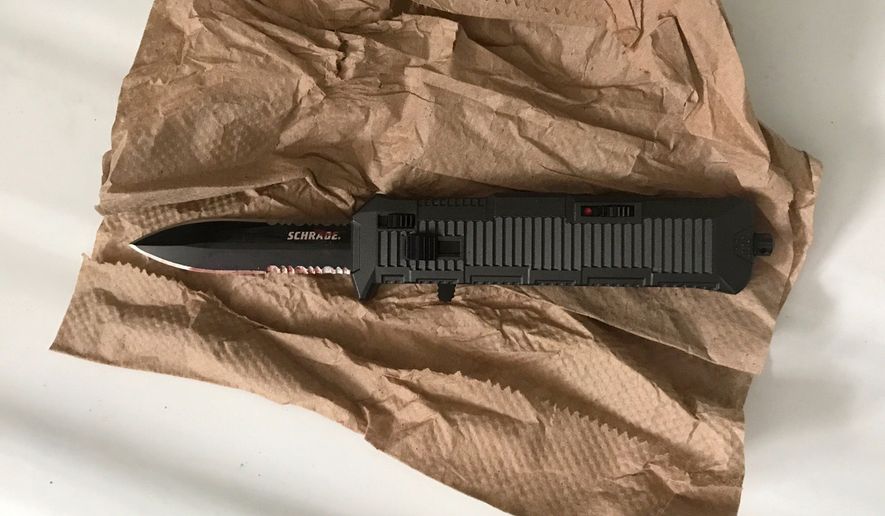

A federal ban on manufacturing switchblades for sale or transport across state lines is unconstitutional, an appeals court ruled Wednesday, saying the knives are self-defense “arms” covered by the Second Amendment and thus entitled to protection.
The 5th U.S. Circuit Court of Appeals applied the same test the Supreme Court has laid out for firearms and concluded that switchblades are in common use, and their predecessors, springblade knives, were readily available when the Second Amendment was crafted.
Federal prosecutors argued that the founding era had a number of laws regulating concealable weapons, and limits on switchblades meet the same goals.
People were interested in these podcasts
But the appeals court said the government couldn’t point to any specific founding-era laws that controlled the manufacture of those weapons — only where they could be carried.
That means the Federal Switchblade Act “is unconstitutional,” the court ruled.
The three-judge panel did reject a separate challenge to another federal regulation on switchblades on tribal or other specific federal jurisdictions, saying there were clearly some instances such as military bases, courthouses and prisons where the knives can be restricted.
Circuit Judge Jennifer Walker Elrod, a George W. Bush appointee, wrote the opinion, joined by two Trump picks, Judges Don Willett and Cory Wilson.
She said the Supreme Court’s 2022 ruling in the Bruen case, which overturned state restrictions on concealed-carry permits for guns, paved the way.
In Bruen, the high court said laws that restrict gun rights can only survive Second Amendment scrutiny if they are the sort of thing that someone in the founding era would countenance.
Once the 5th Circuit decided that knives were arms, for Second Amendment purposes, Bruen’s framework applied.
The challenge to the federal law was brought by Knife Rights Inc., some arms retailers who want to sell switchblades, and individuals who said they want to obtain the knives but feel they cannot under the federal framework.
The federal law grew out of what the court called the “peak of hysteria surrounding juvenile delinquency” in the 1950s.
“Rebel Without a Cause,” released in 1955, featured a switchblade knife fight between James Dean’s character and a street gang leader, and knives were seen as the tool of choice for teenage gangs.
One Senate report fretted that 1.2 million switchblades were sold each year, often crossing state lines and circumventing state bans.
Those fears led to the federal ban on manufacturing or transporting the blades for interstate commerce.
Contact the author

Please read our comment policy before commenting.