


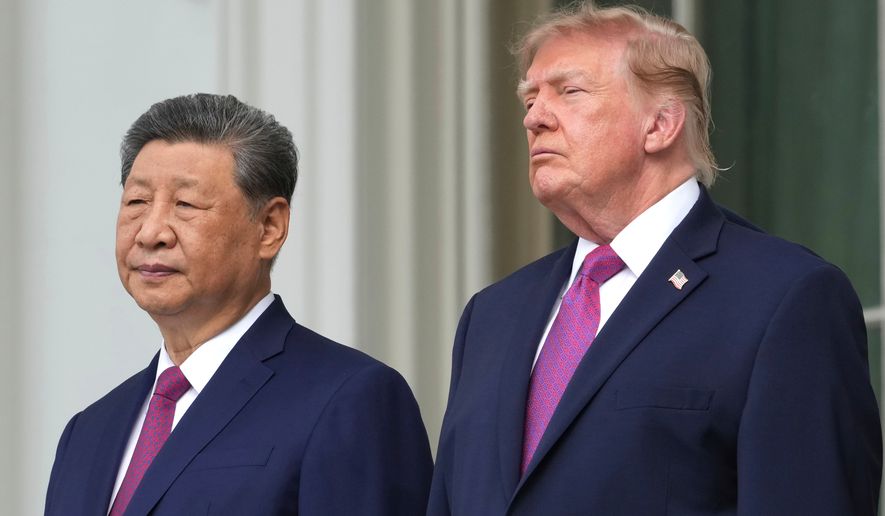

Chinese exports of the precursor chemicals used to make deadly fentanyl are continuing despite Beijing’s agreement last year to halt the flow and despite President Trump’s pressing Chinese President Xi Jinping at their recent summit to do more, Trump administration officials say.
China’s role in supplying the chemicals now appears to be carried out through criminal networks that circumvent regulations and official Beijing scrutiny, the U.S. State Department said.
Mr. Trump raised the topic of China and fentanyl during meetings with Mr. Xi on Sept. 24 and 25 in Washington, though few public details have emerged about what was said.
People were interested in these podcasts
China agreed during an October 2025 meeting between Mr. Trump and Mr. Xi in South Korea to halt all shipments of fentanyl precursors. In exchange, the U.S. cut fentanyl-related tariffs on China from 20% to 10%.
U.S. says controls not working
“China remains the epicenter of the illicit production and trade in precursor chemicals fueling the fentanyl and synthetic narcotics crisis, which is responsible for hundreds of thousands of overdose deaths in the United States and around the globe,” a State Department spokesman, who declined to be identified, told The Washington Times.
The spokesman said supplies of Chinese chemicals to Mexican cartels for fentanyl production are unchanged and blamed Beijing’s weak enforcement for allowing Chinese criminals to continue the exports.
“While China has placed export controls on certain synthetic drug precursors to prevent their direct shipment to North America, criminals continue to find ways around these controls,” the spokesman said.
A White House official confirmed that China’s continued role in fentanyl production remains a problem and referred questions to remarks from a senior White House official days before the Trump-Xi summit in September.
The senior official told reporters that the Chinese were not doing enough to control chemical exports to the cartels.
“It does not appear that China has elevated this issue where China is the overwhelming predominant supplier of precursor chemicals to the cartels in Mexico and remains so,” said the official, dismissing Beijing’s actions as limited to a “few arrests” and urging Beijing to adopt a “much more systemic change.”
Sara Carter, director of the White House Office of National Drug Control Policy, said recent actions by China in scheduling new deadly drugs, such as orphines, and adding export controls on two additional precursors were steps in the right direction, but that more progress is needed.
“Under President Trump, we have seen a continuous decline in overdose deaths and poisonings, more than 40% since the height of the crisis under Biden,” Ms. Carter said. “Part of the success is also making it clear to China that we expect ongoing cooperation to stop the flow of precursor chemicals to the cartels in Mexico that is poisoning our citizens with fentanyl.”
The White House said after the Xi summit that the U.S. welcomed the new controls on orphines, a class of deadly drugs, and announced new export controls on two fentanyl precursor chemicals.
The measures are designed to block illicit shipments of precursor chemicals to drug organizations in North America, the summit statement said.
Yet the Chinese readout of the summit, issued Sept. 25, made no mention of U.S.-China counter-drug cooperation. An official summit statement a day later said U.S.-China anti-narcotics cooperation had produced “visible outcomes,” including multiple cases of precursor chemical interdictions and dozens of criminal arrests in both nations.
Halting the trafficking of fentanyl, mainly from Mexico, into the U.S. and ending the resulting overdose deaths of hundreds of thousands of Americans has been a high-profile priority for the White House since Mr. Trump returned to the Oval Office in January 2025.
A trail of promises
Exports of fentanyl precursors from China have continued despite Beijing’s past promises to crack down.
In early 2025, Mr. Trump imposed tariffs on Chinese goods in a bid to pressure Beijing on fentanyl precursor exports. The exports were cut in half after the October 2025 summit in South Korea, when China promised an end to the illicit chemical flow.
The White House statement on Nov. 1, 2025, said China had agreed to “halt the flow” of precursors — specifically, shipments of certain designated chemicals to North America.
FBI Director Kash Patel traveled to Beijing later that month and met with Chinese officials to “plan and execute” the October 2025 agreement, a spokesman said.
Despite announced restrictions on 18 precursors and seven chemicals, exports have continued.
China slowed efforts to curb fentanyl precursor exports in response to U.S. tariffs, according to a recent Congressional Research Service report on the persistent problem.
The Chinese government claims the core problem is not supplies of precursors but U.S. demand for the deadly drug, said the report, noting that Beijing has stated that the imposition of punishing U.S. tariffs over fentanyl issues “dealt a heavy blow” to joint counternarcotics cooperation.
“Illicit trafficking in fentanyl precursors from China remains an issue in the U.S.-China relationship,” the Oct. 7 report said.
Since 2023, Chinese Communist Party officials, including Mr. Xi, have announced limited steps regarding precursor exports, including scheduling all fentanyl precursors as potential risks for illicit narcotics production — a designation aimed at rendering them restricted for export.
After the Trump-Xi summit in South Korea, China agreed to stop shipments of 13 designated chemicals used in fentanyl production. Three more were added in May and two in September. China also announced guidelines and rules for dealing with fentanyl-related crimes and conducted an unspecified number of joint fentanyl-related investigations.
Criminal networks or state strategy?
Sebastian Gorka, deputy assistant to the president and senior director for counterterrorism at the National Security Council, said in a May podcast interview that the president declared fentanyl to be a weapon of mass destruction in December 2025.
China, by providing the precursors for that weapon, is using fentanyl as a form of warfare against the United States, he said. “This is a targeted killing of Americans,” Mr. Gorka told journalist Miranda Devine on May 13 on her podcast, “Pod Force One.”
China is supporting fentanyl deaths as part of what Mr. Gorka called China’s “unrestricted warfare,” as outlined in a 1999 book by two People’s Liberation Army colonels. The book calls for using all forms of warfare and violence for a weaker Chinese military to defeat stronger U.S. forces.
Covert support for the U.S. fentanyl epidemic also appears to be Chinese retaliation for 19th-century Britain’s Opium War, when commercial interests, backed by the military, exploited China’s large market for opium, Mr. Gorka said.
“There are those who have written this, and I think it has some merit,” he said, noting that China views the U.S. as a new version of the British Empire and that “it is now payback time for the Opium Wars.”
Asked whether Mr. Xi is behind the strategy of using fentanyl to damage America or if the precursor exports show he does not control China’s criminal elements, Mr. Gorka said China is an authoritarian one-party state.
“The idea that you do stuff on this scale as a private actor in China and the [Chinese Communist] Party doesn’t give you permission, it’s complete utter fantasy,” he said.
Garry Clement, former national director of the Royal Canadian Mounted Police Proceeds of Crime program, agrees that a larger strategy is behind China’s fentanyl support.
“The evidence does not establish that the Chinese government has deliberately ordered a campaign to poison North Americans,” Mr. Clement said. “But substantial evidence shows that China-based chemical manufacturers have become a critical upstream source of the precursor chemicals used to manufacture illicit fentanyl.”
Vanda Felbab-Brown, a senior fellow at the Brookings Institution, said the September summit was notable for a lack of focus on China’s fentanyl precursor exports.
“To placate Washington, China adds a few new precursors or novel substances, such as orphines, to its scheduled list before Trump-Xi meetings,” she said in a Brookings online after-summit assessment.
Chinese traders circumvent export curbs by selling nonscheduled chemicals easily converted by drug cartels into those needed for fentanyl production, she said, noting the limited impact of scheduling.
“What is most needed is for China to develop reliable law enforcement mechanisms to prosecute traders who knowingly sell nonscheduled chemicals to criminal organizations — the equivalent of U.S. material support statutes,” she said.
China’s government deploys a massive nationwide surveillance and population control system based on millions of cameras, ubiquitous internet monitoring and near-complete control over its commercial sector.
Thus, continued exports of the deadly chemicals raise questions among some analysts about China’s sincerity in promising to halt the shipments.
The State Department Bureau of International Narcotics and Law Enforcement noted in March that China, as the world’s largest producer of fentanyl precursors, was the only country at the United Nations to vote against a U.S. resolution preventing the sale of precursors and pill presses to drug traffickers.
“Inaction speaks for itself: China continues to be unwilling to stop its companies from flooding the world with deadly drugs,” the U.S. Mission to the United Nations in Vienna stated on social media.
Steve Yates, a China expert with The Heritage Foundation, said the administration deserves immense praise for prioritizing the fentanyl challenge. Tariffs, designating precursors as weapons of mass destruction and controlling the border reduced fentanyl overdose deaths by half, he said.
“But there is very little evidence that the supply manufactured in China and exported to the cartels has gone down anywhere near that amount, or even at all,” Mr. Yates said.
The idea that the Chinese illicit trade in precursors operates outside the knowledge of the Beijing government strains credulity, he said.
Beijing’s position
A Chinese government white paper dated March 2025 asserted that authorities were “striking hard” on fentanyl-related crimes and enforcing strict controls over precursor transfers.
The paper praised efforts by the government to control fentanyl exports. Yet it also stated that a fundamental solution to the fentanyl crisis is difficult to achieve “by simply imposing control of substances or reducing supply.”
The Foreign Ministry, in releasing the paper, accused the U.S. of spreading false information and “smearing and scapegoating China” while increasing tariffs on Chinese imports over fentanyl.
“We firmly oppose the U.S. pressuring, threatening and blackmailing China under the pretext of the fentanyl issue,” the ministry said.
How the chemicals still flow
Multiple U.S. government agencies continue to report on China’s role in supporting fentanyl production.
The U.S. intelligence community’s latest annual threat assessment identified China and India as primary sources for fentanyl precursor chemicals and pill-processing equipment.
Despite China’s promise to halt illicit precursor exports, “Mexico-based drug traffickers continue to circumvent international controls through mislabeled shipments and the purchase of unregulated chemicals,” said the threat assessment, made public in March.
Fentanyl and other synthetic opioids remain the most lethal drugs entering American territory, causing more than 38,000 overdose deaths from September 2024 to September 2025, the assessment said.
The deaths, however, represent a 38% decline from previous years, reflecting increased border controls and drug seizures.
The State Department’s most recent annual report on international narcotics controls stated that China’s massive chemical industry included 160,000 chemical companies, and despite export controls, poor oversight has allowed illicit drug manufacturers to directly source chemicals from China that are used to make drugs in Mexico and Southeast Asia.
The report noted that China’s supply of drug precursors for illicit narcotics production is “a significant U.S. concern.”
Traffickers mainly divert chemical precursor shipments from China by intentionally mislabeling shipments to hide their contents, the report said.
Another tactic in supplying Mexican cartels with fentanyl ingredients is for Chinese shippers to send noncontrolled chemicals to Mexico that are “one step earlier in the chemical process for making fentanyl — so-called indirect precursors,” the report said.
The Drug Enforcement Administration stated in its most recent annual assessment of drug threats that Mexican drugmakers maintain “steady supply chains” for precursors from Chinese companies.
“The cartels produce fentanyl and methamphetamine in clandestine laboratories in Mexico using precursor chemicals and pill presses sourced from companies in China,” said Robert Murphy, acting DEA administrator.
The Sinaloa drug cartel operates extensive procurement networks for precursor chemicals, the report said, noting that the Michoacan Family drug cartel also imports Chinese chemicals.
Mexican cartels and China-based suppliers employ sophisticated shipping methods and multistep processes to evade detection and national chemical controls, the report said.
International export brokers, consignees, transshipment companies, freight forwarders and financiers are all involved in the fentanyl precursor supply chain, the report said.
Fraudulent documents are used to mask shipments, and third countries are used as transshipment points, with legitimate companies buying Chinese chemicals and later diverting them to cartels.
The cartels may expand supply chains to include chemical manufacturers in India, Europe and elsewhere as controls on Chinese chemical exports increase, the report said.
China suspended counterdrug cooperation with the U.S. in 2022 after a visit to Taiwan by then-House Speaker Nancy Pelosi, California Democrat.
Narrow window for cooperation
Daniel Baldwin, a former DEA agent who worked in China, said working-level engagement on counternarcotics was difficult afterward. Cooperation resumed in 2024 with limited progress.
Mr. Baldwin, now director of the Joint Action on Drug Elimination Initiative at the PAX Sapiens Foundation, said Chinese regulatory controls resulted in a decline in fentanyl potency that may have caused the decline in U.S. overdose deaths.
“The recent decline in overdose deaths, evidence of a real supply side shock and the formal resumption of U.S.-China law enforcement cooperation, offer a narrow but meaningful window for progress,” he said in a report published in the online outlet Inkstick.
For more effective cooperation, the two nations’ authorities should share watchlists, identify common forensic signatures of finished drugs and align action against front companies, Mr. Baldwin said.
Ms. Carter, the drug policy office director, said the U.S. has shared new drug threat data with China over the past year that led to additional drug scheduling and additional export controls.
“President Trump has made it abundantly clear that America comes first and that our children’s lives are our top priority,” she said.
Contact the author
Please read our comment policy before commenting.