


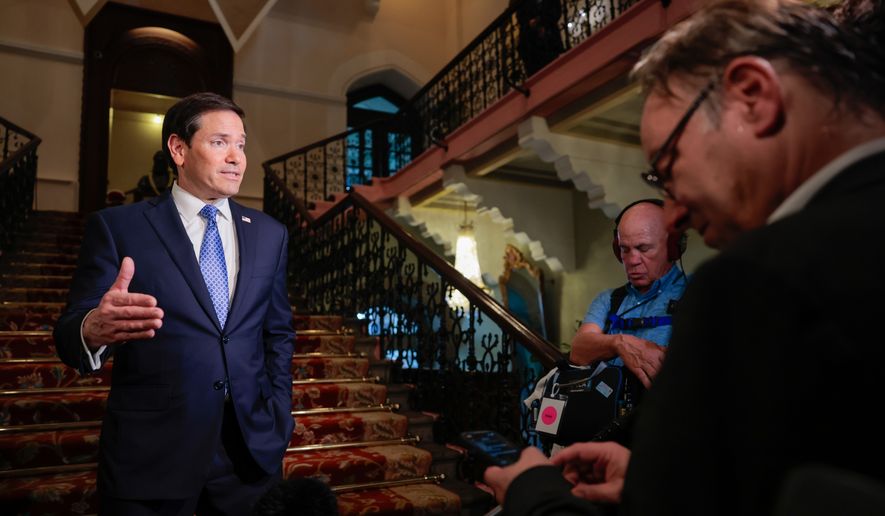

Secretary of State Marco Rubio disputed reports on Tuesday that the U.S. shifted its policy away from sharing intelligence and providing weapons to Ukraine, just hours after fielding a call with Ukrainian President Volodymyr Zelenskyy.
Speaking to reporters in India, Mr. Rubio insisted that U.S. policy toward Ukraine “remains the same” and that reports to the contrary are inaccurate.
“I think the important takeaway from you is that there has not been some deliberate political directive to go out and harm Ukraine. This is just not accurate. Even this talk about I think on the 13th and again on the 18th there were airstrikes in Ukraine that were not detected — that is not because America did not provide information,” Mr. Rubio said.
People were interested in these podcasts
He added that there may have been a technical issue on the Ukrainians’ end that made it difficult for them “to take the information that was being provided and systemize and react to it.”
Mr. Rubio said he addressed on the phone call with Mr. Zelenskyy several accusations that have circulated in the media regarding alleged changes in U.S. policy, including an intentional throttling of SpaceX’s Starshield military satellite service and a halt of intelligence sharing.
The secretary clarified that President Trump made no changes to U.S. policy regarding support for Ukraine.
In a post on X, Mr. Zelenskyy thanked Mr. Rubio for his “clear position” and “readiness to help.” He reiterated that Ukraine is seriously concerned about interruptions in access to Starshield, possible issues with early warning systems and the delivery of ballistic missile interceptors.
“We agreed to get in touch again soon for an update. Thank you, Marco, for the constructive discussion! Thank you to everyone in America who supports fair approaches,” Mr. Zelenskyy wrote on X.
Mr. Rubio told reporters that demand for U.S.-made missile interceptors is high around the world. He clarified that just because a country doesn’t get the equipment doesn’t mean Washington has specifically denied it.
“We have our own needs too. We have minimum standards that we have to meet internally in our base presence all over the world. That includes our bases in Europe, as an example. There’s minimum standards that our Defense Department, our Department of War, requires to protect these facilities, and obviously in the Middle East,” he said.
The U.S. and Ukraine are also at odds over Kyiv’s strategy of hitting Russian oil refineries, which Ukraine says is essential to inflict economic damage on Moscow.
Mr. Trump, in turn, has called for an energy ceasefire between Russia and Ukraine and has implied that Kyiv’s attacks on refineries had driven up oil prices. Most experts attribute the massive increase in oil prices to the Iran war, which has inflicted damage to oil infrastructure in the Middle East and led to the closure of the Strait of Hormuz.
Contact the author

Please read our comment policy before commenting.