


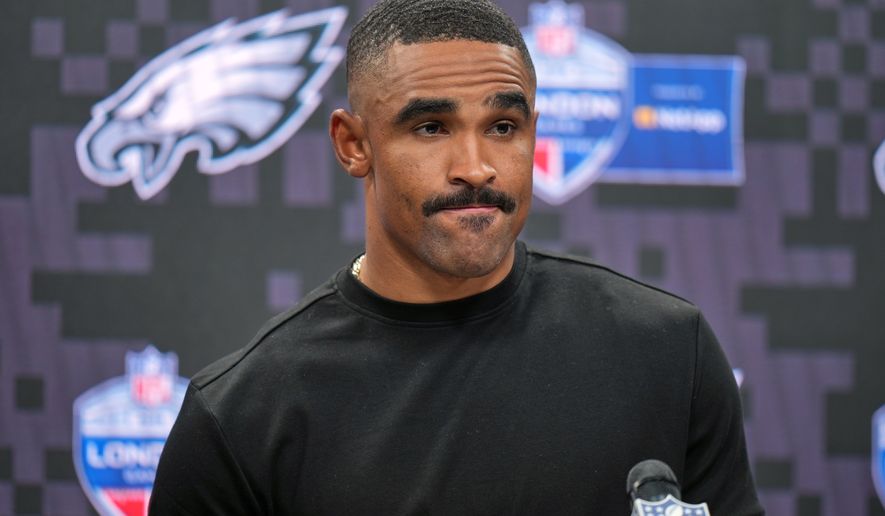

The Philadelphia Eagles will be without their starting quarterback for the rest of the season.
The franchise announced Monday that Jalen Hurts would be sidelined for months after imaging diagnosed deep vein thrombosis and blood clots in his lungs.
Hurts’ “prognosis is very good, and we expect a full recovery,” the Eagles said in a joint statement with Nicole Lynn, the quarterback’s agent. He is being treated with blood thinners, but is on strict no-contact orders.
People were interested in these podcasts
“We anticipate that he will have the opportunity to resume football activities when off the blood thinners,” team officials and Ms. Lynn said. “In the meantime, he will remain active around the team and continue to condition. More importantly, we anticipate that he will have no long-term effects.”
Pulmonary embolisms can be fatal. A 2022 study in the Nature Reviews Cardiology journal determined that about 1 out of 5 people who suffer a blood clot in the lung die within six months, though the root cause of the clot is a key factor in determining a long-term prognosis. Hurts is receiving constant monitoring and appeared to suffer his initial clot when a cleat hit his calf during an Oct. 4 game against the Los Angeles Rams.
Hurts practiced the following week and informed the medical staff of the injury following an Oct. 8 practice. The issue wasn’t considered problematic enough to keep him from traveling with the team to London for the Oct. 11 game against the Jacksonville Jaguars.
Philadelphia had already moved the signal-caller to injured reserve before Sunday’s loss to the Carolina Panthers. Tanner McKee, the Eagles’ backup, is expected to lead the offense for the foreseeable future. Cole Payton, a fifth-round rookie, is next in line. Philadelphia also signed quarterback Joe Milton from the Dallas Cowboys’ practice squad.
“A direct blow can set off a chain reaction — inflammation, injury to the vessel wall and activation of the clotting system — that may culminate in a clot forming at the site. Clinicians have long recognized the connection between blunt injury and clot formation,” Dr. Jordan Schaefer, a hematologist at the University of Michigan, wrote for the National Blood Clot Alliance on Monday. “In any individual case, however, it can be difficult to determine whether trauma caused a clot or aggravated one that was already present.”
“Out of an abundance of caution, an ultrasound was performed on Saturday following the team’s flight to London and walkthrough,” the Eagles said in a statement last week. “The ultrasound revealed a superficial blood clot. Our medical staff and doctors in London reviewed the results and concluded that activity and mobility were important and that Jalen could safely play. Doctors recommended a follow-up ultrasound within 72 hours of the game and the return flight to Philadelphia.”
Even so, team officials determined that he could safely play against Jacksonville. But fans and analysts across the NFL landscape questioned the Eagles’ decision on Monday. Multiple reports indicated that Hurts didn’t sleep the night before the Oct. 11 game in London.
He was given a quiet room to rest in before the matchup against the Jaguars, Hurts’ agent told NFL Network.
The quarterback started anyway.
His efforts fell just short, as the Jaguars won on a last-second field goal. The decision to allow Hurts to play was questioned throughout the NFL landscape as more information about his condition — including his lack of sleep — became available.
“In terms of the decision to allow him to play, I don’t know enough about that to really comment. Intuitively, one thinks it would’ve been prudent to sit out. If it was me, that’s probably what I would’ve done,” Dr. Barry Talesnick, who consults for the Washington Wizards, told The Washington Times. “But hindsight is 20/20.”
Eagles representatives did not confirm whether the blood clot moved from his calf to his lung, or if the initial diagnosis was incorrect. The franchise also did not note whether the transatlantic flight from Philadelphia to London and back complicated the issue. Deep vein thrombosis often occurs on long flights due to a lack of mobility combined with the dry air of airplane cabins.
Superficial clots, such as the one that Hurts was initially diagnosed with, can often accompany undiagnosed deep vein thrombosis. The less serious superficial clots can also lead to clots in deeper veins, and in the lungs, in the future.
Hurts’ current diagnosis — “deep vein thrombosis as well as bilateral pulmonary emboli” — is significantly more serious than a superficial clot.
“They could — and it’s just conjecture — have seen that it was a superficial clot and it propagated, broke apart and caused a pulmonary embolism,” Dr. Talesnick said. “The ultrasound is not foolproof. He may have had some small deep vein thrombosis that may not have been picked up by the ultrasound.”
The blood thinners should help, according to Dr. Schaefer.
“For an athlete in a contact sport, however, this treatment complicates decisions about when it is safe to return to athletic participation,” he wrote. “Jalen Hurts has a world-class medical team and access to continuous monitoring.”
But the Eagles’ decision to bring Hurts home on the team plane has also been questioned on social media. Long flights and superficial clots are both risk factors for deep vein thrombosis.
“In all my years of practice, from the times I’ve had someone with superficial, it’s never come up. I would always err on the side of conservatism and say, ’If it’s fairly significant, cancel your trip and make sure this resolves,’” Dr. Talesnick said. “We always run the risk that it’s superficial and becomes DVT. I might say, ’let’s delay your trip back a day or two.’”
“The question is timing,” said Sydney Schupak, a lawyer who specializes in medical malpractice. “The common and typical advice I’ve seen in these cases from our experts and research is: it would not be safe to get on a plane, both because of the air pressure and because you’re sitting for a long period of time. That makes it much higher risk for these clots to grow, to propagate.”
Eagles officials said in a statement last week that they were in contact with NFL officials throughout the process.
The next step in Hurts’ recovery will see him rely on blood thinners to address the clots in his lungs. But whether he pursues legal action remains to be seen.
NFL players have sued team-affiliated medical staff on rare occasions. Quarterback Tyrod Taylor filed a lawsuit after he suffered a punctured lung at the hands of a doctor for the Los Angeles Chargers.
The case was settled out of court.
Many questions remain about Hurts’ situation, such as which doctors were responsible for diagnosing his initial, superficial clot. The quarterback could decide to pursue legal action, though it would depend on many factors, including whether he relied on guidance from an independent specialist.
“If the advice was from a doctor in the United States, he would be able to pursue medical malpractice action for damages,” Mr. Schupak said. “When you have a blood clot that travels to your lungs, very often you’re on medication for the rest of your life. As a quarterback in the NFL, I can’t imagine it wouldn’t have serious repercussions for him.”
A suit against the NFL or the Eagles would be less likely, Mr. Schupak said. Players are typically counted as employees, with injuries handled under workers’ compensation guidelines.
Hurts has not publicly announced any intention of pursuing legal action.
Hurts’ return-to-play timeline has shifted over the last week. The Eagles initially ruled Hurts out for the Carolina game before moving him to injured reserve — which sidelines him for at least four games — on Saturday. Monday’s update was season-ending news, according to multiple reports.
Panthers right tackle Taylor Moton received a similar diagnosis in late June. He couldn’t make his season debut until Sunday, nearly four months after doctors initially discovered the clots in his right lung.
The Eagles are in the middle of a tight race for the NFC East crown. None of the four franchises, including the Dallas Cowboys, New York Giants and Washington Commanders, have impressed through the first six weeks of the season.
Philadelphia, New York and Dallas all lost on Sunday, while Washington entered Monday night’s game against the San Francisco 49ers as heavy underdogs. The 3-2-1 Giants hold a narrow lead over the Eagles and Cowboys, who both sit at 2-4. The Commanders fell to 1-3-1 — and 0-2-1 in divisional play — after a tie against the Giants on Oct. 11.
Contact the author

Please read our comment policy before commenting.