


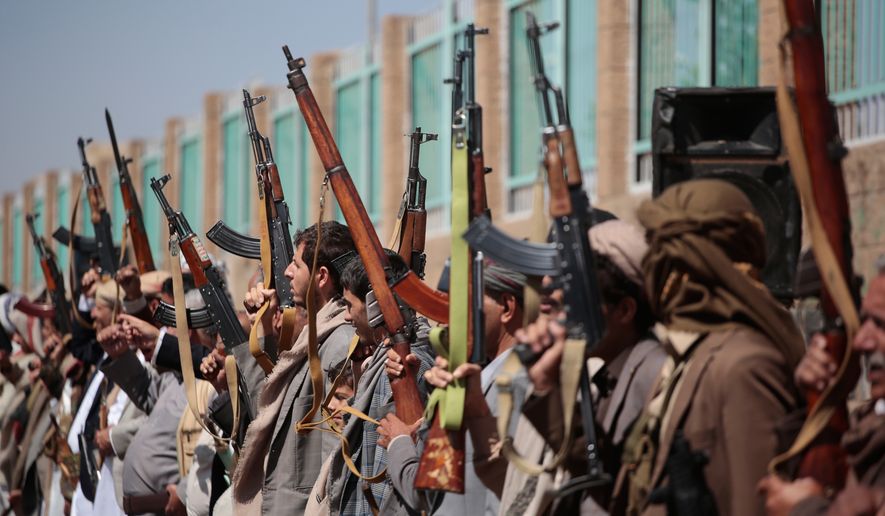

A missile barrage from Iran-backed Houthi militants in Yemen killed at least 53 troops from the Yemeni government on Monday, according to reports, in one of the deadliest attacks since fighting erupted over the summer.
The attack on the Al-Alam military camp in Shabwa province, southern Yemen also wounded at least 200 people, according to officials. The camp was reportedly used by Saudi and Yemeni forces as a training center and staging ground.
Houthi military spokesperson Gen. Yahya Saree said the rebels targeted the camp for hosting Saudi military personnel and framed the strike as defensive, warning Yemeni recruits against participating in attacks against the Houthis.
People were interested in these podcasts
Rashad al-Alimi, the chairman of Yemen’s internationally recognized Presidential Leadership Council, vowed to respond to the strike, which he described as criminal. Awad bin Al-Wazir, the governor of Shabwa province, similarly, called on regional security forces to bolster air defenses in the region.
“This bloody, treacherous attack targeted new recruits in the training and preparation phase and is considered an extremely critical military escalation and a blatant aggression on the security and stability of Shabwa province,” the Shabwa government wrote in a statement.
The government also warned that the death toll could rise this week as damage is assessed.
The strike comes less than a day after the Houthis blamed the Saudi-led coalition forces in Yemen for a strike on the northern province of Saada that killed at least nine people, including women and children.
Monday’s deadly missile strike is one of the deadliest since fighting between the Houthis and the Saudi-led coalition in Yemen escalated earlier this year.
While Saudi Arabia has fought against the Iran-backed Shiite militia since 2015, when it joined the internationally recognized government of Yemen in its civil war, fighting escalated after the U.S. and Israel launched a war on Iran in February.
The Houthis in July declared a naval blockade of all Saudi ships transiting in the Red Sea, which prompted an increase in fighting in Yemen proper between the militia and Yemeni government forces.
Houthi military officials have frequently framed the recent military operations against Yemeni and Saudi forces as retaliation for strikes on rebel territory. The Houthis have asserted that Saudi Arabia orchestrated hundreds of air strikes in recent weeks.
In recent weeks, the Houthis gained control over large swaths of territory off Yemen’s western coast, giving the rebels increased access to the Bab el-Mandeb strait in the southern end of the Red Sea.
The new territory may have also given the Houthis more opportunities to strike at Saudi Arabian infrastructure, including airports, military facilities and the administrative offices of Aramco, the Saudi-owned oil company.
A recent missile attack on King Khalid International Airport in Riyadh, the second busiest airport in the country, killed at least 17 people and injured more than 300. The attack also forced the kingdom to clear airspace and pause flights across the country.
The attacks have emerged as a major economic threat to Saudi Arabia, which has in recent years painted itself as a safe haven for Western investment and culture.
The leaders behind the Future Investment Initiative, an annual financial summit scheduled to take place in Riyadh next week, announced the conference would be canceled over security concerns.
Financial titans like Citigroup CEO Jane Fraser, Goldman Sachs CEO David Solomon and JPMorgan Chase CEO Jamie Dimon were all slated to attend.
The dangerous security situation in Yemen and Saudi Arabia led the U.S. State Department to update its travel advisory for the Middle East on Monday, telling citizens to expect flight cancellations, airspace closures, and travel disruptions due to the “complex security environment” in the region.
The notice specifically mentioned the Iran-backed Houthi rebels’ attacks on civilian airports and critical infrastructure in Saudi Arabia and warned that they have the “potential to escalate rapidly beyond that immediate area.
“Americans traveling to or from the Middle East should monitor information about airport and airline operations and develop contingency plans in advance. Iran and groups supportive of Iran may target other U.S. interests overseas or at locations associated with the United States,” a statement on X reads.
In Tehran on Monday, Russian Foreign Minister Sergey Lavrov met with his counterpart, Iranian Foreign Minister Abbas Araghchi, to discuss regional developments and the status of talks to end the war with the U.S.
Speaking at a joint press conference after the meeting, Mr. Araghchi described the talks as fruitful, according to state-affiliated media.
Contact the author

Please read our comment policy before commenting.