


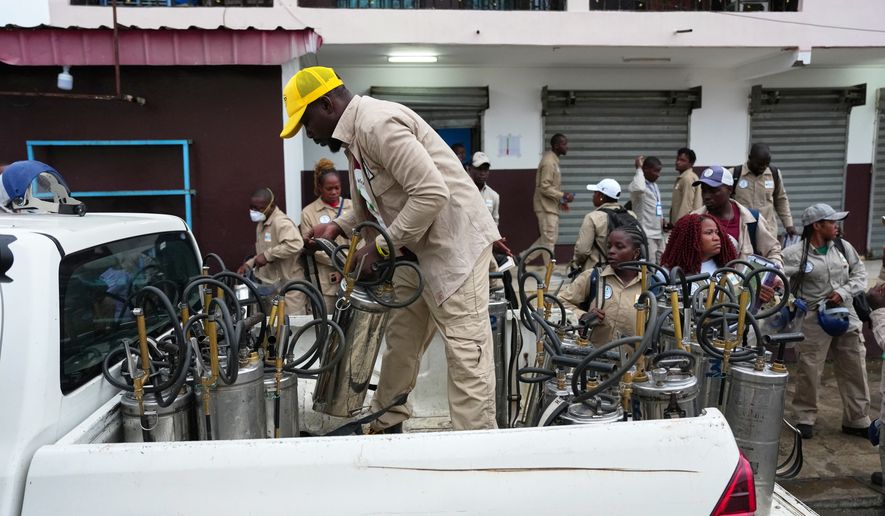

MALABO, Equatorial Guinea — With its torrential rains, tropical forests and omnipresent humidity, Equatorial Guinea provides the perfect conditions for mosquitoes to breed. For centuries, mosquito-borne diseases, in particular malaria, have dictated the fate of residents of this central African nation, impacting how they lived, worked and died.
But Bioko island, off mainland Equatorial Guinea, has managed to sharply reduce malaria infections and deaths.
Bioko, roughly half the size of Rhode Island, has used familiar tools: indoor spraying, mosquito nets and keeping control of the larvae population. Its success, however, has depended on something less easily replicated: two decades of painstaking data collection, sustained funding and workers going door to door to win residents’ trust.
People were interested in these podcasts
Now the tiny, oil-rich country wants to bring that approach to its mainland and eliminate malaria altogether. But the expansion of Bioko’s strategy presents formidable challenges, from porous international borders to the sheer scale of the territory.
In Malabo, Bioko’s biggest city, a team of men and women equipped with insecticide sprayers squeezed between low-rise cement buildings on a recent morning, as heavy rain drummed on aluminum roofs.
“We are here to give key messages so that the population understands the importance of our interventions,” said Cristina Ngui Otogo, the program coordinator. “Today it will be hard to convince people to get out of their homes.”
PHOTOS: Equatorial Guinea is expanding an ambitious malaria elimination plan
Around 610,000 people died in 2024 from malaria, according to the last available data from the WHO, and African countries accounted for 95% of global cases and deaths.
Despite technological advances, such as new vaccines for children, the fight against malaria in Africa has stalled, making it unlikely the continent can achieve its goal of eliminating the disease by 2030. Only two countries in sub-Saharan Africa have been certified malaria free by the World Health Organization: Mauritius and Cabo Verde, both of them island nations.
The program uses data to adjust strategy in real time
Africa CDC experts say one key element of Bioko’s strategy is meticulously collecting data about the population and where people live.
“First, we did a population census with the number of houses and demographics,” said Guillermo Garcia of U.S. nonprofit MCD Global Health, which implements the program. “There is no address system in Equatorial Guinea, so we came up with our own system to map out how many houses there are and where, and track the spraying and the number of cases.”
The collected data allows for designing targeted interventions, tracking their effectiveness in real time and adjusting them if needed. Data teams look at the timings of when houses were sprayed and which ones reported cases of malaria, then analyze how best to prevent future infections.
Empathy is key for getting people on board
The core of the program depends on people who patiently go from door to door and explain the strategy to residents, trying to convince them to get their houses sprayed.
Benjamin Esono, a university student who works part time as a sprayer, said that the key to success was empathy.
“Each person is different, so you need to have a different way of connecting with them,” he said.
“It has not always been easy” to get residents on board, said Ngui Otogo, the coordinator. Sometimes it takes several attempts.
One of those who let the sprayers in despite the early hour and pouring rain was Elena Ntongono, who works as a security guard. As she hastily changed from her pajamas, she explained that she had malaria multiple times, most recently seven months ago.
“It wasn’t very serious,” she said, though it did mean she had to miss work. That was a big problem because she is the main breadwinner in the family.
She wants to avoid that in the future, she said, and to protect her 11-month-old grandson who has not had malaria yet.
“I am very happy my house is being sprayed,” she said.
U.S. oil companies have helped fund the program
Funding is a problem. The effort on the island has been funded by oil giants which have been operating there since the 1990s. Together with the government, U.S. oil companies, including ConocoPhillips and Chevron Oil, have invested over $130 million over the last two decades to fight malaria in Bioko.
No such funding had been available for the mainland until earlier this year, when a $116 million investment from the government and businesses was announced to roll out the program on the mainland and the Annobon island, a remote, volcanic island which forms the country’s southernmost province.
“There was a common shared interest” between the government and U.S. oil companies operating in Equatorial Guinea, Mitoha Ondo’o Ayekaba, the country’s health minister, told The Associated Press in an interview. Oil companies realized that many employees were off sick with malaria, decreasing their productivity.
Because of its oil wealth, Equatorial Guinea has one of Africa’s higher per-capita incomes. Yet the country is rife with corruption, and more than half its population lives in poverty. Many houses in the densely populated middle class neighborhood where the sprayers operated were built with low quality materials, left unfinished or damaged.
Drones and genetically modified mosquitoes could be added tools
Ayekaba, the health minister, was born and raised in Malabo. He said that as a child, he was hospitalized several times a year because of malaria. His two children, ages 5 and 7, have never contracted it.
“That would have been unthinkable before the program was launched,” he said, when around half of Bioko Island’s population was infected with malaria. Now the prevalence of malaria is around 7%, and deaths of children under five decreased by 78%.
Eliminating malaria from the whole territory is necessary to attract tourists and ensure economic growth, the health minister said.
The strategy will combine the methods used in Bioko with the rollout of R21, a WHO-recommended vaccine for children. Garcia said the plan was to vaccinate 300,000 children across the country, and to use new surveillance methods, including drones, to spot mosquito hot spots.
Authorities are also evaluating the use of genetically modified mosquitoes, which are being developed by experts at the University of California, Davis. The plan would be to release the genetically modified mosquitoes, which would no longer carry the malaria parasite, to either suppress the number of wild insects or reduce their capacity to transmit the disease.
Malaria is a disease of rural poverty
Authorities of Equatorial Guinea insisted that Bioko’s success was “perfectly replicable” in the mainland.
But experts point out that Bioko has a natural advantage: It is an island, where the risk of transmission from abroad is reduced.
Mainland Equatorial Guinea borders two countries with high malaria prevalence, Cameroon and Gabon. Mosquitoes and infected people can move freely from one country to another, and success requires complex coordination between the governments. The mainland’s surface is also 13 times bigger than Bioko.
“What experience has taught us is that the current package of interventions is not sufficient for eliminating malaria from any country in continental sub-Saharan Africa,” said Dr. Matthew M. Ippolito, associate professor of medicine at the Johns Hopkins School of Medicine and a malaria specialist.
Eliminating malaria requires precisely timing interventions to local transmission patterns, which can vary significantly even within one country, he said. And even then, infections can be reintroduced from neighboring countries if their control efforts fail.
But the “absolute key” in saving lives was economic development that trickles down to the population, he said.
“Malaria is a disease of rural poverty,” he said, adding it cannot be fought without “better housing, better healthcare, and better health in general.”
____
The Associated Press receives financial support for global health and development coverage in Africa from the Gates Foundation. The AP is solely responsible for all content. Find AP’s standards for working with philanthropies, a list of supporters and funded coverage areas at AP.org.
Please read our comment policy before commenting.