


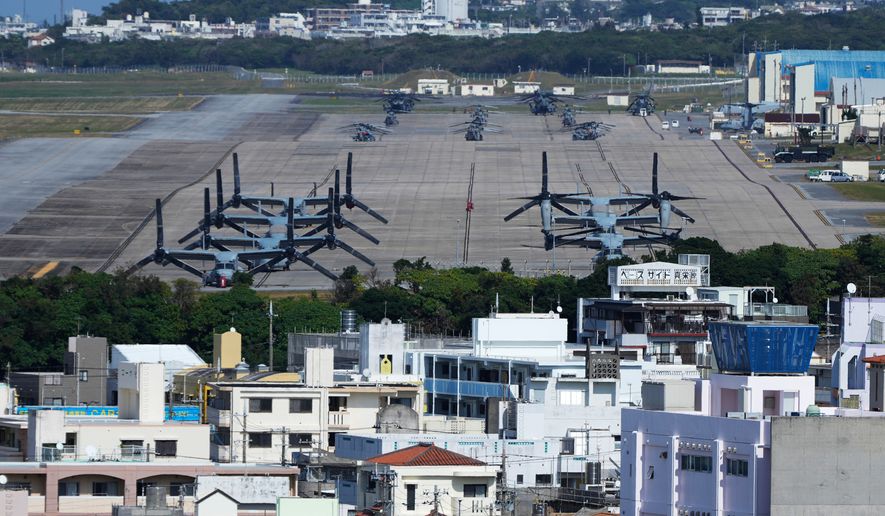

SEOUL, South Korea — In a “thumbs up” signal to American forces in Okinawa, the newly minted prefectural governor approved the deployment of U.S. aircraft long opposed on the Japanese island less than 500 miles from China.
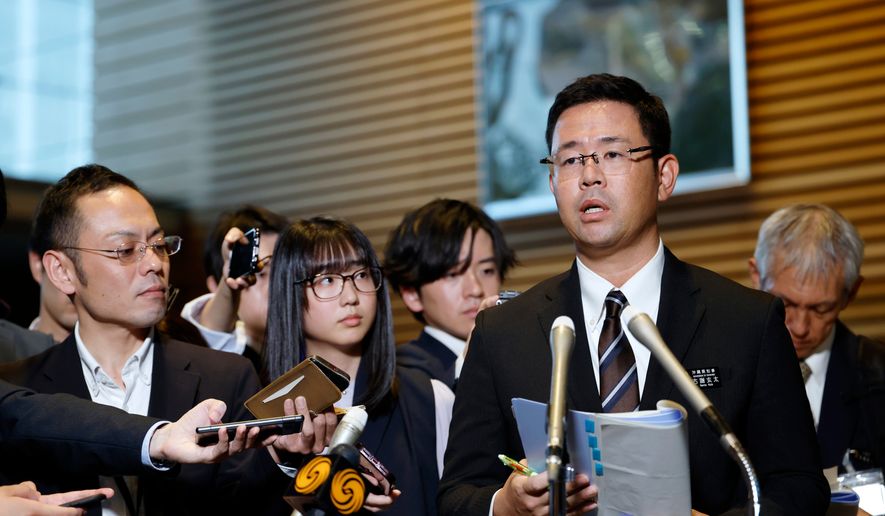
Okinawa Gov. Genta Koja on Friday said he accepted the deployment of Osprey aircraft, used by U.S. Marines, in the prefecture.
“More than 10 years have passed since the [first] deployment,” he said, per Japanese media. “Considering that the [Japanese] Self-Defense Forces operate the aircraft, it is not realistic to call for a reversal of their deployment or use.”
People were interested in these podcasts
The vertical-takeoff model has the characteristics of both fixed- and rotary-wing aircraft, but it has a spotty safety record and has suffered two crashes in and off Japan.
Previous governors had opposed the use of the aircraft, citing its crash risk.
The Osprey has been one of several touchpoints in local sensitivities to U.S. presence in Okinawa.
Others include Futenma Air Station — which is currently surrounded by local civilian domiciles, raising the risk of any potential crashes - as well as the relocation of the base to a coastal location, and crimes by U.S. troops against locals.
Mr. Koja’s Osprey decision comes hot on the heels of the arrest of a U.S. Marine lance corporal on Okinawa on Oct. 3. He stands accused of robbing and murdering a local woman, angering the local community.
Mr. Koja’s nod toward U.S. troops comes against this backdrop of local emotion.
The governor, who at 42 is young by the standards of Japanese officeholders, appears to represent a sea change in Okinawan politics.
He won the gubernatorial seat on Sept. 30, ousting two-term Gov. Denny Tamaki, 67, who had held office in Naha City since 2018.
Mr. Koja, an independent, has connections to the Liberal Democratic Party of conservative Prime Minister Sanae Takaichi, who is seen as a defense hawk and a strong supporter of U.S. President Trump.
Mr. Tamaki, by contrast, was a high-profile critic of the U.S. presence on the island.
Okinawa is the largest of the Ryukyu Islands, the archipelago that runs southwest of Japan’s main islands to just east of Taiwan.
As such, it is a critical node — or series of nodes — in the First Island Chain, covering key naval straits. Both Japanese and U.S. forces have, in recent years, been installing anti-air and anti-ship assets on different islands, and Japan has announced a new drone-based coastal defense system, SHIELD, for the archipelago.
Okinawa, formerly the seat of an independent kingdom, was annexed by Japan in 1879. In an intense air-sea-land battle at the end of World War II, tens of thousands of local civilians were killed alongside troops from both sides.
The high death toll from ground combat — which the Japanese main islands did not suffer — became a source of bitterness between Naha and Tokyo. So, too, has the deployment of the majority of U.S. troops in Japan to Okinawa.
Widely quoted and requoted statistics find that though Okinawa represents just 1% of Japan’s total land mass, it hosts 70% of the U.S. military footprint across the nation.
China has leveraged that friction, questioning Japanese sovereignty over Okinawa during times of Beijing-Tokyo tensions.
Since Ms. Takaichi admitted to the Diet last year that any Taiwan contingency would trigger the activation of Japanese forces, Beijing has been infuriated.
Chinese media and academia have waded into the fray with anti-metropole reports and articles.
China-Japan tensions are flaring elsewhere on another set of strategic islands on Japan’s periphery.
Amid recent tensions over what Russia calls the Kurils, and what Japan calls the Northern Territories — a disputed island chain northeast of Japan’s Hokkaido — a Chinese delegation arrived this week.
Tokyo conveyed its displeasure at the visit to Beijing via diplomatic means. On Oct. 14, when asked about the issue by a Japanese reporter, Chinese Foreign Ministry spokesperson Mao Ning said, “China consistently maintains that the outcomes of the victory of the World Anti-Fascist War should be respected and upheld.”
That is a reference to a Soviet assault on the territory in the very last days of World War II. Fighting continued for days after Tokyo’s formal surrender, and Japan has never fully accepted the loss.
Contact the author

Please read our comment policy before commenting.