





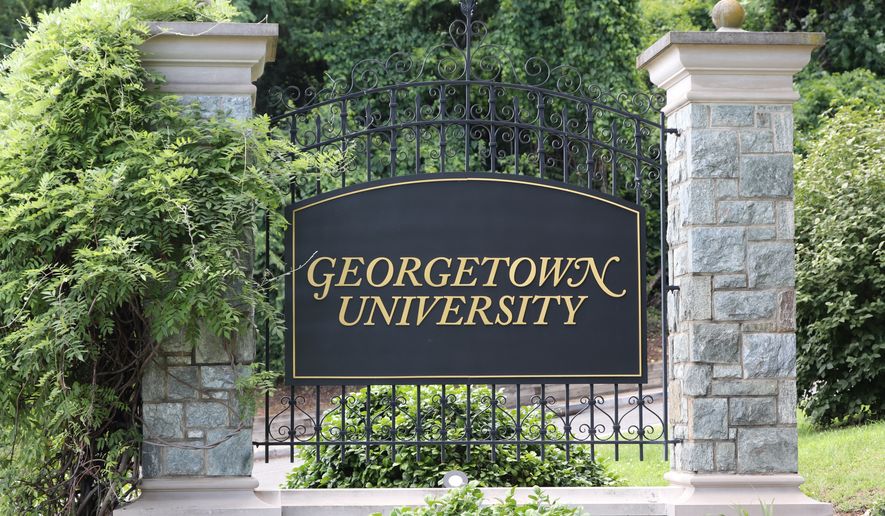
Eduardo Penalver, Georgetown University’s new president, said he believes college needs an “extended argument” — and he told his school he wants to see a lot more debating.
In an address delivered Friday, as he was officially installed as the university’s 49th president, Mr. Penalver made an impassioned defense of intellectual freedom on campus and urged his students and faculty not to seek the numb safety of ideological conformity.
People were interested in these podcasts
“We have forgotten how to argue,” he said. “It’s telling that a common response to disagreement these days is to go no contact.”
He said Georgetown will try a different approach — a “contest of big and important ideas,” with the best ones arguing their way to the top.
Mr. Penalver said the D.C. school’s administration will pave the way by bowing out of the role of referee.
Instead, he said, Georgetown will choose “institutional modesty and restraint.”
He told students not to expect him to issue lots of statements weighing in on matters of the day, “in order to preserve space for student and faculty expression and argument.”
In his previous role as head of Seattle University, another Jesuit institution, he withstood pressure to make a statement on the Israel-Hamas conflict and students’ demands that the school divest from Israel.
He told Georgetown’s student newspaper, The Georgetown Voice, that would have felt “empty and performative.”
In his speech Friday, Mr. Penalver called for campus speech ground rules. Harassing interaction isn’t acceptable, and everyone must share a commitment to civility.
But that can’t become a backdoor way to shut down uncomfortable arguments.
“By civility, I’m not talking about some precious commitment to politeness,” he said.
Mr. Penalver also extolled the need for a diversity of viewpoints, saying otherwise the campus is failing.
“We will welcome conservatives. We will welcome progressives. We will even welcome moderates,” he quipped.
Moms harness AI for liberty
Moms for Liberty, a conservative parental rights organization, is turning to artificial intelligence to help in its quest to keep an eye on the actions of school districts across the nation.
The group announced its new tool, M4LAWFARE, at a summit this month in Dallas, saying it needed a more powerful way to monitor some 13,000 school districts.
“For five years, we’ve asked parents to show up at school board meetings, and they have,” said Tina Descovich, CEO of Moms for Liberty. “The problem is that it’s incredibly time-consuming to sift through thousands of pages in agendas each week, and school districts count on that. Moms for Liberty is harnessing AI to increase the oversight of school boards across the nation, empowering parents like never before.”
M4LAWFARE will scour the agendas to assess how schools’ actions would affect parental rights, free speech, the curriculum and diversity, equity and inclusion efforts.
Alerts will then be pushed to local Moms for Liberty chapters so they can mobilize to make their sentiments known at school board meetings. The hope is for a 72-hour heads-up to members.
Moms for Liberty counts more than 130,000 members in 300 chapters across 48 states.
Attending the summit this month were Texas Gov. Greg Abbott and Attorney General Ken Paxton, who is the Republican nominee for the Senate.
Mr. Abbott said parents must be the deciders in chief for their kids’ schooling.
“In Texas, we will ensure families always have a say in education and uphold the rights that belong to them,” he said.
Scott Presler’s ground game
As most political campaigns battle it out on the internet and airwaves, Scott Presler is going the other way — pushing old-fashioned door-to-door canvassing.
The founder of Early Vote Action, a conservative group, Mr. Presler argues that money spent on getting someone into a neighborhood to register and encourage voting is better spent than that amount dumped into an internet ad that “you’ll scroll past.”
“One motivated activist can have dozens of real conversations in a single hour. Multiply that by the staff we can deploy, and you are looking at the operation that swings seats and majorities,” Mr. Presler told supporters in an email this week.
A particular focus this year is on Christians, among the most reliable Republican voters.
Mr. Presler says 30% of Christians don’t vote, and getting just a fraction of those could mean millions of additional people at the polls — more than enough to swing battleground state races.
Mr. Presler is a social media influencer and political activist who has been working to elect President Trump and his MAGA allies since 2016.
He moved to Pennsylvania ahead of the 2024 election with the goal of picking up the battleground state. It worked. Mr. Trump flipped the state.
Mr. Presler’s map for 2026 includes Arizona, Michigan, Nevada and Wisconsin.
• Seen, Heard & Whispered is a weekly column taking you inside the conversations happening in Washington’s power corridors, the moves being made and the whispers that explain what’s really going on in the nation’s capital. Email tips to whispered@washingtontimes.com. Click here to receive this in your inbox every Friday morning.
Contact the author

Please read our comment policy before commenting.