


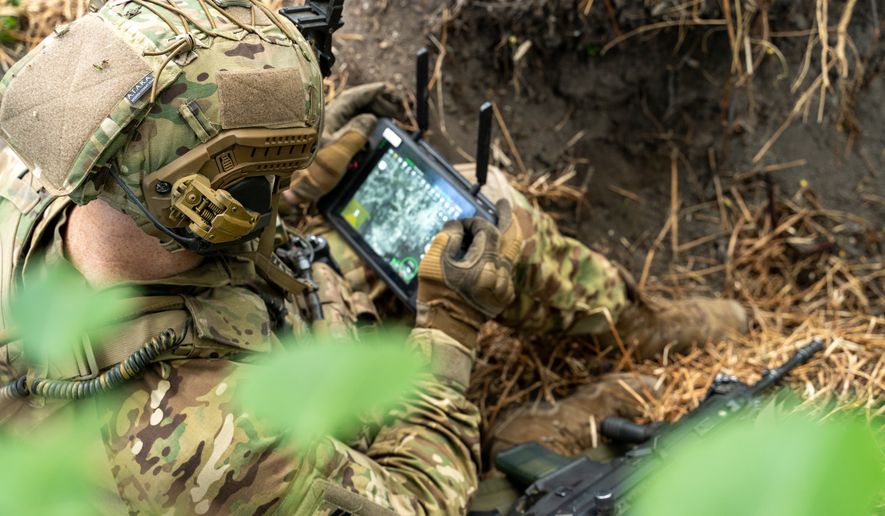

Vital U.S. Army weapons and communications tools are undergirded by software that must be updated at lightning speed, crucial in keeping the nation’s largest military service’s systems from becoming obsolete on modern battlefields, said the Army’s chief technology officer.
In an exclusive interview with The Washington Times, Army Chief Technology Officer Alex Miller explained how the service’s approach of moving at the speed of business, rather than the federal government’s traditionally slow pace, is fueling an overhaul of the Army’s approach to acquiring and fielding new tools for America’s soldiers.
Mr. Miller stressed that core components of Army battlefield capabilities, such as the munitions and other hardware in modern missile systems, will be reliable for years.
People were interested in these podcasts
Still, the software driving many of those systems must be updated on a schedule resembling the routine updates on today’s smartphones, not the yearslong cycles of the Pentagon’s past.
“You get 21 to 90 days before the thing that you’re fielding is near obsolete,” Mr. Miller told The Times in an interview at the Association of the United States Army annual conference this week in downtown Washington, the largest land warfare exposition in the United States.
“And it’s not every component. A lot of our missile systems, they’re amazing. They work now. They’ve worked for years. They will work for years,” Mr. Miller said. “But if you wait five years to update the tracking software that guides the radars, the sensors, the communication, you will be obsolete in a modern battlefield.”
Mr. Miller made the comments against the backdrop of a militarywide push to ensure the U.S. solidifies an edge over its adversaries in developing one-way attack drones and other autonomous systems, long-range artillery fires and artificial intelligence — or, as President Trump calls it, super intelligence.
Nowhere is that push more evident than in the world of drones, with the Pentagon aiming to field small attack drones in the tens of thousands as part of its ongoing push into autonomous systems.
The Russia-Ukraine war, largely defined by drone warfare, offers a window into the software aspect of the equation.
Although a drone’s hardware — its motor, sensors and other physical components — can remain relatively constant, the software beneath it can become obsolete quickly as enemy forces tweak their counter-drone capabilities, such as electronic warfare to jam a drone’s signal.
For U.S. soldiers who could face similar battlefield challenges, Mr. Miller said the Army’s new approach draws lessons from the car industry, which makes periodic major upgrades, such as computer screens, while software updates happen consistently.
“And those software updates happen daily, weekly, monthly, rather than annually,” Mr. Miller said.
He spoke with The Times just hours after acting Army Secretary Adam R. Telle said in a keynote speech at AUSA that the service is undergoing historic change.
“Cut the red tape so we can win again,” Mr. Telle said. “We can’t evolve the Army at the speed of government. We have to evolve it at the speed of business. That’s easy to say but really hard to do.”
A number of Army programs are driving significant change on a host of fronts. Mr. Telle cited the Army’s FUZE program, described as a venture-capital-focused strategy for finding nontraditional companies building cutting-edge capabilities, as one example.
Project Janus and Joint Interagency Task Force-401 — a plan to deploy nuclear microreactors on military bases and a major counter-drone initiative in which the Army plays a significant role, respectively — are two other initiatives the Army is engaged in.
Under the Trump administration, the Pentagon is undergoing significant transformations more broadly.
Defense Secretary Pete Hegseth recently announced the creation of Project Meridian, a working group that aims to rethink U.S. military doctrine and deliver a blueprint for how American forces can succeed amid rapidly evolving technology and artificial intelligence.
For the Army, Mr. Miller said, the pace of technological innovation is so fast that it is critical that soldiers not be overloaded with information and training.
“Here is the 80% solution for 80% of your users. Here’s how it needs to be. Simple to learn, easy to operate, easy to adapt,” Mr. Miller said. “And then for our power users, for our super users who are going to get into the weeds, who are actually going to look at the telemetry data, the parametrics, who are actually going to read radar-type tracks, we can specialize there, and we can train them extra.
“But we really want to focus on, no matter how complex this system is, our soldiers know what their mission is. Our soldiers know what their task is. How do we meet them where they’re at, rather than trying to make them meet the engineers where they’re at?”
Contact the author

Please read our comment policy before commenting.