


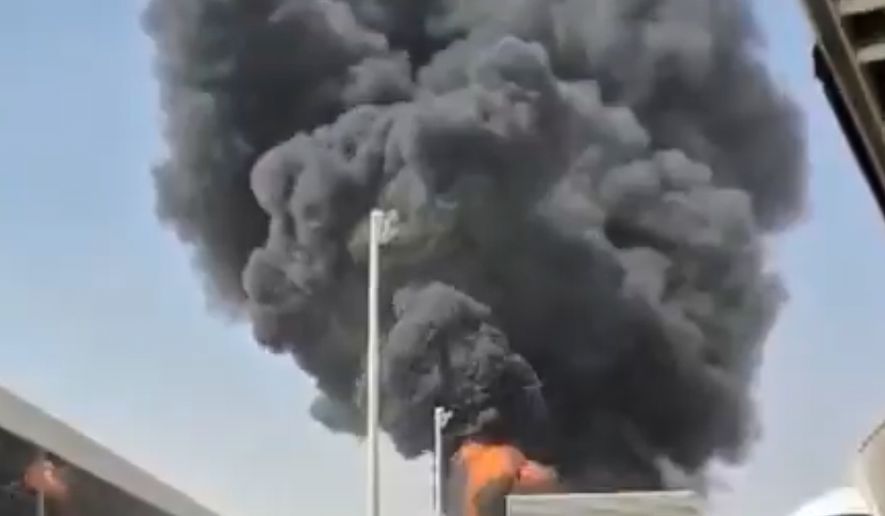

The Houthis claimed responsibility for a Sunday attack that resulted in new injuries at a Saudi Arabian airport passenger terminal one day after a missile hit the same building and killed at least a dozen people, including an American, in an escalation that has the Trump administration weighing retaliatory U.S. strikes.
Saturday’s missile strike on the capital’s King Khalid International Airport left more than 300 people injured and was the deadliest attack in years on Saudi Arabia.
On Sunday, the Houthis suggested that airlines, workers and travelers should avoid Saudi airports and airspace, warning that the facilities are “vulnerable to targeting and constitute a theater of operations for our forces.”
People were interested in these podcasts
“The armed forces affirm their commitment to implement the declared equation: an airport for an airport, a blockade for a blockade, and escalation for escalation, until the objectives are achieved,” said Brig. Gen. Yahya Saree, a Houthi military spokesman.
He said the only Saudi airports not subject to the Houthi threats of attack are those in Mecca and Medina, the two holiest cities in Islam.
“Everyone should take our warnings seriously,” Gen. Saree said. “Saudi Arabia bears responsibility for any failed attempts to intercept,” the missiles.
President Trump said the U.S. may join Saudi operations against the Houthis, including direct military involvement.
“We’re going to look at it,” Mr. Trump told reporters on Saturday outside the White House. “We’ll make a decision. We move very quickly.
The Houthis have attacked the airport in Riyadh several times in recent days. They have expanded the scale of ballistic missile, cruise missile, and drone attacks targeting Saudi civilian airports since Oct. 4, when Yemeni government-aligned forces launched a counteroffensive to retake territory on the Red Sea coastal plain, according to the Institute for the Study of War think tank.
“The Houthis’ frequent attacks on Saudi civilian infrastructure, particularly airports, are currently motivating Saudi efforts to degrade Houthi ballistic missile capabilities and other long-range strike platforms,” the ISW said.
On Saturday, U.S. forces disabled a commercial cargo vessel in the Gulf of Oman after the crew of the Panamanian-flagged ship ignored repeated warnings while attempting to run the ongoing naval blockade against Iran.
A U.S. military fighter jet struck the stern of the M/V Ocean Molica with a precision munition, disabling the ship’s propulsion without harming the crew. The Ocean Molica, also known as the Akira Sun, was attempting to skirt through regional waters after leaving an Iranian port, according to U.S. Central Command.
Central Command said four commercial ships have been disabled and 135 turned around since July 14, when the U.S. resumed a blockade against all ships entering or departing Iranian ports. U.S. forces have destroyed 10 oil tankers linked to the Islamic Revolutionary Guard Corps’ multi-billion-dollar shadow network over the same period, officials said.
Last year, the U.S. launched an intense bombing campaign against the Houthis primarily to end their persistent missile and drone attacks on international commercial shipping lanes in the Red Sea and the Bab al-Mandeb Strait.
The strikes disrupted global maritime trade and forced ships into costly detours around Africa.
Contact the author

Please read our comment policy before commenting.