


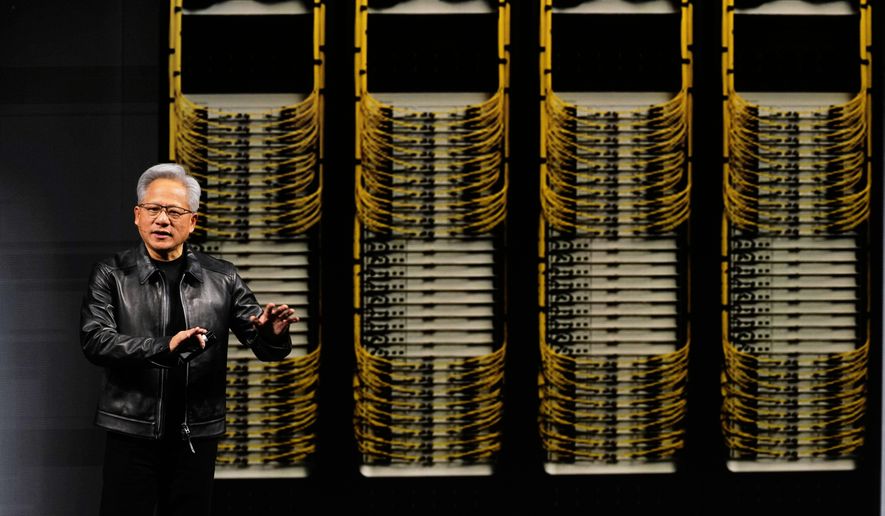

The Chinese Ministry of State Security, the civilian intelligence service, is suspected of conducting a major spying operation by recruiting an agent who had an affair with Nvidia CEO Jensen Huang.
President Trump said Monday that the FBI is looking into it.
Nvidia is also investigating Mr. Huang’s romantic relationship with Alice Huang, a businesswoman whom U.S. intelligence suspects gathered information during a spying operation involving an illicit affair between the two and supplied it to the MSS.
People were interested in these podcasts
The board of directors of the microchip giant opened the independent investigation Sunday after reports that Mr. Huang was the target of a foreign intelligence operation.
Despite the company’s investigation, Nvidia asserted that neither national security nor company secrets were compromised by the spy operation, which is believed to have been underway since 2024.
“While the board has no reason to believe that either national security or Nvidia secrets were compromised, the board’s inquiry will examine all available information,” the company said. Ms. Huang is not related to the Nvidia CEO.
The case follows years of FBI warnings to the Silicon Valley tech industry about Chinese espionage, which many tech leaders ignored, viewing basic security as a nuisance, said John Schindler, a former National Security Agency counterintelligence official.
“Now the Valley has to listen,” he said. “This scandal demands a relook at Chinese intelligence operations against Democrat politicians in the nearby Bay Area — most infamously the disgraced former Rep. Eric Swalwell, who got honey-trapped by a China Doll spy just like Huang did.”
Mr. Huang supports his company’s investigation and is cooperating with a committee of independent directors, backed by outside attorneys, that is overseeing the probe, Nvidia said.
In a note to Nvidia employees, Mr. Huang said he had been “unfaithful” to his wife and hurt her and his two children, who both work at the company.
“I take full responsibility for what I did and the hurt I caused, and I accept the criticism that comes with it,” said Mr. Huang, 63, noting that he supports Nvidia’s investigation. “I am committed to protecting Nvidia and supporting America’s national security.”
Nicholas Eftimiades, a former Defense Intelligence Agency counterintelligence official, said the case against Mr. Huang highlights the aggressive Chinese whole-of-society approach to conducting espionage, economic espionage and covert influence operations.
“Chinese attempts to covertly influence American society are pervasive, ranging from local governments through federal and academic institutions and key industries,” he said.
Former CIA operative Mike Baker said the case appears to be part of a Chinese intelligence “honey trap” — the use of a sexual relationship to gain access to a key American business leader for both influencing U.S. policy and obtaining business or other useful secrets.
Nvidia is a technology company valued at $4.5 trillion that remains the world leader in producing advanced semiconductors for frontier AI systems. It is a key player in the American race against China for AI leadership.
Mr. Huang has a close relationship with Mr. Trump and successfully lobbied the White House last year to loosen export controls on certain less advanced Nvidia chips.
Mr. Trump on Monday said he called Mr. Huang to check in on him.
“He said I had no idea that she was a spy, and I really, and I really believe him,” Mr. Trump said. “I was amazed because I view him as a very high-quality person.”
The president also called Mr. Huang “an amazing guy,” adding, “I hope there’s no problem.”
In Beijing, Chinese Foreign Ministry spokesperson Guo Jiakun on Monday denied there was a spying operation. “The Chinese spy allegation is purely unsubstantiated and directed at smearing China,” he said.
The company’s stock price took a hit after the statement announcing the investigation. Its stock price fell about 4% on Monday.
The suspected spy in the case, Ms. Huang, is an executive of the Singapore-based company Megaspeed, which, according to reports, has purchased billions of dollars worth of AI chips from Nvidia.
U.S. intelligence agencies gathered information in recent months revealing that Ms. Huang was helping China obtain embargoed Nvidia chips and providing information to the MSS, The New York Times reported.
Mr. Trump was briefed on the intelligence but still allowed Mr. Huang to travel on Air Force One during his visit to China in May, the newspaper reported.
Mr. Huang was not originally on the flight but later joined the president and his traveling team at a refueling stop in Alaska.
Ms. Huang was said to have been recruited by the MSS in 2024, according to a secret memorandum drafted with support of Secretary of State Marco Rubio and circulated to senior Trump administration officials before Mr. Trump’s visit to Beijing in May.
Mr. Rubio sidestepped questions from reporters Sunday. “I just can’t comment because of the nature of it. And I also can’t comment on an internal corporate matter that’s going on with Nvidia,” he said.
The intelligence document was derived from classified electronic intelligence surveillance of Ms. Huang, a Chinese national who was working covertly for the MSS, according to the report.
Megaspeed told the newspaper that it was taking the matter extremely seriously and was committed to getting the facts on the spy allegations. The company also said it was conducting an internal investigation and that it was committed to cooperating with U.S. investigations.
Chris McGuire, a senior fellow for China and emerging technologies at the Council on Foreign Relations, said Megaspeed is likely a Chinese “cutout” used by Chinese companies to obtain AI chips or circumvent export controls.
“What is going on here??? We need answers,” Mr. McGuire said on social media.
“The question of who gets the most advanced AI chips in the world is literally the defining strategic question of our time. And not only does it seem like the MSS may be directly influencing the debate on export controls in the United States, but also @CommerceGov is refusing to listen to the warnings of the IC on this issue,” he said.
On Capitol Hill, three Republican committee chairmen wrote to Mr. Huang this month requesting testimony at a joint hearing on “your interactions with a publicly reported People’s Republic of China intelligence asset: Megaspeed executive Alice Huang.”
“Recent reports raise significant national security concerns regarding the PRC’s access to sensitive U.S. technology and information,” the Nov. 4 letter said. “The issue of PRC infiltration and access to cutting-edge U.S. technology is core to the investigative work of our three committees this Congress. It is vital that Congress determines the extent to which U.S. national security has been placed at risk.”
The letter was signed by Rep. John Moolenaar, Michigan Republican and chairman of the House Select Committee on the Chinese Communist Party; Rep. Brian Mast, Florida Republican and chairman of the House Foreign Affairs Committee; and Rep. Rick Crawford, Arkansas Republican and chairman of the House Permanent Select Committee on Intelligence.
Mr. Huang has criticized “China hawks” who he said should wear the label as a “badge of shame” for blocking Chinese researchers from working in the U.S. “Destroying that pipeline [of Chinese researchers entering the U.S.] is not patriotic,” Mr. Huang said in a video interview posted online last year.
Mr. Huang is a pro-China tech industry leader who opposed tightening export controls on China and has been credited by critics with influencing Mr. Trump on the policy.
In December 2025, Mr. Trump said on social media that he agreed to allow Nvidia to sell advanced H200 microchips to China.
Mr. Trump also said he informed Chinese President Xi Jinping that the Nvidia artificial intelligence chips would be sold to “approved customers” in China under conditions that would “allow for continued strong National Security.”
“President Xi responded positively!” the president said, noting that Nvidia will pay the government 25% of the sales.
Nvidia is developing more advanced Blackwell chips and will soon have an even more advanced chip called Rubin, “neither of which are part of this deal,” Mr. Trump said, adding that the administration will always put America first.
It was the second time the president gave in to Chinese demands for the unique U.S. semiconductors critical to the U.S.-China race for AI supremacy.
In July 2025, the Trump administration agreed to allow less advanced Nvidia AI chips to be sold to Beijing, reversing a policy that had sought to prevent U.S. technology from accelerating China’s military buildup.
The July concession granted Nvidia permission to export H20 AI chips. That followed a meeting at the White House between Mr. Trump and Mr. Huang.
H200 semiconductors are gauged to be about one-tenth as powerful as Nvidia’s newer Blackwell chip. However, the H200 is said to be six times more powerful than the H20 that is currently being sold to Beijing.
Mr. McGuire of the Council on Foreign Relations predicted that the fallout from the spying case would be massive.
“Obviously, the motivations underpinning Nvidia’s policy views opposing export controls must now all be questioned. But also, how did [Commerce’s Bureau of Industry and Security] sit on this information and has still taken no actions? We need answers,” he said.
• Jeff Mordock, Kerry Picket and Mary McCue Bell contributed to this report.
Contact the author
Please read our comment policy before commenting.