


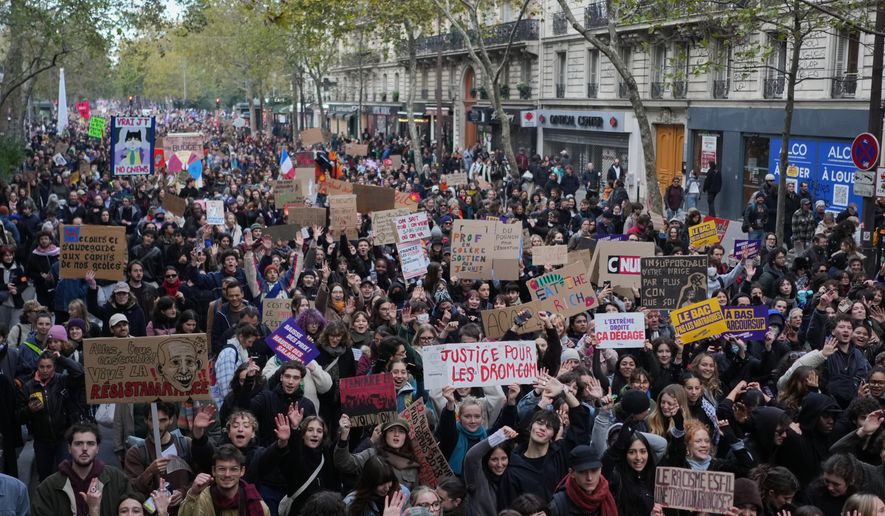

Fury over high prices is bubbling over from Marseille to Michigan, with Europeans hurling Molotov cocktails at the problem and Americans voting for change with a complete reshuffling of Capitol Hill.
Inflation surged to 40-year highs after the pandemic, with post-lockdown spending and stimulus checks boosting demand before supply chains could adapt.
The tumult sparked anti-incumbent ire and rightward political movement, capped by President Trump’s political comeback in 2024.
People were interested in these podcasts
Now, the pendulum is swinging back, with Mr. Trump’s party taking a midterm whipping from voters fed up with energy shocks and elevated prices linked to the Iran war and trade policy.
“Inflation is abstract, and most people don’t understand it very well. While you can say the same thing about tariffs and the Iran war, Trump gives people a name, a face, and someone to blame. That is a politically potent recipe,” said Ryan Young, a senior economist at the Competitive Enterprise Institute.
Mr. Trump isn’t the only one on the hot seat. European leaders face public fervor over years of price hikes, underfunded services and low wages.
Violent clashes in France began as protests over school conditions. They’ve spiraled into mass demonstrations over inflation, driven by soaring energy prices, and a corresponding lack of purchasing power.
Thousands marched in Lisbon and other parts of Portugal over high housing costs and low wages, and similar protests erupted in neighboring Spain.
In Belgium, police used water cannons to subdue students who protested over the high cost of living in Brussels and Liege. Protesters hit the streets in Italy and Albania, too.
French unions issued a joint statement urging people to take to the streets again on Thursday after October violence shocked the world.
“Fuel, food products, rent, gas, electricity — everything’s going up except wages and pensions,” they said.
Their message strikes at the heart of the complaint echoing from the Parisian banlieue to Bangor, Maine.
Prices rise even when the rate of inflation slows. A lower inflation number simply means prices are not rising as quickly.
Wages, meanwhile, don’t always keep up with those prices. The U.S. Bureau of Labor Statistics recently said real average hourly earnings for all employees decreased 0.7% from September 2025 to September 2026.
“Pricing pressures have persisted for several reasons. The Fed had been too late to recognize that inflation wasn’t ‘transitory,’ which created the long, drawn-out inflationary surge. This surge outpaced the growth in incomes, creating affordability problems that persist to this day,” said Wayne Winegarden, a senior fellow in economics at the Pacific Research Institute.
Now, under intense political pressure, U.S. and foreign policymakers are scrambling to undo years of damage from supply shocks, trade friction and overseas conflict.
European leaders are cutting taxes on fuel, finding ways to constrain housing costs and raising interest rates in an attempt to control inflation and the protests spreading across the Continent.
The Trump administration said it made strides in lowering U.S. costs and will work with Democrats on reasonable solutions in the next two years.
“Under President Trump’s leadership, this administration has signed the largest working-class tax cuts in history, cut the cost of prescription drugs, added more than 1 million private-sector jobs, and locked in nearly 20 trade deals,” White House spokesman Matthew Middleton said. “Moving forward, the president will work with anyone willing to advance solutions that strengthen our economy. We hope Democrats will put the American people first and join us in that effort.”
Some liberal lawmakers say corporate monopolies and price gouging are driving price increases. Mr. Trump also said gas companies failed to cut prices fast enough this year, though economists point to a series of underlying dynamics as the root of the inflation problem.
Inflation skyrocketed during the Biden administration, peaking at 9% in mid-2022. The Democrat-led White House initially treated inflation as transitory, and Mr. Biden’s stimulus checks in early 2021 likely fueled the cost problem by overheating demand.
Russia invaded Ukraine in early 2022, causing energy prices to spike on top of it all.
On the 2024 campaign trail, Mr. Trump pledged to slash prices, propelling him to victory over Vice President Kamala Harris.
Inflation fell to about 3% in January 2025. It has ranged from 2.3% to 4.2% in Mr. Trump’s second term.
The Consumer Price Index rose 3.7% for the year ended in September, up from 3.4% in August, and a variety of metrics show inflation running above the Federal Reserve’s target of 2%.
The central bank raised interest rates in September, its first hike in three years, to tame inflation.
Mr. Trump said he inherited the inflation problem from the Biden team, yet voters held him and the GOP accountable on Election Day. About eight in 10 voters said inflation is causing hardship for their families, and 62% held Mr. Trump accountable for high prices, according to an NBC News exit poll.
Economists say Mr. Trump’s tariffs, or duties on foreign goods brought to the U.S., and his decision to attack Iran, which led to widespread energy price shocks, kept prices elevated, so addressing those issues could bring costs down.
“Monetary inflation is actually under pretty decent control, and has been for a couple of years at this point,” Mr. Young said. “The trouble is that price increases from tariffs and energy price spikes are gumming up the works.”
House Minority Leader Hakeem Jeffries, New York Democrat, vowed to address both topics if he’s elected speaker of the House in the new year.
“Donald Trump and House Republicans promised to lower costs on day 1. They failed. Instead, toxic GOP policies like the Trump tariffs and war in Iran have done the exact opposite,” Mr. Jeffries told lawmakers after Democrats secured a massive House majority for the upcoming Congress. “House Democrats must do everything in our power to meaningfully lower the high cost of living.”
The Iran war has been relatively dormant in recent weeks, letting oil prices and gas prices recede, but Mr. Trump is unlikely to relent on his tariff policy. He says it’s boosting economic investment in America and that benefits will flow to workers through jobs and higher pay.
A recent Commerce Department report showed signs of strong economic activity.
The Bureau of Economic Analysis said gross domestic product, a broad measure of goods and services in the country, grew 3.4% in the quarter spanning July, August and September, up from 2.2% during the spring quarter.
Whether that growth, combined with policy decisions between Democrats and Mr. Trump, can boost wages and stabilize prices remains a question. It may keep anger from boiling over, but some measure of discontent will remain.
“Wages were failing to keep pace with inflation for a good chunk of this year, though the difference was just a few tenths of a percentage point. That may change with the most recent GDP report being pretty solid,” Mr. Young said.
Still, he said, “people always have been upset at the cost of living, and they always will be.”
Contact the author

Please read our comment policy before commenting.