


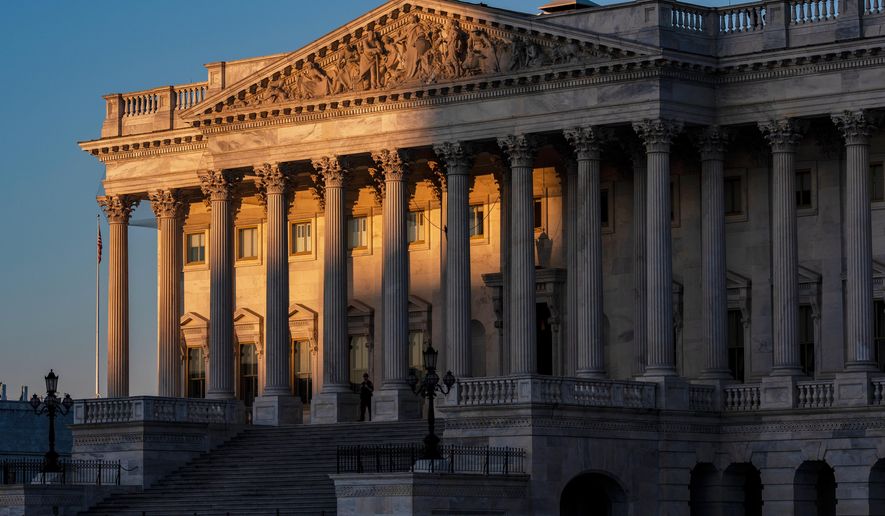

Democrats had flipped a handful of GOP-held House seats on the East Coast in early returns Tuesday and were poised to claim control of the chamber — and a platform to derail President Trump’s agenda.
Republicans’ apparent losses in North Carolina, New Jersey, Pennsylvania, Virginia and Kentucky, combined with their failures to take out vulnerable Democratic incumbents in Florida, had several television networks already projecting control would flip before the final polls closed at midnight.
NBC News projected Democrats would emerge with more than 250 seats.
People were interested in these podcasts
Republicans went into the night with 218 seats to Democrats’ 214, with one independent and two vacancies.
The GOP had hoped to build a bit of a cushion through an unprecedented round of mid-decade redistricting, but those hopes weren’t panning out in the early going Tuesday, as Democrats survived the new lines in Florida and Texas.
“The Trump plot to steal enough seats to keep control of Congress — the will of the people be damned — was systematically dismantled, and, given the opportunity, voters instead chose to elect a new Democratic majority,” said former Attorney General Eric Holder, who heads the National Democratic Redistricting Committee.
Democrats were also projected to have flipped seats in New Jersey, eastern Pennsylvania, North Carolina and Kentucky.
Key races were still to be called, but across the country GOP candidates ran well behind Mr. Trump’s margins — and their own tallies — from two years ago.
Exit polling signaled the growing dissatisfaction among voters with Mr. Trump and an eagerness to install formal checks on him inside Washington.
The president’s approval rating was below 40% in the exit polling done by the major broadcast and news networks. It had been at 45% in 2018, for the midterm elections during his first term.
That’s not to say voters were excited about Mr. Trump’s opponents, either. As of late Tuesday, exit polling showed 54% of voters had negative views of Democrats.
The GOP fared worse still, with 58% down on Republicans.
On the issues, Democrats generally came out on top, with voters giving them an edge in handling the economy, foreign policy and health care. Republicans still prevailed on immigration, and the parties were about even on tax policy.
Asked specifically about Mr. Trump’s actions, though, voters were dismayed.
Some 57% said he’d gone “too far” on immigration enforcement, 62% said it was the “wrong decision” to attack Iran, and 62% said the higher prices they are paying are “because of Trump’s policies.”
The final House breakdown might not be known for weeks, given the travails of counting ballots in places that run all-mail elections. California accepts ballots mailed by Election Day as long as they are received within a week, and Washington state accepts them up until certification, which is three weeks after Election Day.
Democrats’ taking control would follow a pattern.
President Obama enjoyed two years of unified government before losing the House in 2010. Mr. Trump enjoyed two years in his first term before losing control of the House in 2018. President Biden had two years of unified government, albeit only with Vice President Kamala Harris’ tie-breaking vote in the Senate, before losing it in 2022.
Rep. Hakeem Jeffries, the House Democratic leader, would have the inside track on becoming the first Black House speaker.
He’ll have his work cut out for him to manage his party, however, which was unified chiefly by an antipathy to Mr. Trump that papered over some significant divisions.
With Mr. Trump in the White House for two more years — and occasionally joking about serving a third term after that — Democrats likely will retain much of their unity.
Cracks may still show, however, as they navigate some thorny issues abroad, such as Israel, or social policy tests at home, including transgender rights.
Control of committees in the House would give Democrats a perch to pursue investigations of Mr. Trump and his administration.
Republicans did manage to Democrat-proof some of Mr. Trump’s immigration agenda by pouring tens of billions of dollars into the Department of Homeland Security’s enforcement agencies.
That includes money to complete the president’s border wall and to fund his mass deportation campaign.
Unraveling those would be difficult for Democrats, short of winning a government shutdown showdown.
Republicans had little room for losses, having operated for the last two years under one of the slimmest majorities in modern history.
They had hoped to pad their margin through an unprecedented push for mid-decade redistricting, drawing friendlier House maps in Alabama, Florida, Louisiana, North Carolina, Ohio, Tennessee and Texas.
Democrats countered with a better map in California, but saw their hopes for a four-seat gain from a redraw in Virginia dashed by that state’s Supreme Court.
Contact the author

Please read our comment policy before commenting.