



PARIS — Some of Ukraine’s European allies sounded the alarm Tuesday over Kyiv’s dramatic expansion of the nearly five-year war against Russia with crippling new drone strikes on Russian ships in the Mediterranean and the Baltic seas.
Norway’s Defense Minister Tore Sandvik said Tuesday his government cautioned Ukrainian officials about the “need for stability in our near areas,” following a strike Saturday that hit a U.S.-sanctioned Russian cargo ship in international waters in the Gulf of Finland.
Italian officials reported expressing similar concerns over a surprise attack one day later that saw Ukrainian naval drones sink a Russian warship docked in a Libyan port on the Mediterranean.
People were interested in these podcasts
The Libyan operation, carried out more than 1,000 miles from Ukraine, targeted the Merkury, a modern Russian corvette commissioned in 2023, and a cargo vessel that Kyiv says was transporting military equipment.
Satellite imagery confirmed that the warship had capsized in the port of Benghazi.
Ukrainian President Volodymyr Zelenskyy said seven domestically produced naval drones were used in the attack, launched from a larger vessel operating in the Mediterranean. Ukraine’s Security Service, the SBU, also reported striking the Russian cargo ship Angara, which it accused of supplying Russian military operations in Africa.
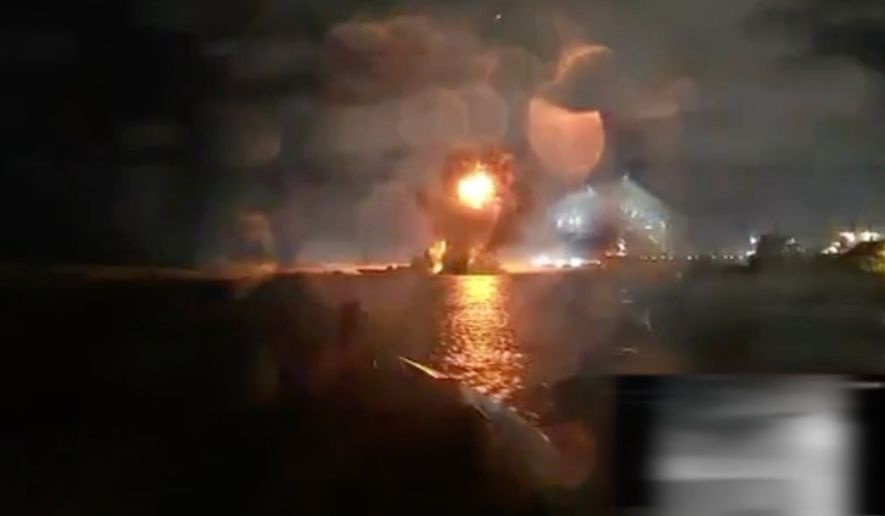
The attack off the coast of NATO-member Finland targeted a Russian military-linked cargo ship, the Sparta II, which was ablaze as it drifted into Finnish territorial waters.
The two operations mark a further geographical expansion of a maritime conflict that has already spilled into the waters of NATO members Romania and Bulgaria, where repeated Russian strikes against merchant vessels have killed sailors, disrupted trade and prompted the alliance to strengthen its defenses.
Commercial shipping under attack
The weekend expansion of Ukraine’s war on Russia’s maritime assets sent shockwaves across Europe while eliciting an ominous response from Moscow, where officials promised “painful consequences.”
Both the Italians and the Norwegians have seen the toll the Russia-Ukraine fighting has taken on shipping in the Black Sea.
At least 21 merchant vessels have been struck off the Romanian and Bulgarian coasts since June, according to figures compiled by maritime security firm Ambrey, with the overwhelming majority of attacks occurring since early October.
Several vessels have been sunk, including the Liberian-flagged container ship Contship Jet, which went down in Bulgaria’s exclusive economic zone on Oct. 28, and the Somali-flagged Betul 8, which sank on Nov. 16 while transporting wheat from Romania to Egypt.
Other attacks have occurred inside Romanian territorial waters: On Nov. 14, the Greek-flagged tanker Evia Petrol V was struck by a drone approximately four nautical miles southeast of the Sulina Canal, a vital artery for Ukrainian agricultural exports. Its crew escaped unharmed.
Although Moscow denies targeting neighboring countries, maritime security analysts have largely attributed the attacks to Russian forces. Romanian authorities have accused Russia of systematically targeting civilian shipping, while stopping short of formally attributing individual incidents pending forensic investigations.
The attacks appear to follow a deliberate economic strategy, according to Tomas Alexa, a senior analyst at Ambrey Analytics.
Of 22 vessels examined by Ambrey following attacks in the Danube Delta and Romanian and Bulgarian waters, 21 had made at least one port call in Ukraine during 2026, Alexa told The Washington Times in an interview Tuesday.
“The Russians are going where there is trade and where they can hurt Ukraine,” he said.
As Russian strikes have severely restricted operations at Ukraine’s principal Black Sea ports, more commercial traffic has been diverted toward the Danube Delta and neighboring Romania. Russian attacks have increasingly followed those alternative shipping routes, Alexa explained.
The number of attacks has risen dramatically.
According to Ambrey data previously reported by Reuters, Russia and Ukraine struck 317 merchant and other vessels in the Black Sea and Sea of Azov between May and October, compared with 74 during the preceding six months.
Russia has also begun employing explosive unmanned surface vessels against merchant shipping, a relatively new development for its forces.
Alexa warned that the smaller cargo ships operating around the Danube Delta are particularly vulnerable to these weapons, which can carry explosive payloads weighing hundreds of kilograms.
He described a potential tactic involving simultaneous attacks against a vessel’s hull and bridge, causing flooding while preventing the crew from effectively responding.
The economic consequences are spreading beyond trade with Ukraine.
“We’ve already seen some owners who don’t even want to send their vessels to Romania or Bulgaria,” Alexa said.
The expansion of designated war-risk areas has also encouraged some vessels to navigate through coastal territorial waters where possible, increasing traffic congestion, collision risks and the risk of environmental accidents.
NATO scrambles to respond
The escalating attacks have prompted mounting concern within NATO, particularly among its southeastern members.
Addressing the NATO Parliamentary Assembly in Berlin on Monday, NATO Secretary-General Mark Rutte warned of “some serious stuff happening on the Black Sea,” adding that the alliance was working closely with Romania, Bulgaria and Turkey to address the growing threats.
The alliance announced additional deployments to the Black Sea in October, including maritime patrol aircraft, surveillance drones, radar systems and intelligence personnel.
A U.S. Navy P-8A Poseidon maritime patrol aircraft was deployed to Bulgaria from Naval Air Station Sigonella in Italy, strengthening surveillance of the western Black Sea following Sofia’s request for allied assistance.
The European Union has also pledged $54 million to accelerate the establishment of a maritime security hub jointly managed by Romania and Bulgaria, intended to improve surveillance and information-sharing.
But the alliance has yet to announce a dedicated operation to escort civilian merchant ships through threatened waters.
According to Alexa, detecting and intercepting small naval drones presents a particular challenge for NATO forces, which have limited experience confronting such systems in combat.
“The Russians are testing this technology every single day in Ukraine,” he said. “NATO is inevitably playing catch-up, not just in detecting but also countering this technology.”
He also pointed to legal restrictions governing military engagements outside national territorial waters, which can complicate efforts to intercept threatening vessels.
Maritime security coordination remains fragmented across Europe, he argued, with no centralized organization comparable to those responsible for informing commercial shipping of threats in the Persian Gulf and other dangerous waterways.
Some analysts believe Moscow is deliberately exploiting NATO’s reluctance to become directly involved in the conflict.
“This is about testing these red lines,” Iulia Joja, director of the Black Sea program at the Middle East Institute, told Reuters earlier this month, arguing that Russian attacks take into account the alliance’s preference for limited responses.
A NATO official, however, reaffirmed that the alliance’s commitment to defending its members, including Romania and Bulgaria, remained “ironclad.”
A widening maritime battlefield
The attacks in the Mediterranean and Baltic illustrate a different aspect of this expanding maritime war: Ukraine’s efforts to pursue Russian naval assets and military logistics networks far beyond its immediate coastline.
The Merkury was docked in Benghazi, where Russia has developed close military ties with forces loyal to eastern Libyan commander Khalifa Haftar. According to the Institute for the Study of War, the corvette had stopped there to refuel and resupply while escorting Russian cargo ships.
The operation has nevertheless created diplomatic complications for Kyiv.
Libya’s internationally recognized government in Tripoli condemned the attack as a violation of its sovereignty. On Tuesday, Ukrainian Foreign Minister Andrii Sybiha defended the operation as legitimate self-defense against Russian military assets, arguing that Ukraine’s right to defend itself was not confined to its own territory.
The Baltic incident has raised similar concerns among NATO members.
The Sparta II, operated by Russian defense logistics company Oboronlogistika, was struck Saturday in international waters in the Gulf of Finland. Its 16 crew members evacuated before the damaged vessel drifted into Finnish waters, requiring a coordinated emergency response involving Finnish, Estonian and Russian authorities.
Kyiv subsequently acknowledged responsibility, with Zelenskyy describing the ship as a legitimate military target.
“The war is spilling over into our neighbouring areas,” Finnish Prime Minister Petteri Orpo warned following the incident.
Alexa emphasized that the Russian merchant vessels targeted by Ukraine outside the Black Sea have generally been closely associated with Moscow’s military logistics networks, including the so-called Syrian Express, previously used to transport military equipment between Russia and Syria.
“These merchant vessels are closely affiliated with Russian forces,” he said.
Nevertheless, even selective attacks can threaten unrelated commercial traffic. Disabled naval drones may remain afloat with their explosive payloads intact, creating hazards for ships operating far from the original targets.
For NATO, the expanding use of unmanned weapons presents a growing challenge to the protection of commercial shipping and maritime infrastructure, particularly where military operations intersect with the territorial waters of alliance members.
And with attacks now occurring in the Black Sea, the Baltic and the Mediterranean, Alexa warned that the geographical spread of the maritime conflict was no longer hypothetical.
“The geographical expansion is already there,” he said.
Please read our comment policy before commenting.