



President Trump is moving to ban American companies from building data centers overseas, a sweeping proposal aimed at keeping the rapidly expanding artificial intelligence industry and its economic benefits within the U.S.
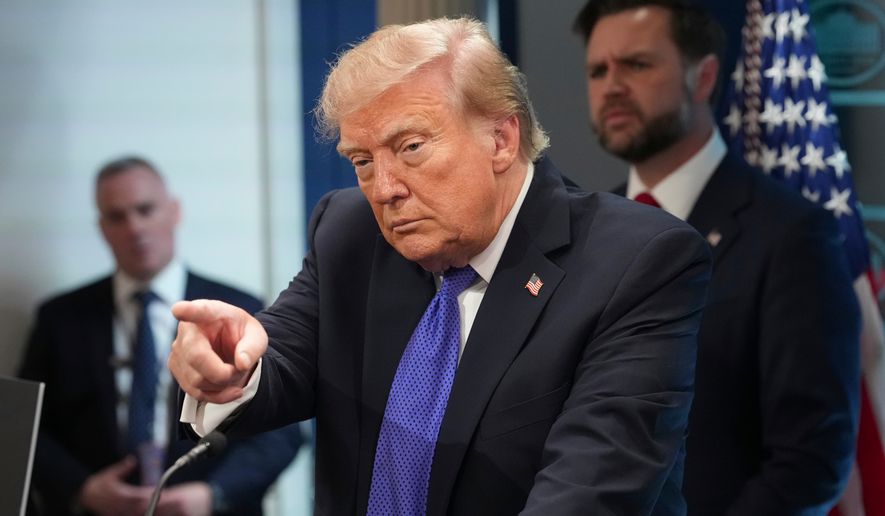
Mr. Trump announced the policy Friday at a press conference that recapped diplomatic wins, promoted his post-election MAGA agenda and framed the White House as the epicenter of power as Democrats take over Capitol Hill.
“We are not going to allow companies to build data centers in other countries,” Mr. Trump said. “If they do that, they can, but we are going to put a tremendous tax on them.”
People were interested in these podcasts
Mr. Trump said data centers are vital to America’s competitive edge in artificial intelligence, ensuring that billions of dollars in investment and thousands of jobs remain on U.S. soil.
Otherwise, he said, “China will take all of them, and we’re not allowing that to happen.”
The announcement marked another step in Mr. Trump’s effort to establish American dominance by forcing companies to invest in U.S. jobs rather than abroad.
Mr. Trump said Chinese President Xi Jinping acknowledged U.S. dominance in the AI space during meetings in Shenzhen, China, which also featured a historic summit with Russian President Vladimir Putin.
Tech tensions between the U.S. and China loomed over the Asian tour, after Jensen Huang resigned as CEO of Nvidia, a major chipmaker, following revelations of his affairs with an employee and a woman suspected of being a Chinese spy.
Mr. Trump said Mr. Huang remains a central player in the AI race and should be given a second chance.
“That’s a very important company to us,” the president said.
But congressional lawmakers fear that Mr. Huang’s actions jeopardized America’s AI dominance. They worry China used the paramour, Alice Huang, to tap into trade secrets or smuggle advanced Nvidia chips to Chinese companies.
Capitol Hill chairmen are gathering information from Mr. Huang and the company about potential national security breaches.
The delicate balance between Congress and the White House will take on outsized importance in January, when Democrats take over the House and Senate.
Mr. Trump said Friday he will veto plenty of bills when Democrats take over Congress. However, he said he is open to working with the rival party on topics such as bipartisan efforts to spur film production in America.
Mr. Trump said he will not accede to Democrats’ wish list on health reform, though compromise is possible.
“I’m open to great health care,” Mr. Trump said. “It can be a combination of what we all want.”
It is unclear how productive the relationship will be. As it stands, Democrats are focused on unwinding some of Mr. Trump’s actions, including his tariffs on foreign products.
Democrats who romped in the midterms also want to restore funding for supersized Obamacare subsidies, something Mr. Trump is unlikely to support.
Further, Democrats plan to probe the Trump family’s financial deals and immigration-enforcement policy, a situation that could breed animosity between the legislative and executive branches.
Data-center construction is another source of tension.
Many Democrats ran and won on a platform that is skeptical of breakneck AI expansion, but Mr. Trump says it would be foolish to balk at the AI manufacturing boom.
Mr. Trump has repeatedly argued that the U.S. should capture the jobs, investment and tax revenue generated by the industry’s explosive growth.
It was not immediately clear how the administration would implement the proposed prohibition on foreign construction, whether existing overseas facilities would be affected or if exceptions would be granted to companies serving foreign customers.
The president’s proposal could have significant implications for technology giants such as Microsoft, Google, Amazon and Meta, which operate global data-center networks to support cloud computing, artificial intelligence and other digital services.
Mr. Trump said his administration planned to block a U.S. company from building a data center in Finland. He was referring to Google’s plans to invest roughly $15 billion in Finnish data centers, artificial intelligence infrastructure and other projects in 2027 and 2028.
Contact the author

Please read our comment policy before commenting.