


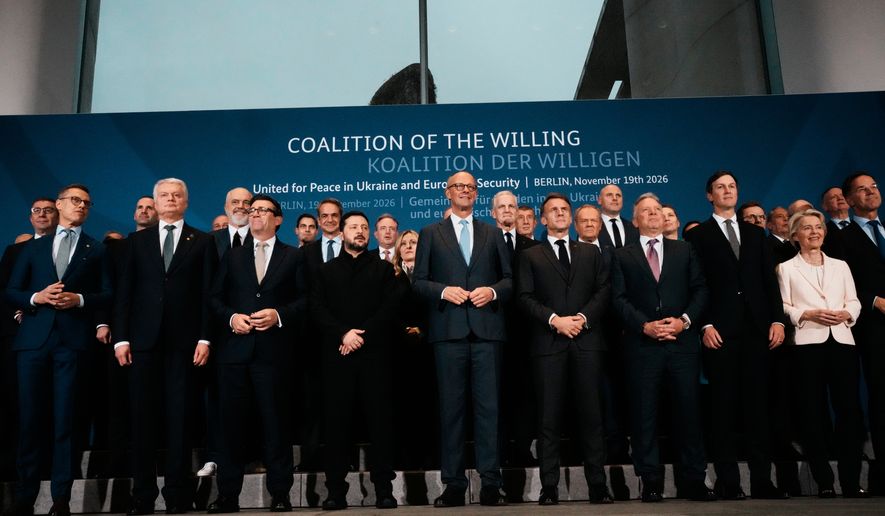

Global power players converged on Berlin on Thursday for a meeting of the so-called “Coalition of the Willing,” a large partnership of Ukraine’s backers and allies, where leaders discussed efforts to find a diplomatic solution to Russia’s brutal invasion and how Europe can play a bigger role.
Meeting in Berlin’s Federal Chancellery were leaders from across the European Union, the U.S. and NATO. President Trump’s special envoys for peace, Jared Kushner and Steve Witkoff, represented Washington.
The three most important issues driving the meeting are discussions of how potential security guarantees for Ukraine could be structured, helping Ukraine shore up holes in its 2027 budget and how Europe could get a seat at the table during the U.S.-mediated peace discussions between Kyiv and Moscow.
People were interested in these podcasts
German Chancellor Friedrich Merz, who hosted the meeting, said Europe deserves to be a part of the conversation “as a team with Kyiv and Washington.” U.K. Prime Minister Andy Burnham said Europe is “ready to enter negotiations.”
Mr. Kushner and Mr. Witkoff updated Mr. Merz on Mr. Trump’s “latest efforts to achieve a just, lasting and durable peace” in Ukraine and developments from his trip to China this week.
“We are grateful for his leadership, constructive engagement, and close partnership as we work together toward our shared goal of ending this terrible war and building a secure and prosperous future for Ukraine and Europe,” Mr. Kushner said on social media.
Mr. Witkoff and Mr. Kushner, who both recently participated in trilateral talks with Russia and Ukraine in the United Arab Emirates, have been fierce advocates for including Europe in peace talks.
Mr. Kushner later told reporters at the event that reaching a deal with Russia and Ukraine will be very hard, and reassured officials that Mr. Trump is not looking to impose a deal unilaterally.
“He wants to do it with Europe and Ukraine, and any deal that we do will be in close coordination with Ukraine and with Europe. And that’s something he asked us to come here today and reassure people in that regard,” he said.
But his statement was slightly hampered by Mr. Trump’s own input into the conference.
Mr. Trump reportedly called into the summit from Air Force One, en route back to the U.S. from his Asia tour this week. In the call, Mr. Trump insisted that Mr. Putin and Russia were serious about peace and expressed skepticism about the extent of financial support for Ukraine from the coalition.
Mr. Witkoff said Mr. Trump’s comments were in line with the views of other leaders at the summit.
The strong statements of support from his European partners appeared to please Ukrainian President Volodymyr Zelenskyy, who also attended the summit and has aggressively pushed for European participation in diplomacy.
“NATO and the EU will be far more reliable defenders of the European way of life and European security,” he wrote on X. “Ukraine’s membership in the European Union is also a security guarantee for all of us – a very concrete one. Just like NATO membership. Everyone needs to recognize this reality – and we are all practically reaching that point.”
Russia has ruled out any military ties between Ukraine and Europe as part of any final peace agreement, but Mr. Putin said he has invited European leaders to participate in talks in Moscow through diplomatic channels.
Mr. Burnham said Europe will only discuss Russia’s security concerns after there is a general peace agreement with Ukraine. Russian President Vladimir Putin has in the past refused to consider temporary or limited ceasefires while negotiations play out, arguing that it would give time for Europe to rearm Kyiv.
The Berlin summit came just as Mr. Trump met again with Mr. Putin, alongside Chinese President Xi Jinping, in Shenzhen, China.
The meeting, the first since Mr. Trump and Mr. Putin met in Alaska last year, was closely watched as a key opportunity to discuss diplomatic efforts to end the Ukraine invasion. But the issue was not mentioned in the joint statements released by the three nations following the trilateral meeting.
Contact the author

Please read our comment policy before commenting.