



President Trump joined Chinese President Xi Jinping and Russian President Vladimir Putin on Thursday for an unprecedented diplomatic summit aimed at reducing nuclear weapons and ending the wars in Ukraine and Iran.
In their opening statements before the actual closed-door meeting, the three men, each speaking in his native language, outlined quite different priorities, including a surprising mention of Ukraine by Mr. Putin, who had started the war in the first place.
The first-ever three-way summit between the leaders of the U.S., China and Russia — the world’s three largest nuclear powers — took place on the sidelines of the Asia-Pacific Economic Cooperation gathering in Shenzhen, China. It comes at a time of growing international tensions and uncertainty about the future of global security.
People were interested in these podcasts
“No problems were ever solved under the old school, refusing to talk about them. No peace was ever forged by declining opportunities for engagement and speech,” Mr. Trump said. “A historic summit offers us the chance to seek out new opportunities and approaches on a range of very important issues.”
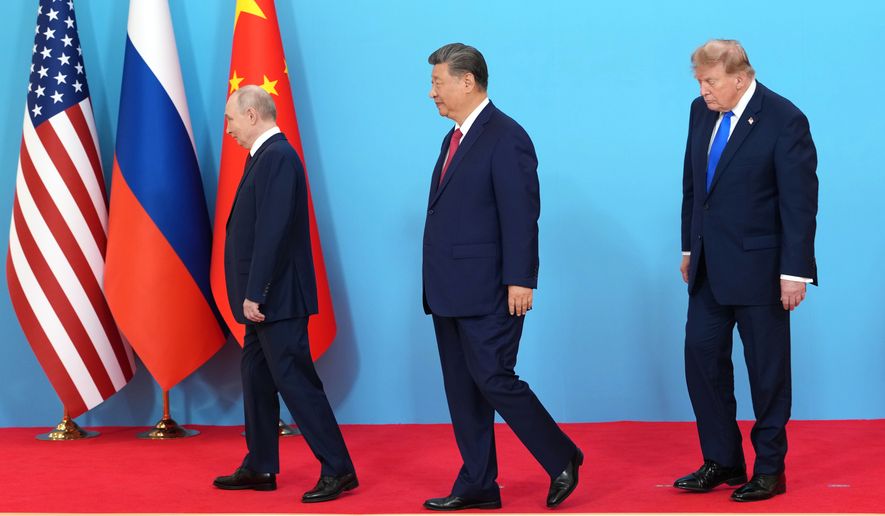
Mr. Trump made it clear that nuclear arms reduction should be the main focus of trilateral talks, though neither Mr. Putin nor Mr. Xi mentioned the topic explicitly.
“It’s frankly a very hard thing to do because once you have the nuclear weapons, it’s very hard not to have them. It’s very hard to give them up as the leader of a country,” Mr. Trump said.
SEE ALSO: Trump tells Xi to ‘do some more for our farmers’
In his opening remarks, Mr. Putin said the three leaders should work to solve the challenges of the time, including solving food security, energy security, and combating terrorism and international crime.
He noted that the settlement of the war in Ukraine was among their “shared interests.”
“I am convinced that Russia, the U.S. and China, our people are capable of making a significant contribution to strengthen peace and security over the world if we cooperate constructively on the basis of mutual respect, equality and a balance of interests,” Mr. Putin said.
As host, Mr. Xi welcomed both leaders, saying their talks were critical to “peaceful coexistence and overall stability” that will “benefit each other and the whole world.”
Although Mr. Trump has promoted the meeting as an opportunity to pursue sweeping agreements with America’s two biggest geopolitical rivals, administration officials have cautioned that major breakthroughs are unlikely.
The president held separate meetings with Mr. Xi and Mr. Putin before the trilateral gathering which was delayed by more than two hours, emphasizing his personal relationships with both leaders and expressing optimism that their discussions could produce results.
SEE ALSO: ‘He’s my friend’: Trump meets with Putin in China for high-stakes talk on Ukraine
“Wonderful things can come out of this — or at least start,” Mr. Trump said during his separate meeting with Mr. Putin, whom he described as “my friend.”
“We’ve had a great relationship for many years,” he added.
The talks with Mr. Putin lasted approximately 40 minutes and marked their first face-to-face meeting since an August 2025 summit in Alaska failed to produce an agreement ending Russia’s invasion of Ukraine.
According to both the American and Russian sides, that was the dominant topic of their meeting.
During his separate meeting with Mr. Xi, Mr. Trump emphasized the importance of keeping oil moving through the Strait of Hormuz while pressing Beijing to increase purchases of American agricultural products.
“I’ll be asking you to do some more for our farmers,” Mr. Trump told the Chinese leader ahead of their 13-minute meeting.
Nuclear arms control is expected to dominate the trilateral discussions following the expiration in February of New START, the last major nuclear weapons treaty between Washington and Moscow.
Mr. Trump has called for a new agreement that would include China, arguing that the three powers must take steps to prevent a dangerous nuclear arms race.
Reaching such an agreement could prove difficult because Beijing maintains a substantially smaller nuclear arsenal than either Washington or Moscow and has resisted for decades any proposals to accept restrictions.
China possesses more than 600 nuclear warheads, compared with more than 5,000 apiece in the American and Russian stockpiles, according to estimates cited by the Associated Press.
The wars in Ukraine and Iran were also expected to feature prominently in the discussions.
Mr. Trump has repeatedly expressed confidence that he can negotiate an end to the fighting in Ukraine, but his diplomatic efforts have produced little progress toward a lasting settlement.
Administration officials initially suggested Ukraine would not be a central topic at the trilateral summit, arguing that negotiations with Moscow and Kyiv were proceeding separately.
Even before Mr. Putin’s opening statement, Kremlin officials had suggested the leaders would address the war.
The U.S. president also hopes to enlist Chinese and Russian cooperation in addressing the conflict involving Iran, which has disrupted global energy markets and international shipping.
The historic gathering offered Mr. Trump an opportunity to demonstrate his commitment to personal diplomacy, but analysts warned that the leaders’ competing interests could limit progress.
The summit also raised concerns among Ukrainian and European officials that Washington could negotiate major security arrangements with Moscow and Beijing without consulting other nations whose interests would be directly affected.
In an interview with Fox News early Thursday in China, before any of the meetings began, Mr. Trump dismissed those concerns, saying he would not make a deal on Ukraine without Kyiv’s participation.
American envoys Steve Witkoff and Jared Kushner were also meeting Thursday with Ukrainian officials and European allies in Berlin to discuss security guarantees and an economic recovery plan for Kyiv.
Please read our comment policy before commenting.