


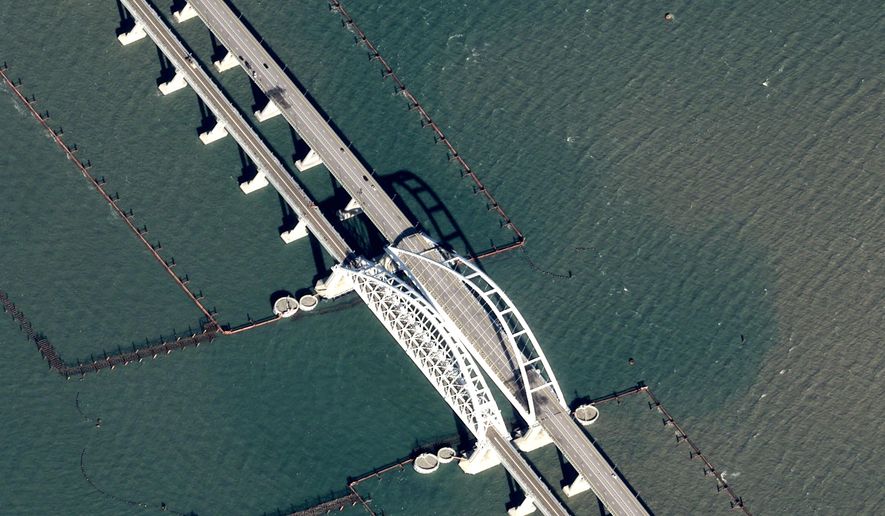

Ukrainian missiles and drones brought down a central span of Russia’s bridge to occupied Crimea this week, while Russian ballistic missiles struck two crossings in Kyiv, marking an escalation of attacks on the transport networks and infrastructure sustaining the war.
While Ukraine attacked a crossing used to supply Russian forces in Crimea and southern Ukraine, Russia struck bridges carrying commuters and essential services across the Ukrainian capital as winter approaches.
Video verified by Reuters showed the main road arch of the 12-mile Kerch Bridge collapsed into the strait below after two consecutive nights of Ukrainian strikes. The adjacent railway section was damaged, although Russian authorities said service had partly resumed on one track.
People were interested in these podcasts
“The symbol of the occupation has cracked,” Ukraine’s General Staff declared.
Opened by President Vladimir Putin in 2018, the bridge links Russia to the Crimean Peninsula, illegally annexed by Moscow in 2014, and has been used to carry troops, fuel and equipment supporting Russia’s southern military operations.
Ukrainian President Volodymyr Zelenskyy described the attack as the final stage of a weeks-long operation in which Kyiv’s forces first destroyed radar installations, air defenses and electronic warfare systems around Crimea.
Ukrainian-made Palianytsia drones, Neptune missiles and Flamingo cruise missiles were among the weapons used, he said.
“Russia strikes our infrastructure every day, including bridges,” Mr. Zelenskyy said Tuesday, warning that the war was returning to where it began.
Kremlin spokesman Dmitry Peskov said Russia would repair the bridge and make it “even better than before.” However, further Ukrainian strikes could complicate repairs.
A fight over supply routes
Damaging the bridge does not cut Crimea off completely: Russian forces increasingly depend on an overland supply corridor through occupied southern Ukraine, running past Mariupol, Berdiansk and Melitopol.
Ukraine, however, has spent months attacking that route, hitting military convoys, fuel depots, railway infrastructure and bridges. The Institute for the Study of War reported that Russian officials also acknowledged Ukrainian strikes on the Rostov-to-Crimea highway near the Mius River this week, further complicating efforts to reroute traffic.
Debris from the collapsed arch also appears to obstruct the main shipping channel beneath the bridge, potentially disrupting traffic between the Black Sea and Sea of Azov. The extent of the disruption remains uncertain.
For Moscow, the loss of road traffic across Kerch increases dependence on routes exposed to Ukrainian long-range drones, though Russian engineers have previously managed to repair damage to the bridge.
The military purpose of the Kerch crossing makes it a lawful target under the rules of war, as international humanitarian law permits attacks on infrastructure that effectively contributes to military operations when its destruction offers a definite military advantage, subject to precautions and proportionality requirements.
Kyiv’s bridges chiefly carry civilian traffic and the transport and utility networks on which the capital depends. Civilian infrastructure cannot lawfully be attacked simply to make daily life unbearable.
Kyiv under pressure
Four Russian ballistic missiles hit Kyiv’s Southern Bridge and three struck its Northern Bridge late Monday, according to Mr. Zelenskyy. Mayor Vitali Klitschko reported traffic restrictions, damage to the metro network and interruptions to water and electricity.
The bridges have been attacked repeatedly since October, while damage to the Southern Bridge’s heating network left 317 buildings without heat in Darnytskyi district Tuesday, local officials said. Three districts switched to backup heating.
Russian forces also struck the Preobrazhensky Bridge in Zaporizhzhia, according to the Institute for the Study of War, extending the campaign well beyond the capital.
Moscow’s Defense Ministry said its strikes targeted transport, military and energy facilities. Military use can also make an otherwise civilian bridge a lawful target. However, attackers must weigh foreseeable harm to residents against the concrete military advantage anticipated.
Russia has not publicly substantiated a specific military justification for the latest Kyiv bridge strikes.
The Institute for the Study of War assessed that Russia’s repeated strikes were intended to disrupt logistics and civilian life, potentially making it harder to move between Kyiv’s two banks. They coincide with renewed attacks on power stations and heating infrastructure ahead of winter.
Ukraine’s largest private energy company, DTEK, said Russian strikes Tuesday left about 700,000 families without electricity in the Dnipropetrovsk region. Other regions also reported outages.
The United Nations reported Wednesday that Russian attacks killed at least 372 Ukrainian civilians in October and wounded 1,981, nearly double the combined casualty figure recorded a year earlier.
The air war widens
Both militaries are firing increasingly large volleys of long-range weapons. Russia claimed to have intercepted 1,441 Ukrainian drones overnight into Tuesday, after reporting 1,336 the previous day.
Those figures could not be independently verified.
Meanwhile, Ukraine’s air force reported 306 Russian drones and decoys launched during the same overnight period, including 92 jet-powered models, alongside missiles.
On Wednesday, Ukraine said it had again hit the Ilsky and Afipsky oil refineries in southern Russia, which it says supply Russian troops. The attacks target fuel supplies supporting Moscow’s invasion.
Thomas Withington, an associate fellow at Britain’s Royal United Services Institute, told The Associated Press that mass drone attacks exploit the limits of traditional air defenses.
“It’s a game of averages,” he said, explaining that launching more drones increases the number likely to penetrate defenses.
While the damage to the Kerch bridge may impose logistical costs on Russia for months, in Kyiv, the immediate costs are borne by residents navigating damaged crossings and interrupted utilities. Whether the damage changes battlefield supply lines will depend on how quickly routes are repaired and hit again.
Please read our comment policy before commenting.