


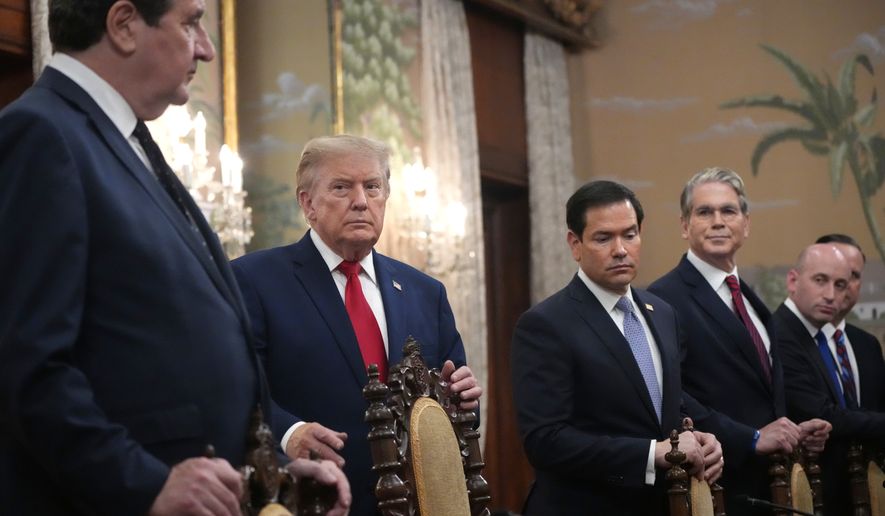

President Trump embraced Chinese President Xi Jinping on Wednesday during a whirlwind Asia trip, while top aides and U.S. tech companies grappled with a wave of disruptive cyber outages at home.
Mr. Xi met Mr. Trump at the bottom of the red-carpet stairs from Air Force One in Shenzhen, China, and shook his hand before the embrace, a reciprocal gesture after Mr. Trump hosted the Chinese leader at Joint Base Andrews near Washington in September.
Locals in pink, blue and white carrying flowers and U.S. and Chinese flags chanted a welcome in Mandarin as Mr. Trump stepped off the plane.
People were interested in these podcasts
Mr. Trump is in China for the Asia-Pacific Economic Cooperation meetings, just days after reports of a scandal involving an alleged Chinese spy prompted the resignation of Nvidia CEO Jensen Huang, a close ally of the president in the tech sector, from the AI chip company. Beijing has denied interference and criticized U.S. restrictions on high-end semiconductor exports.
Key diplomacy is slated for the margins of the summit, including a bilateral meeting between Mr. Trump and Mr. Xi on Thursday, followed by a trilateral session with Russian President Vladimir Putin. The White House said Mr. Trump also plans a separate meeting with Mr. Putin to try to resolve the Russia-Ukraine war. The two leaders shook hands during a pre-APEC photo op.
Meanwhile, questions over the string of technical disruptions kept administration officials busy in Washington. Vice President J.D. Vance canceled his appearance at The New York Times DealBook summit amid the fallout. Traveling with the president, Secretary of State Marco Rubio said there was no evidence that hackers or foreign adversaries caused the disruptions to workplace email, banking transactions and Federal Aviation Administration flight operations.
“We have no indication, no evidence and no reason to believe at all that any of these incidents are related to each other,” Mr. Rubio told reporters Wednesday. “The Microsoft incident has nothing to do with what we saw with the FAA. The FAA has nothing to do with what we saw with the banks a few days ago. These issues that we’ve seen from a technical standpoint are completely unrelated, one from another.”
Before flying to China, Mr. Trump met with foreign leaders and signed a new trade agreement with Philippine President Ferdinand Marcos Jr.
Mr. Putin launched an unprovoked assault on neighboring Ukraine in February 2022, leading to a deadly and drawn-out war. Mr. Trump wants to negotiate an end to the war, a task that has proven difficult.
However, White House officials said the trilateral meeting would focus on Iran and nuclear weapons, while Ukraine negotiations unfold on a separate track.
On trade, Mr. Trump announced a deal with Thailand to remove tariffs on U.S. goods and to overhaul trade terms with the Philippines. The White House said the two sides committed to reducing the U.S. trade deficit with Manila through higher imports of American energy and agricultural products, supporting tens of thousands of U.S. jobs, including a reported $12 billion aircraft deal involving Boeing and GE Aerospace for Philippine Airlines tied to 47,000 jobs.
Mr. Trump also held an unscheduled talk with Canadian Prime Minister Mark Carney on trade amid a tariff dispute that has been ongoing since summer. Mr. Carney said on social media that they discussed a mutually beneficial agreement that supports jobs, affordability and respect for Canada’s languages, culture and sovereignty, and agreed to stay in close touch.
In Washington, Senate Minority Leader Charles E. Schumer, New York Democrat, criticized the administration’s response to outages affecting flights, customer service at J.P. Morgan Chase, Bank of America and U.S. Bank, and some Apple products. He urged Director of National Intelligence Jay Clayton to task intelligence specialists with testing whether the disruptions were routine.
“It’s just too coincidental that all these outages happen within a few days for us to think it’s just business as usual. We have to get to the bottom of this,” Mr. Schumer said. “The Trump administration needs to investigate plausible alternative explanations and get to the bottom of what caused these system failures.”
Other lawmakers and analysts pointed to rapid system patching as a likely culprit. Sen. Mark R. Warner, Virginia Democrat, wrote on social media that artificial intelligence-driven vulnerability discovery is pressuring organizations to patch systems rapidly all at once, straining infrastructure, though he added that current signs point toward defensive patching rather than malicious attacks.
Contact the author

Please read our comment policy before commenting.