


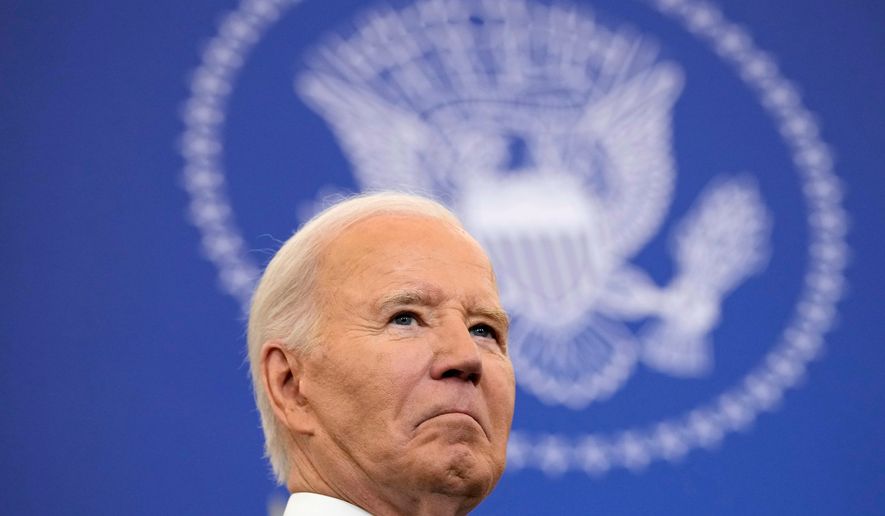

The Biden White House launched an unprecedented crusade to get social media firms to censor Americans’ views, based on the idea that a “crisis” of disinformation was fueling a rise in domestic terrorism.
Five years later, those claims have crumbled.
The Privacy and Civil Liberties Oversight Board, an independent agency that has served as a critical watchdog on government surveillance powers in the wake of the 2001 terrorist attacks, said in a new report released Wednesday that the Biden administration lacked an “adequate basis” for linking disinformation to domestic terrorism.
People were interested in these podcasts
“Drawing a direct causal link between disinformation on social media and offline violence remains tenuous at best, and the government has not made public or provided to PCLOB analyses, intelligence reports or other products on which it relied to develop its policies,” the oversight board said.
Worse yet, the board said, the government’s own efforts to police disinformation can become “drivers of extremist violence.”
The PCLOB praised President Trump’s January 2025 executive order ending the Biden crusade. The board urged Congress to formalize what Mr. Trump did.
The board also said some changes have been locked in through court settlement agreements with the State Department and the Centers for Disease Control and Prevention.
But they don’t apply to the White House, the FBI, the Department of Homeland Security or the Office of the Director of National Intelligence.
The censorship played out amid questions over the 2020 election and the coronavirus pandemic. Under pressure from the Biden White House, federal agencies such as Homeland Security and the FBI identified social media posts they believed to be dangerously wrong and coerced tech firms to erase or minimize them.
Court cases and other investigations, both inside the government and in the press, revealed some of the contours of the effort.
The PCLOB investigation, which began four years ago, looked specifically at the government bureaucracy and how it carried out the Biden White House’s orders.
The findings were grim. Board members said the Biden effort suffered at the start from a faulty premise that never clearly defined an actual threat.
It was then carried out haphazardly, with agencies allowed to devise their own definitions of disinformation, some of which were “simply wrong.”
Until 2024, no agency had a policy requiring it to figure out whether the speech was foreign disinformation — a more viable target — or the views of an American, which have constitutional protections.
Agencies then worked to coerce social media companies to take down or minimize Americans’ viewpoints, particularly over election results and the origins and medical treatments of the coronavirus.
The PCLOB called the effort “highly problematic,” saying the government hid the extent of its efforts. The government also lacked guardrails or, in many cases, policies to govern what it was doing. To this day, the government has yet to fully explain how it decided what sort of speech to target.
“Here, it is not at all clear that disinformation fueled domestic terrorism, or that it did so on any significant scale. The government certainly has not provided PCLOB with support for that contention. Nor is it evident that government efforts to suppress such speech would enhance national security,” PCLOB member Beth A. Williams wrote in her own statement.
Contact the author

Please read our comment policy before commenting.