


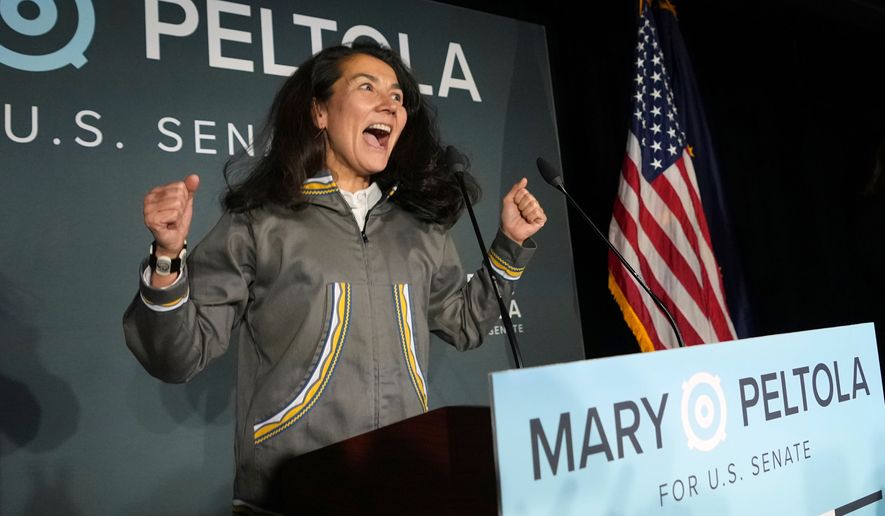

Sen.-elect Mary Peltola’s victory in Alaska delivered the final gut punch to President Trump and a Republican Party already reeling from a brutal midterm election.
Now that the dust has settled, Democrats have flipped nine Senate seats, their biggest gain since 1958, the same year Alaska became the nation’s 49th state.
The victories will give Democrats a commanding 56-44 majority when the next Congress gavels into session in January, upending two years in which Mr. Trump enjoyed the support of a GOP-controlled Congress.
People were interested in these podcasts
The story is much the same across the Capitol. Democrats netted more than 40 House seats, cementing control of both chambers and completing a political rout few in Washington saw coming heading into the fall.
Democrats scored wins in traditionally conservative territory stretching from South Carolina to Mississippi and now Alaska — places that backed Mr. Trump by comfortable margins over Kamala Harris just two years earlier.
“It’s official: 56 Democratic Senate seats!” Senate Minority Leader Charles E. Schumer, New York Democrat, said, highlighting that it has been more than a decade since Alaska has had a Democratic senator. “This win is a gift to Alaska, the Senate and all of America.”
The latest vote tally showed Ms. Peltola with a 50.1%-45.8% lead over two-term GOP Sen. Dan Sullivan.
Kyle Kondik of the University of Virginia Center for Politics said the Peltola win capped a midterm cycle that started with good reason to doubt whether Democrats could win any of the seats sitting in states Mr. Trump had carried by double digits.
“They ended up winning seven, an incredible number,” Mr. Kondik said. “To me, Iowa, Mississippi, Kansas and South Carolina were all more surprising than Alaska, and probably Texas too, just because it had been so long since Democrats had won statewide there.”
Several victories were historic.
Scott Colom is set to become Mississippi’s first Black senator since Reconstruction.
In Kansas, pastor Adam Hamilton became the first Democrat elected to the Senate since 1932.
Texas voters made James Talarico the state’s first Democratic senator in more than three decades.
South Carolina sent its first woman to the Senate, Amie Andrews, while Abdul El-Sayed is poised to become the first Muslim American to serve in the chamber.
New Hampshire’s Chris Pappas, meanwhile, is set to become the first openly gay man elected to the Senate.
The defeats came despite Mr. Trump following through on many of his signature campaign promises. He extended the 2017 tax cuts, tightened security at the southern border, pursued mass deportations and imposed sweeping tariffs on foreign imports.
The president tried to ease voters’ concerns by promising a $5,000 “Trump dividend” check if Republicans retained control of both the House and the Senate.
But voters appeared less interested in the administration’s accomplishments or future promises than in the problems they felt remained unsolved.
Mr. Trump had promised to “end inflation” and lower the cost of everyday life, yet many Americans continued to struggle with high prices for gasoline, groceries and housing.
At the same time, some of the administration’s toughest immigration enforcement measures generated images that dominated news coverage and fueled a growing political backlash.
The president had pledged to focus deportation efforts on the “worst of the worst,” but headlines increasingly featured immigrants with no history of violent crime who had been swept up in enforcement operations, giving Democrats fresh ammunition to argue that the administration’s approach went too far.
Mr. Trump’s decision to join Israel in military action against Iran only compounded those challenges, thrusting foreign policy to the forefront at a time when many voters remained focused on their household finances.
As gas prices remained high and Washington debated billions of dollars in additional war spending, voters increasingly questioned what had happened to Mr. Trump’s longstanding promise to avoid new foreign conflicts and their associated taxpayer costs. And thanks to Democrats’ drumbeat, they felt corruption under Mr. Trump’s watch was a growing problem.
Democrats capitalized on those frustrations, framing the election as a referendum on affordability and the administration’s misguided priorities. They hammered Republicans over stubbornly high prices, deportation operations, growing concerns about corruption and what many voters saw as Washington’s misplaced focus on foreign conflicts over the kitchen-table challenges facing working-class Americans.
The message resonated far beyond traditional Democratic strongholds, letting the party rack up wins in districts and states long considered safely Republican.
Mr. Trump, meanwhile, has defended the Iran war and revived his claim that voting machines contributed to the GOP losses.
He also said Republican candidates struggled because he was not personally on the ballot, despite months of telling voters to treat the election as a verdict on his presidency.
Please read our comment policy before commenting.