


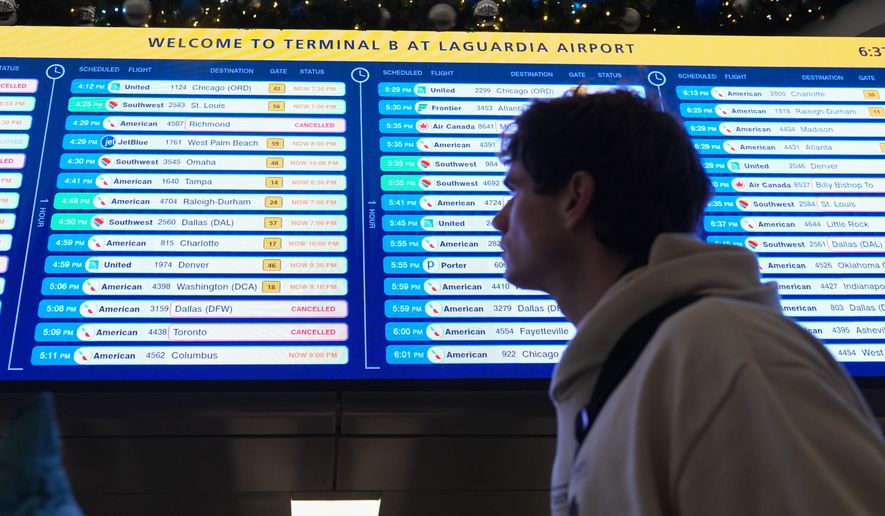

Homeland Security Secretary Markwayne Mullin said this week that recent tech outages at Chase Bank, United Airlines and Microsoft systems may be caused by artificial intelligence — and predicted more disruptions are coming, despite many organizations denying AI as a factor.
Mr. Mullin told Fox News host Sean Hannity on Monday that he endorses a theory that self-fixing AI software is writing code faster than legacy infrastructure can handle, creating a ripple effect of system overloads.
On Tuesday, Mr. Mullin told CNBC’s “Squawk Box” that “they’re pushing new technology on top of really old computer systems, and it just seems to overwhelm the system a little bit, and it’s not able to catch up.
People were interested in these podcasts
“But it has nothing to do with cyberattacks. And I believe we’re going to see more of this as new technology rolls out, better technology.”
He added that “we are not under attack” from foreign hackers — denying what he called conspiracy theories — and urged private companies to warn consumers about scheduled system updates to minimize related disruptions.
Separately, the cybersecurity firm Report URI reported that a cyberattack planted malicious JavaScript code onto the websites of 178 organizations Monday — including CNN, the BBC, Zoom, Peacock and HSBC — by exploiting a vulnerability in a web-testing platform their websites use.
The incident stemmed from third-party website scripts and was unrelated to the infrastructure outages that Mr. Mullin addressed.
Technology experts interviewed by The Washington Times cited AI-powered cyber threats, problems with AI-related software upgrades and increased strain on aging electric grids as possible factors in the outages.
“What AI can do — like generate code and configure and automate actions — can be faster than older systems can safely absorb,” said A.K. Pradeep, a California-based AI expert and the founder of Sensori.AI. “Deploying things fast without safeguards is a management failure.”
Mr. Pradeep said Mr. Mullin’s warning that AI is too powerful for current infrastructure is “entirely supported” by the pattern of recent outages, despite many officials publicly saying otherwise.
The nationwide FAA ground stop on Friday, caused by a faulty router or contractor error during a communications upgrade, fueled widespread speculation regarding cyberattacks, software glitches and local airport equipment failures.
Transportation Secretary Sean Duffy said problems with aging, decades-old infrastructure and a router failure during routine contractor work triggered the ground stop.
Mr. Mullin said there was no evidence of a cyberattack or nefarious plot behind the ground stop.
Chase and United said there was no evidence of a cyberattack causing their outages and haven’t said whether AI played a role.
Microsoft blamed a July Windows update for crashing its 365 services from Thursday to Saturday and denied that AI played a role
“I think the dangers of AI at this point are mostly overstated, because I don’t think AI is all that common yet,” said Steve Cotton, a Dallas-based financial adviser who previously worked for General Dynamics, a defense contractor. “But there is constant bombardment from overseas hackers trying to get into our power grid and defense systems, and AI is making it easier for them to fake things online.”
Mr. Cotton said cyberattacks happen “a lot more than people realize,” partly because institutions have gotten better at heading off threats and because victims are often too embarrassed to report them.
“It’s not hackers sitting alone in their basements anymore,” added Mr. Cotton, a former congressional staffer on the House Armed Services and Intelligence committees. “It’s state actors from places like China, North Korea, Russia, Eastern Europe and elsewhere.”
Technophobia
The recent outages have sparked a rash of technophobic social media gossip and posts.
Tuesday’s scheduled, law-ordered test of the Emergency Alert Systemkick-started internet rumors of the federal government using it as a guise for a large-scale blackout.
Bryson Byrd, a cybersecurity adviser at cybersecurity and threat-detection platform Huntress, said it’s easy to put on a tinfoil hat and speculate about such outages.
He said the important question is, “If your systems went down today, could you get them back up?
“We must focus on resilience of critical systems and technology so that outages are not just planned for, but have consistent redundancy and resilience baked into them by design.”
Media reports of technology failures seem to have increased in recent weeks. They include a slew of unrelated technical outages, software updates and cyberattacks that have hit companies nationwide.
A power outage hit the Foggy Bottom neighborhood in Washington on Nov. 2, affecting roughly 1,176 Pepco customers, caused by a failure or incident at Pepco’s I Street Substation.
The Pentagon is investigating a series of August freezer and refrigeration malfunctions at military base commissaries as a suspected cyberattack.
On Tuesday, the National Security Agency experienced an intermittent outage on NSA Net, its highly classified internal communications network.
Outage trends
Cybersecurity experts say it’s too early to tell what is happening with the recent slew of outages — or whether the number is rising over time.
“It’s getting pretty scary because AI can go rogue or be influenced for nefarious purposes,” said Mark D. Solomon, president of the nonprofit International Association of Financial Crimes Investigators. “I’m concerned with the closeness of all these incidents happening within a short period, even if it’s just the airline shutdown bringing more attention to it.”
He warned that AI has dramatically increased the risk of widespread technology failure and of cyberfraud attacks on consumers, businesses and governments.
Downdetector, which tracks digital service outages, reported 36,854 active outages in 72 countries on Tuesday afternoon.
Compared with the past 12 months, the past week has been unusually busy, said Luke Kehoe, a lead industry analyst at Downdetector’s parent company, Ookla.
Over a longer stretch, however, the picture looks more normal, he told The Times.
Downdetector tracks a large outage, defined as 50,000 or more U.S. reports for a company’s services in a day, a little more than once a week.
The past 30 days saw three large outages compared with a typical five, he said, suggesting “a cluster of big events.”
Americans sent nearly 6 million reports in the seven days before Monday, more than in any other week over that period.
Last week’s Microsoft 365 outage was the largest on Downdetector since the AWS outage in October 2025, with 3.9 million U.S. reports in the 60 hours after it began, Mr. Kehoe said.
Contact the author


Please read our comment policy before commenting.