


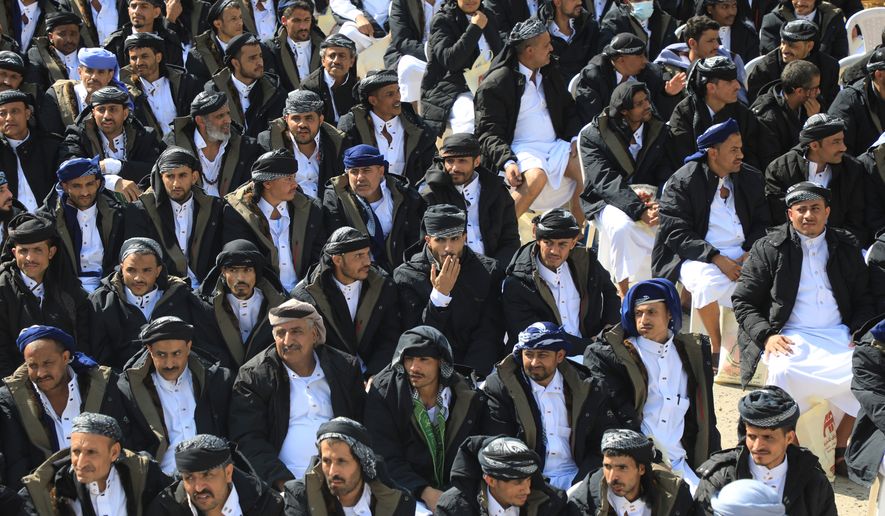

The Iran-backed Houthi rebels on Monday blamed Saudi Arabia for two strikes that killed three people in Houthi-controlled Yemen. The Saudi government did not immediately comment.
Iran said Monday three oil tankers caught fire when they struck naval mines in the Strait of Hormuz.
Israel’s military said it struck an arms shipments from Syria intended to reach Hezbollah in Lebanon.
People were interested in these podcasts
Here is the latest news from the Middle East on Monday. Read our full coverage here.
Houthis say strikes killed 3 people in Yemen
Houthi health authorities said Monday three Yemenis, including a child, were killed in two separate strikes in areas controlled by the Iran-backed rebels.
The child was killed in a drone strike on a house in the al-Sarar quarter of the capital, Sanaa, which also wounded seven others, Health Ministry spokesman Anees al-Asbahi said.
Separate airstrikes Monday morning hit a private fuel station and killed two people and wounded eight in Harf Sufian district in the Omran province, 50 kilometers (31 miles) north of Sanaa, al-Asbahi said.
Al-Asbahi blamed Saudi Arabia for the strikes. There was no immediate comment from the Saudi government.
The decade-long fighting between the Houthis and Saudi Arabia flared up since mid July, shattering a 2022 ceasefire that had largely stopped clashes in Yemen’s civil war.
The Houthis launched missile and drone attacks on the kingdom, which responded with airstrikes on the Houthi-held areas in Yemen.
The Houthis also attacked Saudi-backed government forces in Yemen and captured strategic areas along the Red Sea and the Bab el-Mandeb strait, a crucial waterway for global trade.
Iran says 3 oil tankers hit naval mines
Iran’s state TV said three oil tankers caught fire overnight and early morning Monday after hitting naval mines in the Strait of Hormuz.
Quoting separate statements by the naval arm of the Revolutionary Guard and the army, the report warned shipping companies that a U.S.-supported route in the strait remains dangerous because of mines. The report offered no details on possible casualties or which flags the tankers were sailing under.
Mines have damaged six oil tankers since Sunday and pollution has affected the strait’s coastlines, according to the Revolutionary Guard’s navy.
Separately, a British naval security agency said an unknown projectile struck a tanker attempting to transit through the Strait of Hormuz.
The United Kingdom Maritime Trade Organization said the attack resulted in a fire at the vessel’s engine room but no casualties have been reported.
The crucial waterway, through which a fifth of the world’s oil and gas supply transits in peacetime, has become the focal point of the U.S.-Iran conflict.
Israel says it struck a weapons shipment from Syria to Lebanon
An airstrike targeted and struck an arms shipment Monday near the village of Janta in northeastern Lebanon close to the border with Syria, according to the Israeli military, which said the shipment contained weapons intended for Lebanon’s militant Hezbollah group to be used against Israel.
It was the first time in months the Israeli military said it struck an area deep inside Lebanon.
Lebanon’s state-run National News Agency reported there were no casualties from the airstrike in the eastern Baalbek region.
The latest Israel-Hezbollah war ended with a U.S.-brokered ceasefire on June 20. But the Israeli military, which occupies dozens of towns and villages in southern Lebanon, has carried out detonations and airstrikes in the areas close to Israel’s borders.
Saudi Arabia executes 2 people including an activist
A human rights group said Monday that Saudi Arabia has executed two people, including an activist.
The European Saudi Organization for Human Rights identified the two men as Jawad Abdullah Qureiris and Fadel Hassan al-Safwani. They were executed Saturday in the Eastern Province.
Al-Safwani, the activist, helped organize protests in the eastern city of Qatif calling for civil rights and the release of detainees. Qureiris was 16 when he took part in the protests. Both were detained in 2020 and were among 210 people executed in Saudi Arabia so far this year, according to the rights group.
Jordan bans Telegram over security concerns
Jordan banned the messaging app Telegram on Monday, saying it had been used to spread extremism and radicalization and threatened national security.
Jordan’s Public Security Directorate said it shut down the platform to stop any attempts to disseminate illegal content or spread extremism and radicalization and urged citizens to be cautious when using the app. The directorate did not say how long the ban would last.
The ban comes one day after Jordan sentenced three men to death for a deadly attack on a Greek Orthodox Church in October. Authorities had described the attackers as followers of an extremist ideology, but said they were not tied to an organized group.
It was not immediately clear if the ban was in response to the shooting.
A spokesman for Jordan’s Public Security Directorate declined to provide more information when asked to comment on whether the ban was related. A spokesman for the kingdom did not immediately reply.
The social media ban is not without precedent. Back in 2022, Jordan banned TikTok after violent protests erupted over high fuel prices and a police officer was killed.
Bahrain sentences Shiite clerics to life imprisonment
Bahrain on Monday sentenced dozens of Shiite clerics to life in prison over terror-related charges. Rights groups said the mass trial was marred by allegations of torture and violations of due process.
The Bahrain High Criminal Court sentenced 64 defendants to life imprisonment and five others each received 15 years in prison, according to the Bahrain Institute for Rights and Democracy, which said 56 defendants are in custody while 13 clerics were tried in absentia.
The defendants have been convicted of various charges including establishing a terrorist group with the aim of overthrowing the government. They also were convicted of promoting Iran’s style of governance, known as “the Guardianship of the Islamic Jurist.” One defendant was accused of espionage for Iran, the rights group said.
Their detention and trial came on the heels of the U.S.-Iran conflict, during which Bahrain came under repeated Iranian attacks, most recently over the weekend.
Earlier this month, two dozen rights groups including Amnesty International criticized the trial, saying it has raised “serious concerns about religious persecution targeting the religious life and leadership of Bahrain’s Shia community.”
___
This report will be updated throughout the day as new developments emerge.
Please read our comment policy before commenting.