


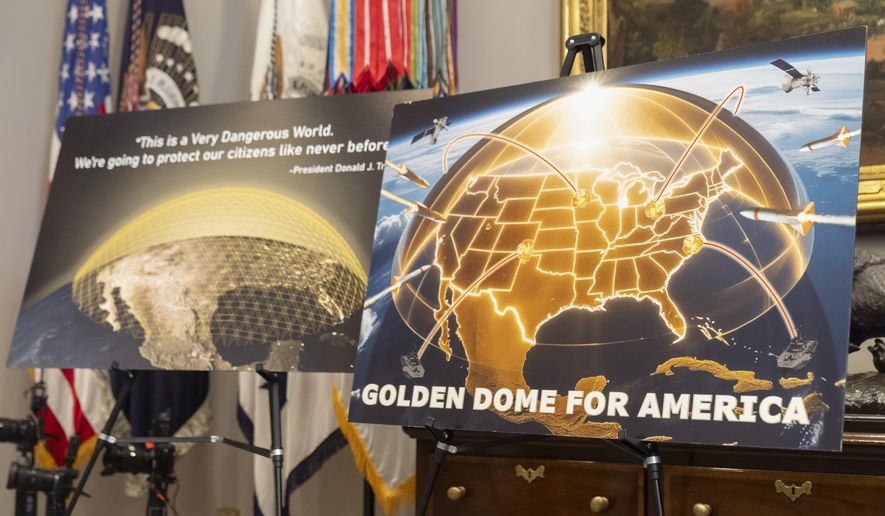

Funding for President Trump’s signature Golden Dome missile defense program is under threat of falling billions of dollars short amid fierce congressional budget arguments over how to account for unexpected costs created by the ongoing U.S.-Iran war.
Mr. Trump has called on Senate leaders to “immediately move” forward with a reconciliation bill that includes $350 billion in defense funding — money that would fill a gap between the $1.5 trillion the president asked for in his 2027 defense spending package and the $1.15 trillion version of the package that was narrowly passed by the House in July.
In the wake of the GOP’s midterm election losses, Mr. Trump has sought to highlight the funding crunch, blaming “the Radical Democrat Majority” as the reason for the Pentagon’s budget shortfall. “Their Number One Agenda is to BLOCK and RESIST this historic investment in our National Security,” the president wrote in a social media post last week.
People were interested in these podcasts
Sen. Jack Reed, Rhode Island Democrat and the anticipated Senate Armed Services Committee chair in the next Congress, says he doesn’t see Republicans being able to support the $350 billion reconciliation bill on their own between now and the impending majority shift in both the Senate and House.
Mr. Reed told Threat Status at The Washington Times that if Republicans “can’t move anything,” Democrats will still consider funding to cover the needs of the military — “but not to their level.”
“That might prompt them to get it done with reconciliation,” he said. “Just to take care of the budget needs this year.”
Democrats have refused to entertain the $1.5 trillion total that the Trump administration has asked for, particularly with regard to funding tied to the ongoing war with Iran.
What remains to be seen is whether Golden Dome funding will be impacted.
Plans for missile shield remain highly secret to prevent adversaries such as China and Russia from developing countermeasures. Over the past two years, Congress has approved roughly $39 billion for technology directly tied to the project.
Debate is heated over the total potential costs going forward. David E. Mosher, director of National Security Analysis at the Congressional Budget Office, has said it could be $1.2 trillion over 20 years.
That figure is sharply higher than the cost estimate made public by U.S. Space Force Gen. Michael A. Guetlein, Trump administration’s point man on Golden Dome, who has put the figure at $185 billion through 2035.
Analysts say a significant portion of the current $350 billion defense funding gap centers on Pentagon space-based capabilities and Golden Dome support. Funds in the gap are also earmarked for other elements of a vast, advanced-technology military modernization effort that Mr. Hegseth has pushed over the past year.
Mr. Hegseth and other top Pentagon officials have told Republican lawmakers that securing the full $350 billion is critical. Industry and congressional sources have told Threat Status that Golden Dome money could be threatened if the Pentagon redirects some of the $350 billion in funds to replenish stockpiles of munitions being used in the U.S.-Iran and Russia-Ukraine wars.
The outgoing Republican chairman of the Senate Armed Services Committee Sen. Roger Wicker has said that without the $350 billion in additional funds, Golden Dome may not be “funded adequately.”
“We’re going to be bringing in Deputy Secretary of Defense [Steve Feinberg] to our caucus early next week to talk about a number of defense priorities,” Mr. Wicker told Threat Status last week. “To the extent that Golden Dome is one of the areas that is not funded adequately, we’ll be discussing that and yes, I am concerned.”
Mr. Feinberg is a Wall Street billionaire who was tapped by Mr. Trump to accelerate U.S. weapons production aggressively and shorten delivery times.
In recent months, he has worked behind the scenes to establish longer-term contracts with major U.S. defense companies that produce critical munitions, committing the Pentagon to consistent purchases for years to come.
But, a major funding shortfall has been a growing concern on Capitol Hill, particularly as lawmakers face the high costs of the Iran war.
In August, Gen. Guetlein told an audience at the Space & Missile Defense Symposium that money is still needed to invest in space-based missile defense.
“We’ve got to figure out as a nation a different way of funding Golden Dome, at least through 2027,” Gen. Guetlein said at the time as reports swirled that most of the missile defense shield’s funding was tied up in the reconciliation bill on Capitol Hill.
“If they don’t figure it out, there is no Golden Dome, because there is no funding,” he said.
“I do believe as a nation that we’re going to figure this out,” Gen. Guetlein added. “But it is a challenging budget environment. Talk to your representatives. Please let them know your thoughts. It is a tough situation that we find ourselves in.”
Mr. Hegseth said during a press conference last week that the Pentagon is actively working with current Speaker of the House Mike Johnson, Louisiana Republican, and current Senate Majority Leader John Thune, South Dakota Republican, to address the funding gap.
“My job,” the defense secretary said, is “to ensure we’re funded and funded properly, which is what the president expects every single day.”
Current Senate Republicans have said they will “do everything humanly possible” to pass another funding bill for the $350 billion, but their slim majority in the Senate means the push will fail if only four Republicans vote against it.
Sen. Rand Paul, Kentucky Republican, has already said he is opposed to the effort, calling it “tone deaf” for Republicans to fund the Iran war after their sweeping electoral defeat in large part over that issue.
Sen. Susan Collins, Maine Republican, has also cast doubt on her willingness to support the bill, saying that her vote will depend on “whether it’s narrowly focused or whether it’s broad.”
Ms. Collins is among a contingent of peers that will not be returning to Congress in the new year. Republican Sen. Thom Tillis from North Carolina and Sen. Joni Ernst, Iowa Republican, will also be leaving.
Sen. Lisa Murkowski, Alaska Republican, who has repeatedly said she is not a fan of reconciliation, also remains a wild card. When asked about the status of the $350 funding push last week, she responded only that Republicans were having “good meetings.”
Contact the author

Please read our comment policy before commenting.