



The FBI’s counterintelligence operation has increased arrests for spying 53% over the past 21 months as espionage threats intensify from China, Russia and Iran pursuing American military secrets, advanced technology and intelligence about U.S. government operations.
Since President Trump returned to office in January 2025, the FBI has made 167 counterintelligence and espionage-related arrests, according to bureau data. That is up from 109 arrests during the preceding 21 months.
Those numbers only reflect arrests, which lag well behind investigations. FBI Director Kash Patel told Congress in September that the bureau disrupted roughly 400 counterintelligence operations over 18 months and removed more than 80 foreign intelligence operatives from the U.S. during fiscal year 2026, a 125% increase from fiscal year 2025.
People were interested in these podcasts
It is unclear if those numbers include cases where spies were either deactivated and sent home before an arrest. The FBI declined to comment.
Two high-profile espionage cases in recent days captured headlines across the country.
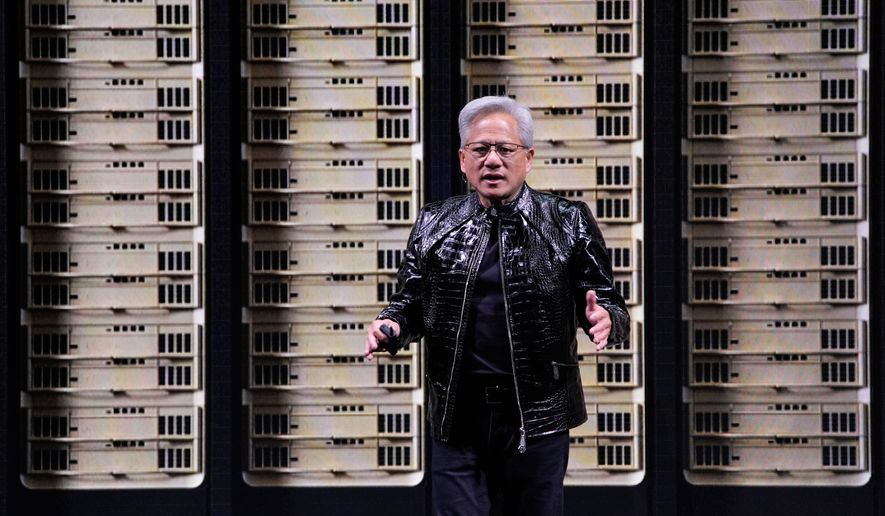
Former Nvidia CEO Jensen Huang admitted to an extramarital affair with Alice Huang, a Chinese businesswoman suspected of being a spy for Beijing, and U.S. Army Lt. Col. Brandon Tyner was arrested in Britain on suspicion of attempting to provide Russia with sensitive NATO intelligence.
Experts say the rise in arrests is due both to increased espionage activity and to U.S. officials becoming more aggressive in trying to stop it. But they warn that the arrests are a small portion of how much espionage is being carried out against the U.S.
The People’s Republic of China (PRC) is generating a lot more espionage cases to be detected, but technological advances are allowing the U.S. to identify a greater number of cases, said retired Rear Adm. Mark Montgomery, senior director of the Foundation for Defense of Democracies Center on Cyber and Technology Innovation.
“The adversary is still winning this game,” Mr. Montgomery said.
Those developments have complicated Mr. Patel’s claims of unprecedented enforcement success, raising the question of whether arrest totals alone adequately measure the bureau’s ability to detect foreign spies before they obtain sensitive information.
China accounts for the largest publicly identified share of the FBI’s counterintelligence arrests. Over the past 18 months, the bureau reported 60 China-related arrests, an 88% increase from the preceding 18 months; Russia accounted for 29 arrests, up 26%, and Iran accounted for 17 arrests, a 55% increase.
Another 25 arrests involved other countries, an increase of 25%.
Beijing’s operations include traditional intelligence gathering but extend well beyond that. U.S. officials have described China as the most sophisticated cyber threat to national security and public safety.
Unlike traditional espionage, which often requires recruiting someone with access to classified information, cyber operations can expose enormous quantities of sensitive materials through a single computer hack.
“One advantage that the PRC has that Russia does not have is that the PRC has greater access to our country, our people, and our technology than Russia has,” said Matt Williams, a Tulane University professor who spent 32 years in the federal government in strategic intelligence, including human intelligence and counterintelligence operations.
“That means the PRC can employ the full spectrum of both technical and human capabilities in a way that maybe Russia and especially North Korea can’t because they just don’t have access to our people and our territory like the PRC does.”
Recent arrests show how deeply China is engaged in both traditional spying as well as cyber theft.
Xu Zewel, a Chinese national, was arrested in July 2025 on charges of participating in a Chinese government-directed hacking campaign to steal American COVID-19 research.
A month earlier, two Chinese nationals, Liren Lai and Yuance Chen, were arrested for gathering information on U.S. Navy personnel in a plot to recruit service members as spies. Lai and Chen were convicted and sentenced to 30 months in prison, while the charges against Mr. Zewel are still pending.
American officials accuse Beijing of systematically pursuing military technology, artificial intelligence breakthroughs, semiconductor designs, trade secrets and other innovations that could strengthen its economy and armed forces.
One prominent example is Salt Typhoon, the Chinese-linked cyber-espionage campaign that penetrated American telecommunications companies. According to the FBI, attackers obtained customer call records involving millions of people, accessed private communications belonging to a smaller group and copied sensitive law enforcement information.
Beijing has repeatedly rejected U.S. accusations of conducting cyber espionage.
Russia, meanwhile, has targeted information about U.S. military capabilities, defense measures and advanced weapons systems. In addition to Mr. Tyner, who was arrested this week, a second U.S. Army soldier, Taylor Adam Lee, was arrested last year on charges alleging that he attempted to supply Russia with information about the Abrams tank and other armored vehicles.
Iran has presented a different type of espionage challenge, mixing traditional intelligence gathering with cyber operations to intimidate or assassinate political opponents living abroad. On Thursday, two Iranian men were convicted of spying on journalists considered enemies of the regime, with one also convicted of preparing an attack against potential targets.
North Korea, meanwhile, has developed an approach that combines espionage with revenue generation through fraudulent cybercrimes. In October, U.S. prosecutors announced charges against 14 people in a scheme that generated roughly $3 million for North Korean-controlled entities.
“Although not as capable as North Korea, Iran is certainly evolving because they don’t have many other options,” Mr. Williams said. “They don’t have much of an air force or navy left anymore.”
There are multiple reasons why espionage has escalated. Artificial intelligence, quantum computing, semiconductors and other innovations have become extremely valuable, and stealing information from an American company can allow foreign governments to bypass years of expensive research.
In addition, geopolitical confrontations in Iran, tensions involving Taiwan and Russia’s war against Ukraine have all provided foreign governments with incentives to learn Washington’s plans. Also, digital technology has dramatically expanded the opportunities for intelligence gathering, meaning spies no longer have to rely as much on compromised personnel or secret agents.
Combating the growing espionage threat will require the U.S. to strengthen its counterintelligence capabilities and improve coordination among federal agencies, experts say, adding that the government should look at non-traditional diplomatic methods.
“The more effort and officers that we have going after our adversaries to either detect or neutralize these types of activities, the better, but we can also refine our export controls, investment screening, using the Foreign Agents Registration Act, sanctions and deportations to close loopholes,” Mr. Williams said.
Please read our comment policy before commenting.